
Schwartz has an interesting role at Salesforce. His job is to tell the future, although they put Vice President of Strategic Planning on his business cards. He did exactly that in his presentation to a receptive audience at the vendor’s World Tour in Sydney this week.
He predicts that as technology becomes embedded in more devices and activities we are going to see a world where technology “comes alive”. Salesforce’s oldest employee, at aged 70, is also the one most concerned, after founder and president Marc Benioff, with the future direction of the company. But he’s seen the world move from the mainframe, through client-server into today’s cloud-based era. He was one of the first people to use the internet and was the real-life inspiration for the character Matthew Broderick played in the iconic 1980s hacker movie War Games.
With the recent launch of Salesforce’s new AI solution, Einstein, Schwartz began by explaining what AI wasn’t going to be able to do.
“It’s very hard to understand the human brain at sufficient depth to try to map that onto silicon.”
Schwartz says that human-like robots are far-fetched. “What we are seeing now is a shift towards little AI”.
“These are small bits of intelligence embedded everywhere that take the friction out of any process so the people don’t have to think about it,” he says.
An example of this is Amazon’s One-Click shopping experience. Schwartz says there are many small pieces of intelligence and automation that link the user’s past shopping with a recommendation engine, shipping information, and payments. The points of friction, where a customer might abandon their shopping cart, are removed.
Little AI will be a major part of the future, said Schwartz. Mobility, increased connectivity, the increasing pace of change, and improved system intelligence will drive AI to assist us at becoming more productive in an increasingly complex world.
Smartphones will continue to be the hub for a great variety of services for the immediate future. This will extend from health and well-being data to diagnostics from cars through to smart home appliances. And this will be part of an increasingly monitored life as more activities are tracked and recorded from CCTV to sensors we wear or carry.
Beyond today, Schwartz identified three major trends that will shape the future.
Augmented reality, rather than virtual reality, is going to be very important. The obvious public example was Pokémon Go which overlaid external data onto the real world. There are myriad applications for equipment maintenance, healthcare and other fields he said.
Haptic reality and feedback will be used to further augment our senses. For example, clothing has been developed that will provide vibratory feedback based on stimuli. Schwartz showed an example of blind and deaf people being instructed in how to recognise people and objects through the patterns of vibration in clothing equipped with haptic feedback systems.
The third, and most significant in Schwartz’s view, is neural control – using our brains to control devices. Driven by advances in the development of prosthetics, Schwartz says this will completely reshape the way we interact with our environment.
“We are going to be in a world where everything around us is going to be connected and awake.”
Already, we are seeing people, homes and cars that are more connected. And workplaces and cities are following suit. As more devices know more about us we will move from the era of personal computing to one of intimate computing where our computers know more about us than we know about them.
This, according to Schwartz, will lead to a revolution in the services sector. Personal services will be delivered directly to each person. We will each have a personal assistant. The big decision, he outlined, will be deciding which ecosystem we want to join – although he predicts the turf war between Apple, Amazon and others will be resolved in time.
With the rise of AI, even in the small form Schwartz expects to be dominant for the foreseeable future, we will be able to look ahead to predict and prescribe, rather than be limited to only looking back. This will happen with little or no human intervention and systems will be able to conduct that analysis.
The rise of AI and automation has not come without concerns. The biggest one being the concern about job losses. However, Schwartz pointed to long-term data that showed employment levels in the US had actually increased over several technology eras, with only small shifts during times of recession or higher prosperity.
AI will disrupt today’s world but, quoting recently passed fellow futurist Alvin Toffler, Schwartz said “The illiterate of the 21st century will not be those who cannot read or write, but those that cannot learn, unlearn, and relearn.”
Adding to the futuristic theme at the event was the use of “silent disco” headphone technology which saw a silent auditorium of delegates tuned in to presentations via wireless headsets.
That’s what Datadriven.sg recently did, putting 20 teams of five members from the “data junkie” community together to solve the problems faced by all sorts of travellers – everyone from the seasoned business veteran to backpackers. The data fix came from online travel marketplace Skyscanner and was spruiked with tooling from Australian BI vendor Yellowfin, arch rival Tableau, and Keboola, a provider of cloud-based data manipulation software.
The hackathon, held in Sydney over the weekend of 25-26 Feb, immersed attendees in 48 hours of complex data analysis, visualisation and predictive data science. The datadriven.sg event is a concept that grew out of a Singapore-based group of Keboola enthusiasts – hence the ‘.sg’. Analytics vendors and commercial sponsors (including life insurer TAL who’s analytics team also participated), sniffing a growing community initiative, have got on board to enable its wider rollout.
Most hackathons start with a specific problem set, or set of questions to answer. But this one didn’t limit or direct the problems people were exploring. Instead, it was an open playground that saw creative takes on data discovery and interesting interpretations using data provided by online travel service Skyscanner.
“The whole point is to engage the ‘data junkie’ community we are a part of,” said Pavel Bulowski, co-founder of DataDriven.SG. “It is not easy to get 100 people to invest their entire weekend into an event like this, but in tech or data analytics specifically, what is often overlooked is that the practitioners have passion for what they do. They are keen to try new tools in the market, get their hands on data, and delve into problems they normally don’t encounter at work.”
By not starting with a specific set of questions for the hackathon participants to answer the scene was set for freeing up creativity in the context of real life data and a scenario that everyone can relate to – the travel experience.
For example, some of the teams considered how seasonality affects prices and tried to work out the best tactic for getting the optimal price on flights.
But, said Bulowski, ‘really interesting’ trends started to emerge when people took to combining data sources. “For example, we introduced lots of govtech data into the equation, so people were contrasting levels of income and market shares of low-cost airlines.”
Unlike many hackathons which reward winners of the best idea or implementation, the results of this activity aren’t going to be used immediately. Instead, Bulowski said the company is looking to collaborate with local companies who will benefit from this ‘fresh look’ at their data. In this instance, Skyscanner will benefit through having new perspectives to use in improving customer experience.
“Importantly, it was the community that made this work. It was not a networking event, but the network really is a big part of it. During work on a project and in a team, people make new friends and there is lot of knowledge rub off,” said Bulowski.
Running in tandem with the Datadriven.sg were Australia’s first two ‘Data Girls’ events held in Sydney and Melbourne. Bringing together more than 100 women for fast-paced days of analytics education, the events were tailored to budding data scientists. The intent was to encourage more women to embrace a career in data analytics.
Over recent years, CIOs have seen their budgets fall as cloud services have eaten into capital budgets and IT spending has shifted from the CIO’s office to lines of business.
Emerging technologies in the big data and analytics space may turn that around however as CIOs grapple with exploding data volumes and increasing business demands for more sophisticated data analysis.
Local research and analysis firm Telsyte has released its Australian Big Data & Analytics Market Study 2017 and budgets for big data analytics on the rise. According to their study, which looked at 269 ICT decision makers, 83 percent of CIOs plan to invest more on big data hardware, software and services in 2017. The relationship with the marketing department is also strengthening with about a third planning to use these tools for sales and marketing analysis.
Telsyte said big data analytics is now in the top five enterprises applications managed by third-party service providers, indicating a lack of in-house capability to process large data sets. Interestingly, they found one of the blockers for IoT applications is a lack of capability in dealing with all the associated data – something these budget increases are poised to address.
Telsyte Senior Analyst, Rodney Gedda, said “Just collecting and processing data is half the story. Australian business leaders must use real-time analytics to gain business value from data and transform their decision making from reactive to proactive.”
Gartner recently released their Magic Quadrant analysis of the BI and analytics space. They noted the emergence of a number of new vendors in the increasingly competitive space such as Zoomdata and Datameer.
But established players, such as IBM, Amazon Web Services, Cloudera, Dell/EMC, Google, Microsoft, SAP and Oracle are all in the race to reap rewards from the increased spend.
The good news is some local vendors such as Contexti, EngineRoom.io and YellowFin are also pushing into this space on the back of some solid innovations and focusing their skills on niches where they can add the most value.
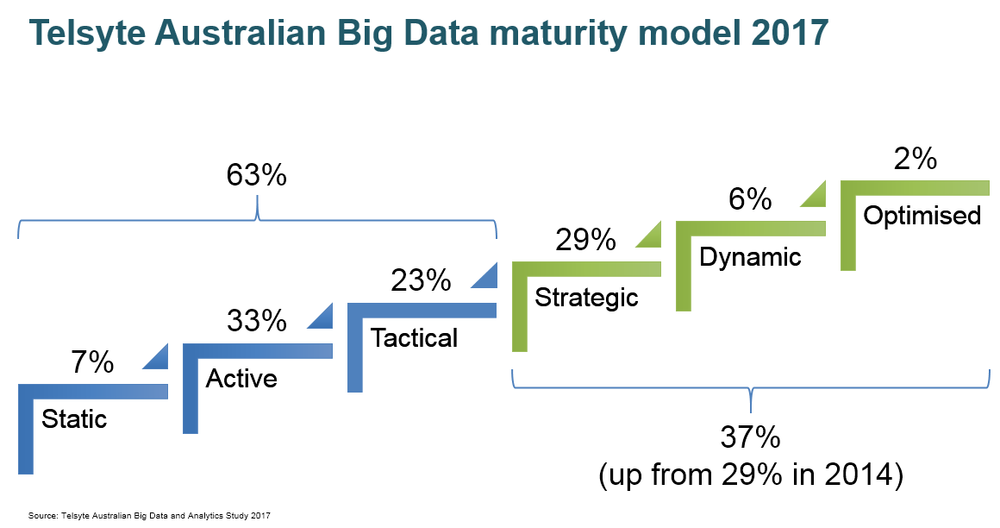
The report also gauges the level of maturity in Australian enterprises and while most (63%) are at ‘low maturity’, there has been significant improvements in the past two years. Those in the ‘strategic’ to ‘optimised’ groups rose from 29 percent to 37 percent.
It is not a space for the faint hearted however with a large number of vendors, each with complex architectural requirements creating a challenge for CIOs to find the right combination for their environments.
Certainly, the bedside reading is chunky. The Telsyte report runs to 98 pages and joining the Gartner report at a similar length with detailed analysis on 24 vendors will take a while for time- and data-challenged CIOs to digest.
Although the focus of Telsyte’s report was on BI and analytics, it’s clear from Telsyte’s data that there is a desire to bring more of the data analysis and decision support tools in-house.
While this may be good news for CIOs who have seen budgets pared back over recent years, the eternal challenge of delivering business users what they want when it comes to reporting means they need the business on their side to drive the initiative, not IT.
But layered security is hard to manage as it often requires products from multiple vendors that don’t always play nicely with each other. And anything that makes the life of users hard is met with resistance, or worse, workarounds that bypass corporate systems and processes – the dreaded “shadow IT”.
But rather than focusing attention inwardly, what about concentrating on the bad guys. What pisses hackers off?
Security company Nuix recently published its Black Report, which surveyed professional hackers (they call themselves penetration testers) about their pet peeves at last year’s DEFCON event in Las Vegas.
These white-hat hackers say the thing that most annoys them is coming back to a client to retest and learning that most of the issues previously found have not been addressed. Just one in ten clients fix all the problems which come to light in testing. And 5 percent do sweet blow all after learning of problems.
It’s hardly surprising that this is the case. Verizon’s 2016 Data Breach Investigations Report found over 99 percent of malicious hack used vulnerabilities that had been reported at least a year previously, and which had patches available to prevent them. The company’s report said “Hackers use what works and what works doesn’t seem to change all that often.”
Each year, infosec vendors try to convince us of how great they are by telling us how many zero-day vulnerabilities they have discovered. But it is quite damning to learn many of the breaches we suffer are our own fault.
We don’t fix what we know to be broken.
Purchasing and weaponising a zero-day vulnerability is expensive. But exploits that use known vulnerabilities are cheap, commodity items on the dark web. And if we don’t take the advice of experts and fail to patch our systems and address issues, then we are making the life of the malicious hacker easy.
And we make white-hat hackers cranky.
Security is not a checkbox exercise. It’s an on-going program. You’d think that’s obvious but the data coming from a number of security analysts and vendors suggests otherwise. The trick, perhaps, is to put in place techniques and measures which won’t annoy the good guys, but instead frustrate the bad guys.
Whether it’s faster broadband for video-consultation or surgery by remote control, tech experts are pushing the cred of new inventions which have multiple applications in healthcare. Among the more promising is virtual reality, which has a range of applications from training, through to helping patients overcome irrational fears.
For its part, Velpic is a training company specialising in the development of training tools. It offers a cloud-based platform for delivering education solutions to schools and business. CEO Russell Francis said the company will be releasing a new VR training app; he said a recent VR rollout by the Victorian government for training paramedics is an example of how the technology can be used.
“One of the fundamental benefits of VR is that the experience can simulate hazardous situations without putting anyone in real danger. The simulations can be made to appear real in look and sound, giving a life-like training simulation that can be repeated over and over again without any danger to the trainee,” said Francis.
It is, he said, similar to what the aviation industry has been doing for decades with flight simulators. “But where those cost multiple millions, a VR lesson can be completed within a Google Cardboard headset costing a few dollars. ”
We doubt optimal results will come from using a fancy cardboard box and indeed Velpic’s VR platform works with more advanced options including Samsung’s Gear VR and others.
“VR training provides a far more engaging training solution than traditional learning methods, with the ability to immerse users in the experience,” added Francis.
“VR will soon be a mainstream method of workplace training as it offers a compelling range of benefits including enhancing the learning experience that ultimately leads to higher knowledge retention. What we are doing, alongside our partner Cortex, is delivering a VR training solution that is both cost effective and practical to implement,” said Francis.
The application of VR in the medical industry is growing. New Zealand’s Virtual Medical Coaching, which is part of the Consortium for Medical Device Technologies, has created a VR-based simulator for radiographers.
And Melbourne-based psychologist Les Posen has used VR systems since 2001 to work with patients who have a fear of flying. His setup includes airline seats connected to a system that allow patients to experience take-offs and landings in a safe environment.
Posen said, “I started with a large and heavy gaming headset, the VFX-3D, costing AU$3,000 at the time, using Windows-based software licensed from the US. We’ve now progressed to iPhone and Android-based mobile phones in lightweight headsets where I can use my MacBook Pro in real time situations.”
Posen said the system allows simulation of multiple take-offs per hour session, with the ability to control the conditions: daytime vs night-time, rainy vs sunny, aisle seat vs window, back of plane vs front, many people or just a few.
“Other modules I use are driving, public speaking, heights and enclosed spaces, underground metro, and two new ones for MRI scans and exam taking,” he added.
In Posen’s case, at the very least, it can certainly be said that VR for healthcare is taking off, occasionally dramatically.
Initially conceived as a repository for source code, GitHub has grown into a broader catch-all information repository in the vein of Microsoft’s SharePoint; with customers like the REA Group, Xero, and ANZ Bank, it is a platform which has gone from helping codies collaborate and manage versions, to being used for multiple purposes.
The company’s chief business officer, Julio Avalos, said “When I got to GitHub in 2012, it was transitioning from this source code repository tool to a one with broader use.”
At the time, GitHub could connect to LinkedIn via an API, but the business social media giant cut off access on discovering that GitHub was being used as a recruitment tool. Prospective employers were looking at code snippets shared by developers and making hiring decisions on that basis, cutting into LinkedIn’s revenue stream.
“We were competitive with them in a way the world had not really seen. It became a de facto place for tech hiring,” said Avalos.
In much the way start-ups use AWS and other online platforms as part of their foundational technology stack, Avalos said the same was happening with GitHub as companies are using the repository as a platform for their businesses.
For example, one application sees the law as a collection of source code, stored in GitHub. Legal issues are then seen as bugs in the code, said Avalos. That allows the company to manage the issues in the same way developers see bugs in source code, tracking their remediation.
The ‘repository’ approach makes it easy to find and re-use documents; with legal issues, precedent is important – when workers can quickly identify similar issues, it is possible to share resolutions and accelerate the process,saving time and effort.
Success when using GitHub, or any other collaboration tool, is achieved by answering some key questions, explained Avalos. “It’s about starting with the problem we are trying to solve. What are the business outcomes we are trying to get to? Who are the stakeholders? Then, let’s let the teams come to us with solutions on how to solve that rather than being prescriptive and top down. That’s not going to work.”
As anyone working in the real world knows, getting people to collaborate through formal systems and structures is challenging. Avalos, and ANZ lead Sam Hunt, agreed that there needs to be cultural and behavioural shift.
“It’s really about having best of breed tools that make the cultural change as easy as possible,” said Hunt. “People know what they need, but not how to apply those tools. They need the cultural shift. The tool’s not going to do it for you.”
Hunt said it can be daunting. As a recent starter with the company, he was thrown into the deep end as GitHub uses its own software for internal collaboration. But he said the learning curve, while challenging, was not insurmountable.
Until recently, GitHub has been a cloud-based service; it has since released an on-prem offering for enterprises that don’t want their code repositories or other business data stored off-site. The features in that on-premises offering have been updated over time while this week, the company launched a new cloud-based enterprise version.
Over time, Avalos has seen companies that initially used GitHub’s original cloud service, move to the on-prem enterprise service that supported LDAP, SAMIL and other enterprise needs, and now want to take that enterprise service back to the cloud using public or private services.
“There’s been a real shift in the market from a risk tolerance viewpoint,” said Avalos. “They are choosing a deployment model so they can have GitHub any way they want it.”
Oh, and that silly name? Linux programmers will recognise ‘git’ as a version control system for or tracking changes in computer files and coordinating work among multiple people. While the git was primarily used for software development, its incarnation in GitHub has shown that it can be used to keep track of changes in any files.
That was the theme running through the opening keynote of the business software provider as it kicked off its recent two-day Summit Tour partner and user conference in Melbourne.
Alan Laing, Sage partners and alliances EVP, said the ‘rapidly changing world’ offers significant opportunities, and that after spending much of 2016 focused on innovation in products – something the UK-headquartered company was compelled to do in the face of heightened competition from cloud competitors – he said the company is well placed for further growth.
He said among the goals for Sage is to reduce the time spent on administrative tasks spent by business owners to zero by 2020 by using bots, artificial intelligence, and other automation tools. For example, the company recently announced the integration of its AI chat-bot Pegg in Sage One, its cloud-based application.
Pegg works with popular chat apps Slack and Facebook Messenger so users can track expenses and manage finances through these messaging apps. Sage has said the aim is not for Pegg to pretend to be human, but to add value.
A significant part of Sage’s growth strategy, said Laing, is being built around partnerships with other major software partners. Sage has forged alliances with companies such as Slack, Microsoft, Amazon, Apple, Salesforce, Google, American Express, and PwC.
“We’ve done that to help us enhance our products and platforms to give our customers choice,” said Laing.
The company said it is investing in building better user experience through the hiring of a new vice president with a specific responsibility for making applications mobile friendly, embracing the cloud, and committing to not shutting down legacy applications. These are signs, said Laing, of the company’s commitment to its existing customers and the future.
Fabiola Stein VP product management, has a strong focus on mobile and cloud based products that will complement and expand the existing Sage product portfolio. “We know that the question of cloud is no longer up for debate,” said Stein. “The question is now when the switch will happen.”
Sage, regarded as somewhat conservative in its approach and late to the cloud/mobile game, first signalled its intent to ‘modernise’ in late 2015. And at this Australian gathering, Stein said there are three key areas for product development investment at Sage, said Stein. All are cloud-based offerings.
Sage One is pitched at startups. Sage Live is for ‘scale-ups’ with Sage X3 focussed on enterprises. All are cloud-based, mobile-ready and offer rapid access to business data; given the breadth of the market it addresses, the competition it faces is equally broad, from Xero at the one end, to, Oracle and SAP on the other.
Development of these platforms will follow what Stein described as an “aggressive roadmap” founded on leveraging the company’s existing assets, taking advantage of better product delivery through an enhanced user experience. There was even a claim that Sage, late as it might be, will leapfrog competitors.
Sage Live is built on Salesforce’s force.com platform and therefore doesn’t share a code base with X3. Live, said Sage, was a response to the market’s appetite for innovative products and an acknowledgement that the company’s open API strategy is being demanded by customers.
And what of the older Sage 300 product? It, added Laing, will still be developed and enhanced and there won’t be forced migrations to newer products.
The 80’s and 90’s had cube farms. The 2000’s and into the 2010’s is arguably making that, like the legendary Monty Python Four Yorkshiremen skit, look like luxury, as the era (or, potentially, error) of hot-desks heralds the end of dedicated workspaces. Instead, people are now allocated an impersonal and somewhat random place to work.
Alison Hirst, from Anglia Ruskin University, said ‘hot-deskers’ are made to feel like the homeless people of the office world. And it can also harm inter-office interactions.
“You will also be sitting regularly alongside relative strangers. It’s not acceptable to introduce yourself, because that would interrupt them. Instead, the normal manner is what sociologist Erving Goffman calls ‘civil inattention’. This is the practice of signalling to others nearby that you are not available for communication with them, despite your close proximity – it’s the kind of manner most people adopt on a crowded commuter train.”
One the challenges facing hot-desk workers is the need to get going quickly at the start of each day. Most of us rely on certain infrastructure being in place when we arrive at our desks. While opening our laptops and connecting to the wireless LAN is easy, there are other challenges, such as phones, that need to know where we are and if you’re available.
On the back of a recent study released by IDC New Zealand, Polycom founder Jeff Rodman said the impact of digital transformation is forcing a rethink of what is required from workspaces. He explained that throughout the world, traditional offices are being replaced with more open, technology-enabled environments – albeit at different speeds.
At the heart of this change is collaboration. While open-plan and hot-desking have been touted as offering collaboration benefits by moving people around and removing the barriers between them, they have not necessarily been realised.
During Polycom’s Innovation Roadshow breakfast in Sydney, Jace Moreno from Microsoft Australia said, “The essence of a digital transformation is a cultural transformation [recently discussed by Westpac’s Karen Dallas]. The single biggest challenge an organisation faces during this transformation is their people. The greatest technology in the world will not be enough if people are not readily armed to embrace it. In the workplace of the future, being ‘at work’ means so much more than visibility in a physical office. Technology is giving all of us location liberation – the ability to make work what we need it to be to get to the result faster.”
The business case around open-plan and hot-desking is often made around the cost savings that come from squeezing more people into increasingly expensive real estate. But those benefits can be eroded unless there’s an associated culture shift and the provision of tools that help businesses establish relationships and effectively collaborate.
Ron McClay, CIO at The Australian Human Right’s Commission said “Putting in place a carefully planned change management program to support our own journey was key. Our workplace culture is evolving in line with our new technology. Faster decision making, enabling people to work and collaborate from anywhere and at any time has facilitated greater productivity and these are just some of the benefits we are seeing.”
The challenge of creating great workspaces is significant. Often, IT is dragged into the process where supporting infrastructure is critical. But IT practitioners often end up being roped into deploying collaboration systems such as IM platforms, point-to-point video-conferencing and other applications. And while these things are important, designing a worker-friendly environment and taking people on a journey through cultural change is arguably where the difference between success and failure will be found.
The world of retail has seen massive changes over recent years. The era of walking into a store, chatting to a sales associate and making a purchase is closing. Today, customers carry out online research, entering shops armed with more knowledge and information than ever before and are better informed than many sales associates.
Online purchasing has resulted in distribution centres having to change the way they pick orders from warehouse bins. Instead of workers picking many items to fulfil orders, shoppers are buying single items, resulting in higher labour costs in warehouses.
A recent survey of retailers, carried out by JDA Software, looked at the customer and retailer challenges facing this transforming market.
Patrick Viney, APAC VP retail industry strategy at the company, said the survey focuses on profitability, costs and the customer proposition.
“As we’ve moved from multi-channel, to omni-channel and now to digital transformation, that’s impacting profitability in a number of ways,” he noted.
Margins are being eroded as customers expect more fulfilment options from stores. For example, the increasingly popular ‘Click and Collect’ options mean the number of staff needed in some stores, and the work they do, is changing. And items might ship directly from a warehouse to a customer, or be shipped from a store.
Transactions that were previously low-touch are changing. Viney said in the past, customers would enter a store, browse, choose and move to the checkout to complete the transaction. Customers now ask more questions requiring more time from sales associates and have shopped around for the best price before entering the store.
“In order to compete, a lot of retailers are having to offer more options. They’re having to think about the omni-channel strategy and think about how they minimise that labour and cost impact,” he said.
In order to overcome these challenges, Viney said automation, robotics and better systems integration is key. For example, he pointed to the potential offered by RFID tags.
Although these have been around for some time, they are becoming a viable option for more retailers as prices fall.
Intel’s retail sensor platform allows retailers to track items within a store. Viney said this would allow workers to locate a garment left in a change room by a previous shopper – something that could be the difference between closing or losing a sale.
And that system could be integrated with a task management system that would direct sales associates to find items that are in short supply or that have been moved from their correct location so they can be made available to customers.
RFID does have some challenges. Viney noted there are still a number of vendor-specific standards in the market with Motorola, NCR and others delivering proprietary solutions to the market. But he expects some common standards to emerge so retailers won’t be locked into single vendors.
The cost of tags is also an issue. But some retailers, such as Zara, are no longer tagging specific garments in their stores. Instead, they are putting the RFID tags on security tags. When the security tag is removed at the point of sale, it can be recycled. This means RFID tags can be used on relatively low cost items – something that the ROI didn’t previously support.
As well as the integration of systems, Viney said robots are also being deployed. US retailer Lowes is using robots in stores to help customers find goods.
“The robots are deployed and interact with the customer, take them to the location. What we are seeing is a lot of automation and IoT devices connecting back to traditional retail store solutions. Category management and floor-planning now become the template which they can access to get location from. Inventory visibility systems allow you know where the inventory is.”
Meanwhile, Amazon Go stores are fully automated with a combination of AI and robotics allowing customers to shop without the intervention of a sales associate at all.
The data and analytics that underpin the retailer of the future will mean customer demand will be accurately forecast. Stores will know when customers are more likely to arrive so they can manage staff appropriately. Stock levels will be optimised and sales associates will know exactly where every item is located – even if it is misplaced. In-store mobile devices will deliver this information to workers and allow them to either allow the items to be taken home by the customer or shipped to them.
While many of the pieces to this perfect retail puzzle are available today, Viney said the next step is to integrate them for a seamless experience. And Viney believes this is not far away.
The road to deploying technology in the education sector has not been without some issues. The Ultranet project in Victoria was beset with issues almost from its conception. Aside from some significant governance issues, it did not deliver with the initial rollout marred by poor performance and constant outages.
And in New Zealand, the bungled school payroll project Novopay went hopelessly over-budget, failed to deliver a fundamental requirement to allow schools to pay part-time teachers, created widespread administrative headaches for schools, and had the education ministry scrambling to correct a litany of errors.
There are bright spots however. The OneSchool initiative developed by Education Queensland is one example.
Many schools run separate systems for learning management, assessment, curriculum management and school administration functions such as HR, finance and student records management. OneSchool brought together these many disparate operational systems onto one platform and has been embraced as a success by the 1,300 schools and 50,000 users in the State.
Operating in the cloud on the Unit4 platform, OneSchool has successfully connected teachers, school administration, students, and parents and guardians.
Ultimately, the success of any technology program in a school comes down to several factors. Although BYOD, cloud platforms and device preference often dominate the discussion, Allan Shaw, the principal of The Knox School, an independent co-educational school in Melbourne, said “a lot of it depends on the school and the teachers.”
Shaw was an early adopter of technology when he was in the classroom, during the 1990s.
“The key to it is how the teacher uses IT and how the school sets up the infrastructure and trains and expects its staff to use it. Education is a human business, no matter what the technology is.”
This is perhaps the most critical point. Although the IT devices and systems may attract lots of attention, Shaw said they are merely an enabler. The basic rules around successful pedagogy remain with teachers retaining a firm footing on the educational principles that ensure learning goals are achieved.
And while technology can aid with engagement and support teachers, it is not a panacea for teaching technique that may be found wanting.
Successful use of technology, said Shaw, starts with senior teachers and management being clear in what they expect from how technology can be used to drive positive teaching outcomes.
“There needs to be a balance between the headline results that come from standardised national assessment testing which our community holds as important, and what underpins that – which is good, engaging learning at any age.”
Shaw said it is crucial that the schools’ technology strategy and its educational policy are aligned. Good schools, he said, put their focus on learning objectives with technology supporting those aspirational goals.
That extends not only to educational tools and programs, but also ensuring students have a safe environment where they can take appropriate risks to aid their learning.
The ultimate success of any technology program in a school will be determined by how it supports the educational objectives of the institution. Always on, reliable infrastructure is a must. But the devices and tools that are put in the hands of students and teachers can’t just be interesting gadgets. They must equip students to safely achieve learning goals and prepare them for life after school.
Schools and the boards that run them are now recognising the value in establishing a solid IT infrastructure to modernise both the classroom environment and the administrative support.
The issue remains, however, that the ICT curriculum through schools is hopelessly inadequate, given the influence that technology now has on day-to-day life beyond the classroom.
Put simply, it is not the how, but the what that really counts.
…
AU: 1800 462 388 · +61 401 189 448