
Technologies and mega-trends are having a profound impact on manufacturing all around the globe. If you want to take advantage of the challenges and opportunities that come with manufacturing in the global economy of the future, technology and automation must be a critical focus.
Tomorrow’s manufacturer needs to be a leader when it comes to adopting technology. The future-proof manufacturer will be able to provide highly personal, flexible products where and when the buyer needs them, versus large quantities of homogeneous products. Increased connectivity between devices and consumer products opens wide the opportunity to gain market share.
Those who want to run the factory of the future will need to shed any lingering habits of waiting for a new technology to become the norm before embracing it.
iStart interviewed Epicor’s Industry 4.0 expert Frank McLoughlin recently to understand his views on where the local manufacturing industry is at on their 4.0 journey. You can read the article (or listen to the full interview podcast) here: “Australasian manufacturing is going to be great again.”
The resources below have been assembled as a collection of educational assets designed to assist forward-thinking manufacturers assess their priorities, and embolden their decisions on implementing modern automation systems.
Resource library for manufacturers:
- eBook: Factory of the Future
- eBook: Building a Better Tomorrow with ERP
- Infographic: Transform Your Manufacturing Business Through Digital Technologies
- Ray Wang Video: Get Fit for Growth
- Webinar: Grow your Business through Digital Transformation
- eBook: A manufacturer’s guide to growing profitably
1. eBook: Factory of the Future
In this eBook, you’ll learn how to take on life- and business-changing megatrends with new technological tools, ultimately enabling you to improve efficiency and reduce cost to keep you competitive and, most importantly, deliver greater value to your customers.
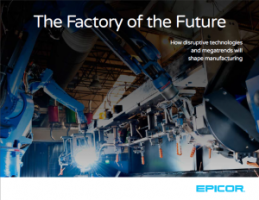
Register to download the eBook: The factory of the future
2. Visibility and Industry 4.0: The Transformation of Manufacturing
Digital transformation is sweeping through the manufacturing sector as businesses move to capitalise on the Internet of Things (IoT), advanced analytics, cloud technologies, artificial intelligence (AI), and more. It presents significant opportunities to achieve growth by addressing key operational issues and aligning products and services to the demands of today’s market. Leading manufacturers see these new technologies as game-changers; enabling them to redefine business models, revolutionise internal operations, and improve customer experience.
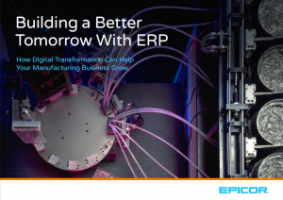
Register to download the ebook: Building a better tomorrow with ERP
3. Infographic: Transform Your Manufacturing Business Through Digital Technologies
This infographic provides a simple visual workflow to get on the right path to transforming your manufacturing operation:
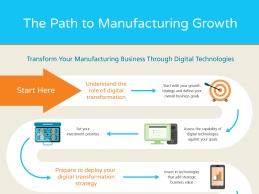
Learn how to: Transform Your Manufacturing Business Through Digital Technologies.
4. Ray Wang Video: Get Fit for Growth
A recent survey revealed trends on how businesses get set for growth. The study surveyed 2,450 business decision makers and employees in the manufacturing, distribution, retail and lumber sectors across 12 countries. Ray Wang, Principal Analyst and Founder of Constellation Research, Inc., explains the key factors for growth, and how your company can Get Fit for Growth.

Learn more from Ray Wang’s video: Get Fit for Growth
ABOUT RAY WANG//
Ray Wang advises Global 2000 companies on business strategy and technology selection and is author of the popular enterprise software blog, “A Software Insider’s Point of View.” He is a regular contributor to Harvard Business Review and well quoted in The Wall Street Journal, Forbes, CNBC TV, and others.
5. Webinar: Grow your Business through Digital Transformation
In the race to maintain business growth in an increasingly competitive environment, manufacturers face significant challenges to meet and exceed customer expectations. Discover how manufacturers are taking advantage of the opportunities digital transformation can bring to their business by viewing this insightful webinar which explores:
- Global megatrends and how they impact the world we now live in and how to stay ahead of the ever changing global landscape
- Technology change and Industry 4.0 and how to become a future ready manufacturer
- Implications for next generation manufacturing and the importance of predicting trends that will help your company grow

Watch the webinar here: Grow your Business through Digital Transformation
6. eBook: A manufacturer’s guide to growing profitably
Whatever your growth ambitions, chances of achieving them are increased with effective planning. Download this eBook to learn about the five key factors that can help grow your business quickly, efficiently, and profitably. Also, learn more about the pitfalls of growth and how to make sure they don’t overwhelm your business.
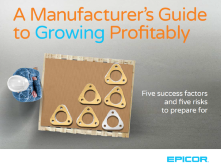
Register to download the eBook: A manufacturer’s guide to growing profitably
…
…
…
…
It’s important for manufacturers to stay current if they wish to remain successful. Positioning yourself for growth means looking to the future and gaining efficiencies through new technologies. That’s why this question may be the most important one for your business – are you a future-ready manufacturer?
Before you can adequately answer that question, you and the members of your organisation need to know the answers to these three questions:
- Where are we today?
- Where do we want to be in three to five years?
- How can we embrace innovation and automation?
If decision-makers in your organisation can’t answer these questions, you have bigger issues than you may realise.
At the very least, tackling these tough questions now will put you ahead of competitors who are consumed with putting out today’s fires rather than focusing on growth opportunities. Manufacturers that aren’t prepared for the coming global megatrends and don’t invest in breakthrough technologies will be rendered irrelevant – and more often than not, it will happen at a much faster rate than they ever could have dreamed possible.
Table of contents
- Are You A Future-Ready Manufacturer?
- The paradigm is shifting
- Keep an eye on the forecast
- Megatrends that can’t be ignored
- What modern factories will look like
- Future-ready and driving change everywhere
- The people behind the technology
- Industry 4.0 will change how everyone does business
- The smart curve is accelerating—don’t get left behind
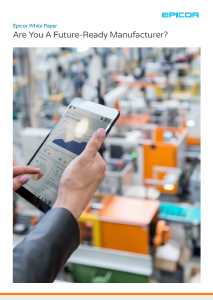
To find out more please download our free Whitepaper Are you a future-ready manufacturer?
Whatever your growth ambitions, chances of achieving them are increased with effective planning. Download this eBook to learn about the five key factors that can help grow your business quickly, efficiently, and profitably. Also, learn more about the pitfalls of growth and how to make sure they don’t overwhelm your business.
Five key growth enablers:
- Good planning
- Hard work and determination
- Right technology in place
- Agility and quick responsiveness to market demands
- Talented staff with the right skills
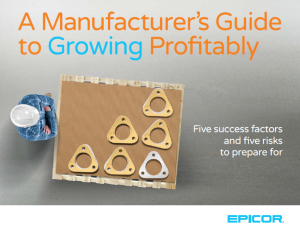 To find out more download the eBook: A manufacturer’s guide to growing profitably
For manufacturers, staying competitive is critical to success. Technologies and trends are having a profound impact on manufacturing all around the globe. If you want to take advantage of the challenges and opportunities that come with manufacturing in the global economy of the future, technology and automation must be a critical focus.
Tomorrow’s manufacturer needs to be a leader when it comes to adopting technology. The future-proof manufacturer will be able to provide highly personal, flexible products where and when the buyer needs them, versus large quantities of homogeneous products. Increased connectivity between devices and consumer products opens wide the opportunity to gain market share.
Those who want to run the factory of the future will need to shed any lingering habits of waiting for a new technology to become the norm before embracing it.
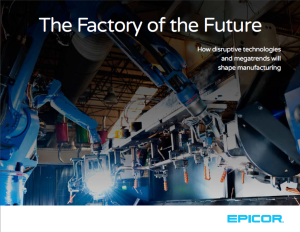
To find out more download the eBook: The factory of the future
Digital transformation is sweeping through the manufacturing sector as businesses move to capitalise on the Internet of Things (IoT), advanced analytics, cloud technologies, artificial intelligence (AI), and more. It presents significant opportunities to achieve growth by addressing key operational issues and aligning products and services to the demands of today’s market. Leading manufacturers see these new technologies as game-changers; enabling them to redefine business models, revolutionise internal operations, and improve customer experience.
This eBook will help you:
- Understand what growth looks like for your business
- Assess the capabilities needed to support your digital transformation journey
- Highlight some best practices to implement your digital transformation strategy, and
- Capitalise on growth opportunities with speed and conviction.
Whether growth means reaching new markets, enhancing the customer experience, or streamlining operations, you need the capability to respond.
Get growth, be fit for growth, and act on growth.
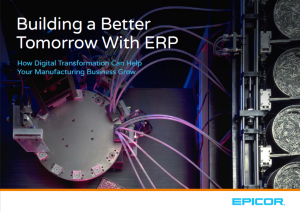
To find out more download the ebook: Building a better tomorrow with ERP
Whatever your growth ambitions, chances of achieving them are increased with effective planning. Download this eBook to learn about the five key factors that can help grow your business quickly, efficiently, and profitably. Also, learn more about the pitfalls of growth and how to make sure they don’t overwhelm your business.
“Even if you do your best to try to plan for future growth, there will be surprises along the way.”
Five key growth enablers:
- Good planning
- Hard work and determination
- Right technology in place
- Agility and quick responsiveness to market demands
- Talented staff with the right skills
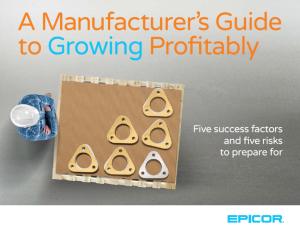
To find out more download the eBook: A manufacturer’s guide to growing profitably
Introduction
An Enterprise Resource Planning (ERP) system is a series of software applications or modules that collects data from your sales, purchasing, finance, inventory, supply chain, manufacturing and quality functions into a common database so that your company can share the information, coordinate activities and collaborate.
If you’re looking for your first ERP system or looking to upgrade from an existing system, the evaluation, selection and implementation process is a long-term strategic decision for your organisation.
The Steps
To help you through this process, here are eight simple steps for a successful ERP system selection.
- Evaluation
- Make an assessment
- Establish criteria
- Schedule consultations
- Create a shortlist
- Make contact
- Prepare questions that address your concerns
- Check vendor references

To find out more download the whitepaper: How to successfully select an ERP system in eight simple steps
Not-for-profit aged care services provider Royal Freemason’s Benevolent Institution (RFBI) has selected Epicor’s Senior Living Solution (SLS) software to upgrade its financial, client and operations management capabilities.
RFBI opened its doors in 1880 before there were any government funded social welfare programmes, and began caring for Australians in need. Over the years, it has diversified and expanded, and today is a leading aged care provider operating 20 retirement villages, 20 residential care villages and offers home care services throughout New South Wales and the Australian Capital Territory.
Working better
“Technology allows us to work better,” said Frank Price, chief executive officer, RFBI. “Our core purpose is to deliver quality care and services that have a positive impact on people’s lives and to do that efficiently we need a strong, flexible IT platform to support us.”
By implementing the latest version of Epicor SLS, said Price, the organisation wants to make use of the latest functionality to continue growing to meet the needs of Australia’s ageing population and provide a critical service to the vulnerable.
RFBI has been using Epicor SLS for more than ten years and in 2016, conducted a thorough review of the IT systems available in the market, seeking a complete solution from a vendor that could offer a good understanding of the aged care industry and requirements that go along with providing services within the aged care legislative framework.
“We considered our options and made the informed decision to stay with Epicor SLS due to its track record in our industry. Epicor has the infrastructure in place to continue to service our industry and provide seamless integration with government agency systems,” said Price.
Flexible to meet changing needs
“The government makes changes to legislation on a regular basis and offers limited time for software vendors to make amendments to meet these changes,” Price continued. “Epicor understands this as well as we do, and updates its software without prompting from us.”
“Having a technology partner with the experience and capacity to meet these changes as and when they happen is vital,” Price added.
RFBI’s chief information officer, Andrew Alpe, is particularly keen to implement the enhanced functionality that the latest version of Epicor SLS offers. He was looking for one solution that could provide RFBI with efficient financial management and residential client management system as well as offering mobile functionality to give staff access to client information whenever and wherever they need it.
Added functionality
“One of the things I think gets overlooked when organisations consider new technology solutions is the flexibility of the new system to allow you to set up your own rules around workflows,” said Alpe.
“To be successful we need a business solution that allows us to optimise what we do—provide care and services to older Australians. The flexibility of Epicor SLS will make a real difference to our business. I am particularly excited about the customer relationship management (CRM), the dashboards and the business activity querying aspects. As we transition to a model where staff move across our range of services, mobility will be increasingly important.”
Epicor regional VP for ANZ Vince Randall said the company’s software manages over 50,000 residents in aged care services across Australia, and continues to help invest in and support Australian operators of residential aged care, independent living, home and community care organisations. “Providing aged care comes with a range of challenges. These include funding restrictions and ongoing changes to government legislation,” he noted.
Randall added that providers also need to effectively manage a large contingent of staff and clients in the midst of general business management pressures. “A combination of residential management and enterprise resource planning (ERP) such as Epicor SLS can take a huge weight off the shoulders of aged care providers who really want to focus on taking care of people.”
The manufacturing and distribution marketplace is challenging to say the least. With a wide number of competitive forces at play for Australian and New Zealand companies, meeting growth targets is just not possible without the right foundations in place.
When it comes to choosing the right resources, aside from people, technology is arguably the most important. Therefore, if your technology platforms aren’t facilitating for your growth, then they are a handbrake for your success. When we place people alongside technology in this same consideration, it becomes clear that the two are interdependently linked on a number of levels. This is why you need to ensure your ERP system is compatible with your growth plans.
However, if you are like the 67% of Australian business leaders that are concerned about whether their IT systems can cope with the complexity that growth brings1, then it’s time to seriously consider what you need to do to prepare for tomorrow.
In this eBook we will discuss the functionality and approach that can help you identify the traits of the right ERP system for your company’s future.
Table of contents:
- Driving growth
- Remove the constraints
- Uncover capability and need
- Generating value from ERP software in the cloud
- Increase productivity with mobility
- What does growth look like?
- Preparing for growth to be sustainable
- Operating in the social age
- Providing a positive customer experience
- Summary
To find out more download the white paper: How to know if your ERP solution is compatible with your growth plans
Recently rebranded from JB Attachments, Calibre manufactures attachments for excavators with a range of products including quick connection and release couplers and devices allowing attachments to tilt. Calibre oversees the full process from product development through to manufacturing and distribution. The company also supplies to original equipment manufacturers (OEMs), with the associated demands on quality and delivery.
Jenna Smolenski is the rather unlikely chief operating officer of a grimy business of heavy lifting, steel dust, welding and plasma cutting. The contrast in her style is emblematic of where she and managing director Graham Smolenski are taking the Calibre business.
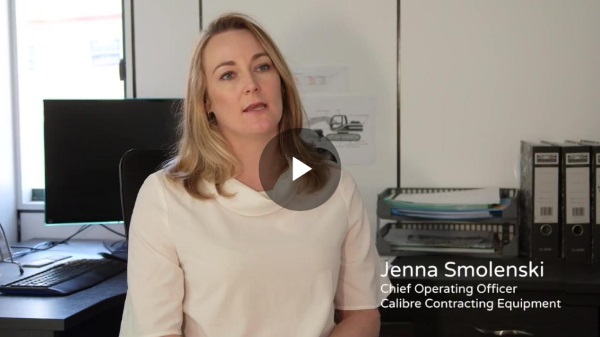
Smolenski’s thinking is centred on what is important for customers – the operators in the field. “Downtime is expensive in their industry – it’s all time sensitive so lead time in getting new equipment to them working is really important,” she says.
Identifying and eliminating gaps
Historically, the business has had information gaps between inventory and production that meant it couldn’t always keep customers informed with accurate information. Customer orders also competed with maintaining an inventory of spare parts, and the production planning process struggled to reflect the correct priority on jobs.
To address this, Calibre implemented the Epicor ERP (enterprise resource planning)solution, including production planning and financial processes. The ERP system is an important cog in the planning required to build each component. Smolenski says, “The Epicor ERP solution allows us to operate efficiently in various divisions—in particular its planning and production capability allow us to organise capacity through the shop floor.”
Smolenski adds that this is helped by other features such as perpetual real time inventory tied in with manufacturing and invoicing. With this information flowing through the entire system, from production to finance, timely reports make for informed decision-making to support business growth.
With 120 staff across four sites, and around NZ$20 million revenue, a single source of the truth and accurate inventory and order tracking are vital to both an efficient operation and servicing the demands of both OEM and end-user customers.
Growth through quality
“We are able to maintain quality better as the process is now less haphazard, the planners know what is in the pipeline and can make sure we have the correct materials in inventory all the way from ordering the right quantities of raw steel to always having stocks of the urgent spares that need to go out to a job,” says Smolenski.
Quality is more than a differentiator for Calibre. It is key to business growth as cheap Chinese or other Asian products are readily available at prices that look attractive on paper. “We know operators have a choice, so they need to have trust in both our finished product and in us to do what we say we’re going to do,” says Smolenski.
“We know operators have a choice, so they need to have trust in both our finished product and in us to do what we say we’re going to do.”
Jenna Smolenski, chief operating officer
Epicor on the shop floor
Out on the shop floor, production manager Charles Meyer is the person tracking the job sheets (paper and steel) through the process and making sure any exceptions are quickly reflected in the Epicor ERP system. “We can optimise steel utilisation using the integrated CAD and plasma cutting machinery, but what Epicor does is look after the big picture—what is being cut and why.”
The reality of the process is made stark on a tour of the facility. This is not a linear automobile production line with raw materials incrementally building a finished product. Rather, individual workstations produce seemingly random components (sub-assemblies) that are brought together in the assembly process with production configured around each machine’s capacity and set up time..
“There are two main streams of production—inventory and customer orders. Jobs often need to be prioritised through the process, so a central control point to handle that is crucial. Quality is obviously one of our main concerns. Quality gets tracked throughout the cycle of each product so every single job that goes through gets monitored and measured according to customer specifications and drawings,” says Meyer.
Cloud for a distributed workforce
Smolenski explains the influence a distributed workforce had on Calibre selecting the Epicor ERP Cloud solution.
“It has advantages for us in that there’s a lower burden on our internal IT systems and hardware required. Every time we set up an office we can tap into the cloud hosted environment from anywhere and allow them to be on the ball with all the information at their fingertips,” she says.
“It’s a great way to go for us.”
AU: 1800 462 388 · +61 401 189 448