
The very organisation of NZTech’s recent panel discussion on developing diversity in the technology sector attested to just how sensitive this male-dominated (but increasingly not pale nor stale, to be fair) industry is to the topic.
In light of recent attention in the media by way of the Jacinda-effect and the possibility of a serving Prime Minister having a baby, its concerns are timely. Putting aside my own unconscious biases (and I can assure you there was much talk of this) it was a frank and candid discussion on just how tricky navigating diversity and inclusion (‘D&I’ for those of you short of time) in practice really is.
(Disclosure: I’m female and pushing 50, so developing diversity in the workplace does have some personal resonance.)
Speakers cited research output from the likes of McKinsey and MIT about reaching a D&I Shangri-La that leads to more successful organisational outcomes. McKinsey’s research defined the ‘diversity dividend’, finding that companies in the top quartile for gender or racial and ethnic diversity were more likely to have financial returns above their national industry medians.
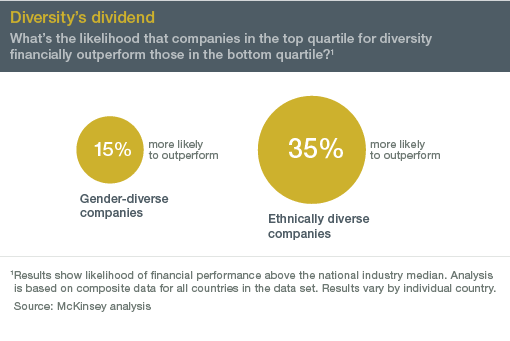
We know intuitively that collaboration between people with different backgrounds and different points of view are fertile grounds for innovation and creativity. However the point made at this discussion was that diversity in itself is not enough, it requires inclusion to leverage the real benefits of diversity in an organisation. The translation? Hiring women to get your gender balance to quota is completely counter-productive if you are not going to value their point-of-view and accept a different perspective. This equally applies to hiring millennials, 50 year old women (!), immigrants or anyone else who thinks differently to you.
This is where unconscious bias is at its most influential – people like to hire people who look and think like they do, which talks to the age-old adage “if you always do what you’ve always done you always get what you’ve already got”…not exactly a proven formula for innovation.
The expert panel was facilitated by Michael Carden, an entrepreneur, investor and director across several HR and human-process centric software businesses and self-proclaimed “pale, male and stale”. This demographic extended to two further members, Gerard Graham, COO at the Technology Bank of New Zealand and Andrew Weston, director of software development house Propellerhead. This being an IT industry event perhaps the irony was not so much humour as fact. Fortunately, the gender diversity quota (at least) was met by Rhonda Koroheke, head of diversity and inclusion at Spark New Zealand and Lesley Elvidge, HR director at Russell McVeagh.
Collectively they provided some interesting personal experiences particularly Weston with his company wide paradigm shift to self-organising systems and transparent, self-setting salaries. And there was much talk of empty pipelines with regard to senior female candidates (excuse me?). More encouragingly, led by the not-pregnant Elvidge, they did agree there were signs that the discussion had moved on from ‘she’s pregnant, can we still make her a Partner?’ to ‘how can we support her if she’s going to be pregnant and a Partner?’
The panel also offered up some starting points for those organisations serious about tackling the issue, with an emphasis on dialogue to help us become more aware of our own unconscious bias. Driving D&I programmes from the top and surveying your employees views on diversity, culture and inclusiveness were seen as key initial steps, as was the use of suitable tools for recruitment to help remove that meddlesome unconsciousness.
What became abundantly clear was that the tech industry in New Zealand is just at the beginning of the D&I journey.
What was also clear was that the politically-correct potholes of gender and ethnicity quotas have no place in the conversation. My suspicion however is that conscious bias might be driving exactly in that direction, to put a quick and measurable tick in the D&I box if you will. But perhaps it’s not so bad to at least get it wrong by trying.
Could the Internet of Things (IoT) be the future of technology in business? According to a convincing IDC analyst, speaking at Conferenz’s event in Auckland this week, very much so. Hugh Ujhazy said the IoT has moved on from the component parts to the connection of endpoints data contributors which are improving business processes and lowering the cost of commerce.
Just like fighter pilots need acute situational awareness, Ujhazy said operators in today’s business environment need to be similarly vigilant; he suggested that the IoT can deliver the necessary sensing network to keep a close eye on rapidly changing environments where opportunity, risk and challenges constantly shift. With better warning systems, business can prepare and respond in timeframes which minimise disruption, with a view to reducing costs, improving customer experience and being more competitive. This he summarised by the operational tenet “availability is key” as IoT seeks to bridge the divide between IT and operational technology.
One of the major developments in delivering working IoT solutions is the introduction of low power wide area networks (LPWAN). iStart has previously reported on the introduction of two such networks in New Zealand, including LoRaWAN and SigFox; these networks are, in effect, the missing link for true IoT deployments, providing a dedicated network for low-power, SIM card-free devices which can be powered by a single battery for up to a decade. It is this technology which could revolutionise sectors including facilities management, agriculture, healthcare and logistics.
‘Fog’ was another development that got airtime. Essentially, fog computing is the premise of aggregating and/or removing noise close to the source and producing exception monitoring whereby more useful data is fed in to a decision-making system – the opposite of garbage-in garbage-out if you like.
There was a long list of the good and the bad in IoT, with the good including developments in smart buildings, traffic monitoring with intelligent routing and sensory clothing. The bad, on the other hand, included the internet-enabled crock pot, Fitbark for dogs and sensor nappies. These applications for IoT might be considered a byte too far.
While the IoT is no doubt upon us, the real job seems to be turning all that data into useful, accessible decision making tools for businesses at an operational, tactical and strategic level. For early adopters, advice from the experts is start small with proofs of concept; don’t boil the ocean, and understand that some benefits won’t be obvious until experiments are underway.
The benefit of the incubator/accelerator model is best summed up by Phil Morle of Sydney’s Pollenizer when he said: “I think most of the start-up culture understands now that ideas are cheap, and that it’s the execution that’s really difficult.” The business incubator or accelerator gets the rubber on the road as fast and as cost effectively as possible and wraps around it the business people who have done it before and know some tricks. For example, 87 percent of firms that graduated from incubators since inception are still in business, according to an NBIA ’Business Incubation Works’ Report.
Incubators and accelerators have the same mission – both aim to get young companies over the initial start-up hump. The main difference is that the incubator is there from the beginning helping to build the business – they act as co-founders which typically involves early-stage investment, heavy mentoring, guidance and resourcing. It’s essentially a business bootcamp that will either kill you, or build you into a strong, lean and profitable business. Accelerators on the other hand begin with a cohort intake process whereby they accept applications for entry and pick a set number per round, they make an equity investment in the start-ups, and in-turn the business model is based on generating venture style returns, not rent, or fees for services. Finally they add value to the entrepreneur via mentoring, making connections, and the notoriety that comes from being chosen to be a part of the accelerator.
Here in Australasia we are well serviced by business incubators and accelerators, particularly if your business idea falls into the digital technology arena. Australia has a greater offer of accelerator programmes with a number of start-ups being accepted into a range of three to six-month programmes. Australia also differs to New Zealand in that at least half of its incubators are driven by private individuals or enterprise. New Zealand has only a handful of accelerator programmes and the mostly private/public partnership incubators dotted around the main centres appear slightly more nebulous in terms of their offerings, promoting more of the entrepreneurial ecosystem (think office space), mentoring and the promise of an introduction to people who can invest and help.

New Zealand Incubators and Accelerators
The Icehouse & Ice Angels
www.theicehouse.co.nz
Auckland
Incubator
Soda Inc
www.sodainc.com
Hamilton
Incubator & entrepreneurial hub
3 Creative HQ & the Lightning Lab
www.creativehq.co.nz
Hamilton
Incubator & entrepreneurial hub
Creative HQ & the Lightning Lab
www.creativehq.co.nz
Wellington
Incubator & accelerator
eCentre
www.ecentre.org.nz
Auckland
Incubator & accelerator
powerHouse Ventures
www.powerhouse-ventures.co.nz
Christchurch
Investor/incubator
Upstart
facebook.com/UpstartDunedin
Dunedin
Incubator

Australia Incubators and Accelerators
StartMate
www.startmate.com.au
Sydney
Incubator & angel investor
Pollenizer & Pollenizer Ventures
www.pollenizer.com
Sydney
Incubator & venture capitalist
Blue Chilli & Blue Chilli Capital
www.bluechilli.com
Sydney & Melbourne
Incubator/accelerator & venture fund
York Butter Factory & Venture Capital
www.yorkbutterfactory.com
Melbourne
Co-working space & venture capitalist
iLab
www.ilabaccelerator.com
Brisbane
Incubator/accelerator
muru-D
www.muru-d.com
Sydney
Accelerator
Optus-Innov8 Seed
www.optusinnov8seed.com.au
Sydney
Angel investor…
AU: 1800 462 388 · +61 401 189 448