
Published on the | Written by
Order your coffee via your photocopier? It’s weird, but some modern copiers can do just that. Although you might not fancy your machine doing so, Fuji-Xerox has one set up at its headquarters to do just this, as a way of demonstrating how versatile the modern copier has become.
Of course, it’s not attached to a coffee machine… instead it sends an email to reception to bring you a flat white or long black, or whatever.
Obviously a sales demo, it nevertheless serves to illustrate the fact that the office copiers are so much more these days. And the once-were-photocopier suppliers have been transformed into document management specialists, moving well beyond the realms of merely photocopying in the process. The machines have also changed their name along the way and are usually called multi-function devices (MFDs) now, reflecting their enhanced capabilities.
As well as being printers and now usually scanners too, the new photocopiers aren’t actually copiers at all as we once knew them. They now come bundled with document management and workflow software to deliver business process management (BPM) capability.
Document management software and increasingly ERP (Enterprise Resource Planning) systems are now integrated with MFDs and are used to track documents’ journey, archive them and make them easy to retrieve. The latter facility is not to be underrated if you have ever had to spend hours trying to track down an essential paper file that’s gone missing.
MFDs can now talk to MS Exchange, Lotus Notes, SharePoint and ERP software via middleware. This allows them to undertake a huge variety of tasks, from assigning metadata to aid document retrieval; to controlling who has access to documents; to identifying who has sent emails. They can also aid workflow and help manage storage.
The latter is becoming a major issue, with legal compliance requirements increasing markedly in the wake of the Global Financial Crisis. Compliance is still quite light in New Zealand, but requirements will get heavier as the countries we export to get stricter about it and the Public Records Act is put into force next year.
On a more practical level, the new souped-up copiers can ‘talk’ to your server, making document management much smoother and less scary. MFDs aren’t so new, having been around for four to five years now. However, until recently they’ve been confined to the corporate world, so haven’t had a high profile. But prices are now dropping to the point where some SMEs (small- and medium-sized enterprises) can afford them too.
“Our machines are now portals to get into other applications, whether it’s Sharepoint, TRIM, Hummingbird, Lawbase or Syteline. We can link them to various workflows.”
They still have their place in the big corporate and government world, but ordinary businesses are also starting to discover just how useful they can be. Fuji-Xerox solution specialist David West says that the company is seeing interest from the smaller accountancy and law firms, as well as companies that have to deal with a lot of inventory and invoicing. Fuji-Xerox is actually in the process of developing a bar-code system to help its clients scan and file purchase orders automatically into their ERP system.
“Our machines are now portals to get into other applications, whether it’s Sharepoint, TRIM, Hummingbird, LawBase or SyteLine. We can link them to various workflows,” says
West.
‘Talking’ gets the job done
The link between the copier and business software is middleware, such as the eCopy and Kofax document imaging software, which allows MFDs to ‘talk’ to software. Canon solution specialist Mike Hooker explains: “The business solution side was separated from scanners, or MFDs, for a long time. Now, through these technologies, they are starting to talk to each other and we are starting to see organisations wanting to utilise the infrastructure they’ve already purchased.”
“Traditionally, 80 percent of information is not stored in a relational database structure. It’s either a piece of paper, in someone’s head, on the local laptop, or a piece of email, something like that. The trick is to consolidate all that information and get it into a manageable repository,” says Hooker.
Canon and Fuji-Xerox are seeing the integration of scanning with BPM in several specific areas: to manage invoicing and purchase orders; to manage email communications, for law firms in particular and government departments in general; and for remote document management.
Distributed capture is the name given to managing scanned documents remotely. Hooker says it is the fastest growing area when it comes of MFD use. It is particularly useful for getting information from remote offices and putting it into workflow. For example, it can be used to automate accounts payable rather than having the job done manually.
“Lots of organisations are looking at systems where you scan in these document images, strip the information and put it in the ERP system, then put it into workflow and approve the invoice, which makes for a much more efficient accounts system,” says Hooker.
Fuji-Xerox’s West puts it more cynically. “It means you can find out exactly who’s responsible for an invoice, instead of getting on the phone and asking, ‘Have you received this?’ and getting, ‘No, it’s lost in the post’, when really it’s under a whole layer of documents on their desk and they haven’t got around to it.”
Distributed capture aids document security in this way too – no more ‘lost’ documents – and you also have “immediacy of information”, says Hooker, as that information is now available to everyone who needs it, while the person who generated it still retains control of it.
Business efficiency is the biggest driver behind take-up of BPM-integrated scanning in New Zealand, says Hooker. “And that’s where the accounts-payable solution comes into play for the CFO – they can get a quick ROI when they start to plug into MFDs.”
| Helping Doctors You’d think hospitals would be a shoe-in for document management systems. Well, the health sector is a real laggard when it comes to taking up technology, but there is some interest in using scanning-based BPM, says Fujitsu’s Mark Broome, who specialises in “intelligent data management”.One use of DMS (document management systems) that has caught doctors’ interest is ‘search’ and the use of keywords to search through patients’ health records.“These can be 200-300 pages long and a clinician might need to search through the whole lot to find a patient’s discharge details, or information about allergies or medication. Search can help with this.”What is standing in the way here though is the huge task of scanning all those paper patient records into electronic storage. But the search facility and the promise of being able to rationalise people’s NHI (National Health Identifier) numbers is a lure here. The goal is for people to have just one NHI number, making for easier document management. But many people have several. This often happens if they have presented at different hospitals.Using metadata and keywords, documents can now be classified down to the page level, says Broome. This could not only help with the NHI number problem, but also with research. |
“Take-up in Health is good but slow,” says Broome. “It’s affected by the current change of government and the present economic climate, which means there’s caution around what projects are taken up.”
However, the valuable information that can be mined out of patients’ records for research purposes, to improve New Zealanders’ health, is an incentive to better manage health documents.
Secure email
Another growing use of software-enhanced MFDs is email authentication. This is of particular interest to legal firms, which must ensure that documents are authentic, so need to know who sent them and be able to create an audit trail for documents. This ‘compliance’ issue, as it is termed, is about to become much bigger in New Zealand as the Public Records Act starts to bite next year, when PRA inspections start, says Hooker. Although it mainly affects public organisations, those who deal with them will be also affected. In addition, exporters and companies that are subsidiaries of US firms in particular face heavier compliance demands to ensure their paperwork is in order.
Law firms copy and email a lot of documents, but, surprisingly, aren’t always very efficient about this – even though some have to do so late at night when there is no secretarial support. Simpson Grierson is a large NZ law firm, with 420 staff spread between Auckland and Wellington. It brokers a lot of big deals – and generates a lot of documents. It wasn’t coping and was getting buried under the paperwork that it was also having difficulty sending to clients around the world.
 Canon’s solution to the paper deluge and communications problem was to install 55 networked MFDs, equipped with eCopy document management software that can integrate the paper and digital worlds, and allow you to scan and email a hard copy document to anyone, anywhere, straight from the MFD. It also creates an audit trail in the process, so improves security. In addition, it interfaces with Microsoft Outlook, so emails are automaticallylogged in users’ sent items folder.
That audit trail is created because, unlike simpler MFD email systems, the integration with Outlook makes it clear who sent what email where. Newer software enhancements now allow for encryption too, which enhances security even further.
Browser makes it easy
When it comes to modern copier-scanners, or MFDs, it’s all about the browser. This is the portal that gives the user access to… well, whatever he or she wants. But, before the browser, there is the password, the swipe card or, now, the bar-code. This is what gives the user access to the machine. It can be programmed to give different people different permissions for, say, black and white or colour copying, and to access different applications. For example, the finance manager would have access to account information that others wouldn’t have.
Fuji-Xerox’s modern MFDs come equipped with particularly user-friendly web browsers. They look like mini PC-screens and have touch functionality that allows the user to access various applications. While the basic software is Japanese-made, integration to other applications is done by a local in-house development team based in Auckland.
“This means we can find out what genuinely affects NZ businesses and how we can use this technology to help businesses, rather than forcing the Japanese model on to them,” says Fuji-Xerox marketing manager Richard Penny.
Accordingly, the look and feel of the browser interface can be customised to meet different needs. Fuji-Xerox’s David West explains that a warehouse person might have two or three option buttons on the screen, while there would be a much wider range of options for the finance manager. Access, and security, is achieved by means of ID swipe cards, plus, possibly, a password to access, for example, the user’s email account or SharePoint document management files.
“It depends on what the company we’re doing the customisation for wants,” says West. “They might not want the extra step. They might say, ‘I just want the document scanned by a given user.”
But the password option has advantages. The fact that the view of, say, SharePoint files that appears on the MFD’s browser screen is identical to what appears on the user’s PC not only makes for a comfortably familiar experience, it also means that “instead of sending a scanned document to a scan file, and trying to find it, you can select where it is going and it goes straight into your files,” says West.
Bar-Codes make it easier
The latest development is the use of bar-codes to enhance both scanning into ERP systems and to aid subsequent retrieval of purchase orders and invoices.
This system is being developed in-house by Fuji-Xerox’s Auckland development team. It’s a simple but elegant solution to managing multiple invoices and purchase orders in particular.
“Basically, if the document I scan has a bar-code on it, the machine will recognise that bar-code and file the document away based on that bar-code,” says West. It takes out a lot of manual steps and allows for easy document retrieval.
West says a lot of clients are now using this system. For instance, Tip Top, the icecream maker, now generates invoices with pre-printed bar-codes. “The invoice is then scanned into the server, which recognises the bar-code and automatically files it in the right place. The document is effectively named with the bar-code, so you can now go into the ERP system, enter that bar-code number and click on the link that comes up, which takes you to the invoice .”
“This saves time on entering document information, or scanning it in, then dragging it to where it needs to go and re-naming it,” says West. The process also takes out a lot of manual steps, so admin clerks no longer find themselves sifting through physical files to answer queries.
As West puts it, the aim is to “deal with it once”, so improving business process efficiency – and to make dealing with it once easy.
“We now talk about paperless filing. It’s a case of ‘scan once, view many,’ so it’s available to everyone who needs access to it, because you captured the information.”
Future: Growing and green
And what about the future? Canon’s Mike Hooker sees a growing move to scanning. But there has to be a push to get organisations to do so, he says. This can be an office move or the rising cost of real estate. Such caused Canon itself to digitise old manuals using scanners, to cut down on its files when it moved offices.
“But the paperless office is not going to be a reality,” says Hooker. “We now talk about paperless filing. It’s a case of ‘scan once, view many’, so it’s available to everyone who needs access to it because you captured the information.”
Fuji-Xerox’s Richard Penny has quite a creative view of the future. He says local systems integrators are already looking at new ways of using the technology. Automated capture of marketing information and surveys – and making this information available to CRM (Customer Relationship Management) systems – is one area of interest, he says.
Schools are also using it to automate, for example, form-filling. He gives the example of students scanning in their signed forms for a school trip, and having parent signatures ‘searched’ and compared with a stored example. More positively, a school in Albany, north of Auckland, has been scanning in children’s artwork and putting it up on a webpage for parents to view.
 Penny says the technology is also going green and cites the fact that some components of Fuji-Xerox’s machines are now made of a biomass plastic that is 30 percent cornderived, making it both bio-degradable and less energy intensive to manufacture – its carbon footprint is 16 percent lower than that of conventional plastic. The company is also using lead-free shafts in its MFDs.
| Why Metadata Matters Metadata could become a new buzz-word as document management becomes more important. It means to assign properties to a file, typically, name, location, type f document or a pre-set (say, contract, sales brief); ‘types’ can include PDF or TIF. Keywords can also be assigned. This eans the user can go into, say, MS Sharepoint or another document management system and search for documents sing keywords. The barcode technology that Fuji-Xerox is developing is a further enhancement here, as it allows the machine to read the number embedded in the barcode and send a document to where it’s supposed to go based on just that.However, Fujitsu’s Mark Broome adds a cautionary note. “Scanning is fantastic – providing you can find it later.”Which is why you need to pay close attention to the metadata you attach to documents.As well as thinking about making search-and-retrieval as easy as possible, you also need to think about the life of a document, says Broome – do you need store it for two years or 50 years? – and store it accordingly. |
It wasn’t the easiest time to take over as chief executive of a major company, but PriceWaterhouseCooper’s newest CEO in New Zealand, Bruce Hassall, took the helm in September last year.
Mind you, as the company’s recently released ‘CEO survey’ shows, by October things were definitely looking up as far as the New Zealand economy was concerned.
“I think as a leader you realise the importance of communication, and how it can be more about what you don’t say…”
“We surveyed 1,200 CEOs worldwide in our Global CEO Survey. This included 72 New Zealand CEOs. The survey showed that from October there has been growing ‘cautious optimism’ and people think the worst is over. This is especially so since January”, says Hassall.
“Some industries are seeing an upturn, while others are bumping along the bottom, but the general view is that 2010 will be a better year.” He says PwC’s acquisitions and private equity units actually saw business activity levels start to slow two years ago, when the US sub-prime mortgage crisis started to impact. Now, well-managed organisations, with low levels of debt – the “lean and mean” – are taking first mover advantage’ and gearing up for new activity, says Hassall.
The downside of this for a company like PwC is it does well when the economy is thriving or when it is faltering. “So, when it’s bumping along on the bottom, like it is now, we do less well,” says Hassall. “We feel the impact at the end of the recessionary cycle.”
“In 2008, we were doing fine when the banks were being badly hit. Professional services do well when there is a lot of activity. June to September 2009 saw activity tighten up.”
‘Character-building’
PricewaterhouseCoopers (or PwC) is one of the world’s largest professional services firms, and one of the Big Four auditing firms, along with KPMG, Ernst & Young and Touche Tohmatsu. Formed in 1998, as the result of a merger between London firms Price Waterhouse and Coopers & Lybrand, it enjoyed global revenues of US$28 billion for the fiscal year 2008. It employs over 146,000 people, in 150 countries.
Hassall is a PwC career man, joining the firm as a young graduate. He cut his teeth on the local auditing track, before heading off for PwC London.
He was made a partner in 1987, at the relatively tender age of 29, just in time for the hard New Zealand recession of that year. An experience he describes as “character-building”.
Now sitting in the chief executive’s chair, he’s actually a little unusual for a CEO as, while describing himself as definitely “not a geek”, he is hugely switched on to the fact that technology can be used to leverage business and seriously boost productivity. For Hassall, this realisation started with data cards.
They maybe rather boring technology-wise now, but five-to-six years ago, when Hassall first latched on to them, they were quite new and were being used by only a few people in a lack-lustre way to access email while on the move and to help meter-readers in their work.
What fired up Hassall’s interest in them was discovering PwC staff were plugging their laptops into the back of clients’ fax machines, while out on jobs, to download audit data to the computer back at the office.
Not only was this not a good look, but it was inefficient too.
“A lot of our staff work out of the office and deal with large amounts of data that they would download on to their laptops,” says Hassall. “To do this, they were physically attaching their machines to the back of clients’ fax machines, which would then take 15 minutes to download the data.”
When Hassall discovered what was going on he thought it was ridiculous, which is when he got interested in wireless cards. He started off using Telecom’s T3G cards. PwC now primarily uses Telecom’s XT network cards, of which it currently has 590. It also uses 40 Vodafone data cards.
Using both mobile carrier networks allows for national coverage as well as high speed data transmission. Staff can send 4-5 Mbs/per/sec of data using the cards.
“I was looking into this when virtually no corporations were using them,” says Hassall.
The T3G cards fit Hassall’s “simple philosophy”. They also made people more flexible and productive.
“Technology needs to be easy to use and intuitive then people will come and use it. That’s my philosophy.”
Expensive but worth it
The data cards were quite expensive early on, says Hassall. We had 250, and straight away became the largest customer for them, as we were moving a quantum level of data. PwC currently sends 300-350 Gigabytes of data per month over wireless networks, and over the last few months this has been increasing by 10 percent every month, as staff find new uses for them.
However, Hassall initially had trouble convincing senior management that the company should use them. Not everyone was keen to embrace the technology leap moving to using data cards represented.
The response was: “I don’t think this is the right thing to do; it’s an expensive waste; people will use them to access the internet!” says Hassall.
And then, when he’d persuaded them it was a good idea, the response was, “Well, they can’t have a phone and a wireless card.” Needless to say, he won the day – it’s probably one of the reasons he’s now CEO.
“It’s been an astounding success,’ he says of the cards. “They’ve transformed the way people work. They can access information at any time and are very flexible. They’re particularly good for our female staff with young children, as they give them the ability to work from home.
‘Not a geek’
Despite his obvious ability to latch on to certain technologies’ business potential, Hassall describes himself as “a user not a geek”. He was alive to the potential of mobile technology to improve business processes early on, something that is only now being latched on to by other organisations.
“You do need to be innovative in your use of technology,” says Hassall, who the proceeds to tell his fishing story.
Gone fishing – almost
Hassall says he experienced the joys of data card flexibility himself when he took a conference call while fishing off Cape Brett, in the Bay of Islands. Despite being 2kms off the coast, he was able to make a presentation on his laptop to the CEO of a large organisation.
“I didn’t let on that I wasn’t at the office but was actually fishing… then their network crashed and I had to admit where I was.”
It became clear PwC’s ‘network’ was much better, because I was using a wireless card, he laughs.
“It shows how you can use technology to change how you operate. Ever since then – and coming from a non-geeky perspective – I have been looking for ways to use technology to improve our service to our clients. Our people use it all the time in a value-added way.”
As a result of these experiences, PwC set up a technology innovations group, which deliberately includes young people, to look at ways of embedding technology more deeply in the company’s culture, as it can be such a useful tool.
“We specifically look at how we can use technology to improve the quality of the service we offer to our clients.”
Technology also plays a big part in facilitating company communications, in particular internally, as the company employs 1,300 staff who work at eight locations around the country. It’s actually the largest private sector employer of graduates in the country.
This means it also boasts one of NZ’s largest networks. We’re currently looking to take a technology leap with our network too, says Hassall.
“But we want to be leading edge, but not bleeding edge,” says Hassall, who concedes, with a smile, that perhaps the data card initiative was closer to the bleeding edge, but it did pay off handsomely.
The company is presently reviewing its WAN (Wide Area Network) with the aim of moving the whole network to an “in-house cloud”, says Hassall. This will offer us an amazing jump in speed and quality of performance; up to 10 times what we have at the moment, for the same cost.
Hassall says he’s always looking at ways to use technology to leverage the business and improve the service PwC offers its clients. “The wireless cards – that came out of frustration. There had to be a better way.”
“We can use technology to change our business. It’s not just about shiny machines; it’s about what will be best for the business. But it has to be easy to use or else people won’t use it.”
They’ll go off to one side if their current system isn’t providing them with the tools they need to do the job.
“An example we see is clients’ running their core information through spreadsheets. This is high risk. The system can crash, and there is a lack of control and quality, especially around who can change the formulae.”
New network in the ‘cloud’
PwC is currently moving to what it describes as an “in-house cloud service”. This will see it provide services to the country’s eight PwC offices via a dedicated private network operating out of the company’s two main offices, in Auckland and Wellington.
Using SAN (Storage Area Network) architecture, the new network will allow for proper virtualisation, which will mean big savings as it will be able to access under-used server resources.
Although the network is a private one, to protect client information, there will be gateways to the public internet, to allow for portals, browsing, research and emails etc.
The company is also upgrading its main desktops to Windows 7, having bypassed the ill-fated Vista, which was not well received by the world.
One the custom software side, PwC uses iPower, a proprietary practice management system developed in-house, by PwC Australia, which is a centre of excellence. This is used as a client-billing and time-sheet application by 80 PwC offices around the world.
The company uses Microsoft Office for its desktop applications and Lotus Notes for email and workflow systems, and as a prime audit tool.
‘I can still get up there’
Despite being somewhat older than the company’s average of 27, Hassall is a water-skier in his spare time. “I can still get up there,” he laughs. He’s also keen on fishing, of the salt water variety, chasing snapper from off the coast of his “beach place north of Tutakaka”. Sometimes he’s even game to chase marlin.
A family man, he has three grown children. One of his sons has followed him into the professional services industry, while the other is of a more academic bent, he says, and is currently studying at the prestigious University of Pennsylvania, in the US. His daughter is at school in Auckland.
Hassall is an Auckland boy himself. He attended Auckland University, after school, before joining PwC as a graduate. He was made a partner in 1987, at the youthful age of 29, just in time for the jarring New Zealand recession of that year, which devastated the NZ stock market.
But, he says, “It’s held me in good stead. People are surprised at how calm and collected I’ve been this time around.”
And on that note, the BlackBerry-less – it was a meeting – Mr Hassall took his graceful leave, with the reassuring comment, echoing PwC’s CEO survey, that we are now coming out of this recession too, although it will be a slow road.
|
Hassall says his “key gadget” is his BlackBerry Pearl, because he finds it so very functional. “But I don’t think I’m a crackberry. I turn it off for meetings or don’t bring it,” he laughs. He thinks people answering phones during meetings is “unprofessional”. The Pearls’ main value for Hassall is in helping make use of those otherwise dead blocks of 15 minutes or so in taxis and airport lounges – he travels a lot – to check emails, do follow-ups and keep in touch with his PA. “It’s a productivity tool. Before BlackBerries I had my laptop with me at all times.” Beyond this – and his obvious interest in using technology to support the business – Hassall says he’s not terribly interested in technology as a toy. “I have an iPod, but I hardly ever use it.” However, there is the blog, which he has just started and is enjoying greatly. The idea behind it is to improve communication with staff, as there are 1,300 of them. |
…
Perhaps the recession does have an upside. If you’re at all green, or concerned about your bottom line, you might be pleased to hear that organisations big and small are scrutinising their IT bottom line very closely indeed these days, to see just what sort of return on investment they’re getting from their technology.
iStart asked five people in the field what their recent experience around IT investment has been.
Long-time IT consultant Ron Peake, former CIO at NZMP (now Fonterra) and ENZA, says, “The key things I am seeing at the moment are all around getting value for money. People are looking for the business point of view, and focusing on business processes, and the business architecture to support these.”
 His view is strongly supported by Tony Wickstead, recently Auckland International Airport CIO. Wickstead says companies are going beyond just applying pressure to justify IT spending; they’re also looking for analysis.
“It’s not only ROI; it’s the requirement to do more in-depth analysis. CIOs are having to understand the business case and what is the NPV (net present value), the financial value of a project into the future. They’re having to discount the cashflow,” says Wickstead.
Such detailed analysis is more usually the preserve of accountants and CEOs, and involves calculating cashflow using the ‘time value of money’, to arrive at the NPV, and so measure the financial viability of a project.
“People are getting more stringent in their thinking.
Gone are the days of a fag packet payback period of say 12.6 months and that’s  fine. What’s happening is a demand for indepth analysis to make sure the business case stands up.”
Going mobile
One of the trends emerging in the wake of this new pressure to justify IT expenditure fully is a big interest in mobile solutions.
Peake says mobility solutions are becoming increasingly popular.
“Organisations are asking: ‘how do we use these to our best advantage; how do we get our people mobile, and how do we get the knowledge out to them?’”
They’re looking at different devices, so they can make business transactions and get data out into the field. The government in particular is interested, which came as a bit of a surprise given the usually slow moving pace of the public sector. As Peake says “They’re saying, ‘how do we free up our people and make them more mobile, and get them more customer-focused?’”
Wickstead is also finding lots companies are looking at wireless technologies. The big interest is around mobile technologies’ ability to enhance productivity. The emphasis is on operational effectiveness, especially when it comes to equipping salespeople out in the field.
Auckland-based mobile specialist Mobico is seeing something similar happen from the sales end.
“The recession has sharpened some people’s thinking around cost and efficiency,” says Mobico solution specialist Allan Moyle.
“A number of organisations have approached us in the last little while that are looking at how to be more efficient and productive. They realise they can’t continue doing things in the same old way.”
Measurement and value
This new, sharpened interest in scrutinising the ROI on technology investments leads to the question: how do you measure it?
There is the aforementioned accountants’ discounting of future cashflows, but that’s only part of it. Scorecards and business intelligence systems also play a part, but business improvement specialists the Kaizen Institute says, in practice, it’s not quite like that.
Kaizen’s measurement methods derive from Japan and the Toyota car company, with its historic emphasis on continually fine-tuning production. Kaizen identifies and then measures the cost and effectiveness of organisations’ business processes.
The aim is to help companies “do more with less”, something that has become increasingly important this past year or so, says chief executive Danie Vermeulen.
“Last year, people needed to reduce spending, so they needed to work smarter, which is not to be confused with doing the same with less.”
But it’s also about “continuous improvement,” says Vermeulen.
“If you’re not improving, you will stagnate and go backwards.”
Many people found themselves having to address needs further down the food chain than they were accustomed to, as a result of last year’s recession, but “continuous improvement” is connected with spending containment. If you address spending intelligently, you often end up with improved business processes.
Vermeulen says he sees a lot of people working harder but not necessarily smarter, “because the processes they’re using are all over the place and aren’t efficient.”
“You have to be careful when cutting spending and measure what you’re doing in case it’s not more efficient.
For instance, cutting service levels can be risky. However, there is still a lot of slack in many systems. Waste is often as high as 70 percent.” (See box story below: Seven Sins of Waste.)
But exactly how do you measure these processes, to discover what sort of ROI you’re getting on your IT – and it often is IT, as technology is increasingly used to address efficiency issues; but it’s not always used well.
Take Microsoft Office and upgrading to Windows 7. “Why do you want to do that?” asks Vermeulen, referring to the fact that people often don’t use what they already have in an efficient or in a standard way.
“You need to train people in the standards you want them to use. They shouldn’t have to re-invent the wheel every day. Sometimes this can come down to personal preference, but this can lead to people becoming inefficient very quickly.”
As an example, Vermeulen points to how Microsoft Outlook’s many features are under-utilised, especially around email categorisation, despite this being potentially such a good efficiency tool.
“You can map value by looking at the time taken to complete tasks, number of errors and how accurate completion is. We start at the bottom, at the practitioner level, and train these people to become self-sufficient. Then, at the next level, we train the coaches, so they can help people become proficient.”
But before this, Kaizen’s “measurement” man Kimball Fink Jensen does the nitty-gritty analysis – with pictures.
The bigger picture
It goes back to Henry Ford, he says. “You have to speak with data if you’re ever going to improve. If you can’t measure what you’re looking at, how do you know what to do to improve? A gut feel is not enough.”
A lot of data we measure isn’t data as such, however, it’s visual indicators, or tools, says Jensen. For example, the fuel gauge on your car tells you when you’re running out of fuel. And there’s even a second dimension, with a light coming on, so you know when you’re below your safety level.
“Having a lot of visual elements is good, as humans get most of their information visually – 83 percent of information is communicated visually.”
On the visual measurement side, it’s about understanding what the problem might be. Perhaps an error in a despatch process? Unless people are recording this information, they can’t get to the cause of the problem, says Jensen.
There are cultural challenges in installing measurement methods too, he says, as people can see measurement as punishment.
“We need to help people to create their own measures to understand what is happening. These can be technical or tick marks that are later translated into a graph.”
Jensen says he works with a lot of smaller companies, but some of these enjoy a sizable turnover. He mentions a company he’s currently working with that turns over $10 million but is having difficulty figuring out what’s happening in its business.
“It has a good CRM/job management system, for capturing jobs that come in, but it doesn’t have the capability to measure the statistics associated with this, so it can’t see how the business is actually performing; what the problems are and what the opportunities are,” he says.
“Unless you’re looking at the bigger picture, and seeing what the trends are, you have no context.”
This isn’t, strictly speaking, a formal method of discovering the ROI on IT investment as in NPV, pay back periods etc, but it is a way of getting maximum practical value out of an organisation’s IT systems, whatever they are – and measuring that value too. Particularly when that measurement can be tracked before and after change.
Jensen, for instance, is a big fan of Excel for smaller businesses. “Excel in the right hands can do an awful lot of analysis… can analyse upcoming jobs and their product requirements, or job time, from notification to installation.”
He makes the point that “IT is not a solution, it’s a tool.
SAP or Oracle can’t tell you what to analyse. And the tool must fit the business. Many ERP systems come in modules that may not fit your business processes… They have a role in big business as they can customise. But you can grab data and analyse it in Excel. It can do some heavy duty analysis relatively easily.”
Peake makes a related point about ERP. ““Bigger ERP systems are a thing of the past unless yours is a big organisation,” he says.
Business ‘blueprints’
Peake says he is seeing a move to open standards and more selectivity in IT buying.
“ open standards, we’re starting to see a number of organisations looking at best-of-breed technologies. In particular, organisations are selectively out-sourcing and linking back through a backbone architecture. People are becoming a lot more selective with their technologies. One size may fit all for 80 percent , but if they need 95 percent people are prepared to take the risk of making the integration work.”
“ total outsourcing to one where people are looking at bringing certain pieces in-house and selectively outsourcing where necessary,” he says.
“People are looking at business processes and knowledge from a management perspective. What they’re asking is: ‘what is the blueprint for our business? What is our point of difference? Do we need to invest in just information or product development, and, therefore, what are the commodity services we need to minimise spending on, so we can ensure we can pay for the other ones that we do need to invest money in?”
Wickstead’s comments expanded on this point.
“Projects that are showing a positive return, in terms of the business case, are going ahead, but companies are looking at different ways of delivering technology, rather than accepting the old vendor-client relationship. Email, for example, is a commodity service, and people are increasingly having it delivered as a service (SaaS). They’re also looking at other applications and asking: ‘should we keep this in-house?’”
An example of this is the Post Office’s move last year to move to Google for email. Wickstead says Auckland Airport has been looking at a similar move.
Clients are looking at vendors’ cloud offerings for commodity services like email, he says. But, they’re also looking at what other SaaS (Software as a Service) offerings are available.
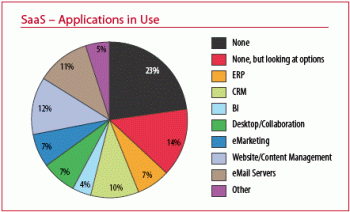
Source: 2010 iStart Investment Intentions Survey n=398
There has been a proliferation of cloud services and of cloud computing. For example, larger companies are now accessing ERP via the cloud, says Wickstead. Vendors such as JD Edwards and Oracle (which are now the same company) have been offering this overseas for some time now, he says.
“We’re a little bit behind, but business down here is starting to access these integral services via the cloud; it’s coming to terms with this.”
The reason behind this move is to cut back on staff costs. “You don’t need to employ so many people at the datacentre,” says Wickstead.

Seven Sins of Waste This slack is largely composed of the following, says Vermeulen: 1. WAITING. A prominent example of this is waiting for sign-off approval, which can take an interminable time. Kaizen advocates a simple email sign-off. Then there is waiting for replies to emails, which are needed before work can progress. Kaizen recommends setting in place times for how long replies should take (an hour, a day) to overcome this. 2. OVER-PROCESSING. This is the tendency to make things too complicated, and includes those long email distribution lists people are flooded with. Typically, only two percent of emails are of use to people, says Kaizen. Similarly with meetings – there are too many of them and they waste time. 3. TRANSPORTATION WASTE. A stunning example of this, from a client, was the movement of printer paper through a variety of storage rooms, says Kaizen. 4. INVENTORY WASTE. Related to the above, this is often the “fat in the cupboards” syndrome. For example, a bank Kaizen worked with had huge numbers of toner cartridges stored in various cupboards. 5. ERROR WASTE. People make errors, which leads to inaccurate data that eventually, no-one feels they can trust. A big culprit here is Excel, says Kaizen. The result is people end up not trusting their organisation’s main system data, so they run systems on the side. Unfortunately, this means there’s “no one version of the truth”. The solution to this is discipline and training, says Kaizen. 6. OVER PRODUCTION. An example of this is producing and publishing reports that no-one wants to read, as they’re not really of use. This consumes resources unnecessarily. 7. HUMAN POTENTIAL WASTE. Perhaps the biggest waste: people doing work in a rote way – “functional thinking”. People may know a better way to do something, but won’t do so if they can’t see the beginning and end of a process, says Kaizen. They feel alienated. The solution is to engage staff more. |
…
Published on the | Written by
Third-generation real estate man Mike Bayley is a marlin fisherman in his spare time. He says he “likes the challenge” of fighting the big sports fish, and has chased them from as far afield as the Bay of Islands to way off the wild West Coast down south. He always puts them back though, as it’s just about the sport, he says.
You could view real estate as a competitive sport, although that’s not how Bayley treats it. However, the past 18 months to two years have certainly challenged the managing director, and the family company he runs, as the son and grandson of three of the founders.
It’s a real Kiwi company, he says. It started life in 1973, in his grandfather’s three-bedroom family home in Pakuranga, with his grandmother doing the books, and his father and uncle pitching in to help with sales.
Originally, a commercial real estate operation, although much of the company’s business is now in top-end residential sales, Bayley can’t remember not being in the business. I started erecting real estate signs, and then moved into industrial sales and leasing in Otahuhu.
“Most of my days saw me eating hot dogs in the local burger bars on the Great South Road,” he laughs.
Both Bayley and the company have come a long way in the ensuing 25 years. Bayleys Real Estate now occupies a nice suite of offices in Auckland’s smart Viaduct Harbour precinct.
The headquarters has a commercial purpose though, as it also acts as the company’s auction rooms.
A private company, Bayleys keeps its financial information largely private too, although Bayley did reveal that it averages around $6 billion in transactions annually. The recession saw revenues dip last year by $7-8 million.
The company now employs around 1,200 staff nationwide and quite a number of family members work in the company. Bayley counts off 11, before you get to the coming generation, who come in and work during school and university holidays, starting at the bottom where he did, with envelope stuffing etc – one of his first jobs. He thinks such bottom-up training is a good way to go. The company takes on graduate trainees every year, in its valuations and commercial section.
Recession: reporting is king
Like many companies, Bayleys has been having a tough time lately. “The last 18 months to two years have been challenging times in the business community, particularly in the property sector in New Zealand,” says Bayley.
However, he sees the next 12 months as offering more opportunity for a number of reasons.
In the higher-end residential – the $700,000 to $2 million – bracket, there is an excess of demand over supply. And, while the collapse of the second-tier finance companies that funded most commercial building has devastated this sector, low interest rates for residential loans should fuel the residential market, he says.
Bayley also sees good opportunities in the south of the country and has just opened office in Invercargill to service the rural sector.
The big international
players in New Zealand have been more adversely affected than local operations, he says. They can’t get the funding injections they need from offshore as their parent company is often in trouble.
Upbeat as a good salesman always is, Bayley does however reveal, in a measured way, that the downturn has been pretty painful for his company.
To cope, he has used technology to support the business in a number of ways, most especially to better track costs and unnecessary overheads; to help identify where new opportunities might be, and to reach out to customers at home and abroad, via the web.
Reporting has become almost an obsession compared with previously.
“Every morning I get updates from every office, on deals signed, on new campaigns and settlements; cashflow analysis and deal numbers versus budget,” says Bayley.
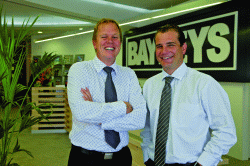 ‘All about people’ – Mike Bayley with fellow director Dave Poole
This all happens before 8.30am, when before the recession much of this information was only digested in the second two weeks of the month. “It’s great to have transparency of information,” he says.
A financial software suite from France, Foreground, is used for financials and deal management. This links into listing system RealNZ, while property management is handled by Portfolio. And, to pull reports together, IBM’s Cognos business intelligence is used, in conjunction with Microsoft CRM reporting.
All this information supports strategic decision-making too, such as where to open a new office, and ensures there are few surprises. Actual market results are revealed, which also highlights where the opportunities are, says Bayley.
This is the most valuable information, he says. Individual office KPIs (key performance indicators) are largely to do with actual versus budgeted deal numbers.
Property love affair continues
For an example of how varied an individual market can be, take the stricken commercial property market. The fact is it’s not equally stricken in all areas. Kiwis haven’t discontinued their enduring love affair with property, particularly as the global financial crisis has further eroded their already shaky faith in equities and the stock market.
Bayley says property investment has served Kiwis very well down the decades, and there are still a lot of private investors looking for commercial property investments, especially now bank deposit rates are so low.
We’re still selling less retail property than three years ago, but if something is well located and providing attractive returns there is interest as there has been very little, if any, softening of yields, says Bayley. The over $10 million market is still strong, he says, while the “under $5 million is red-hot”. However, vacant or development land is impossible to move.
Waterfront dreams
Something that has ratcheted up as a result of the financial crisis however is the appeal of New Zealand as an attractive bolt-hole – for those from the UK and South Africa in particular.
 …not to mention location, location, location.
To better reach these overseas markets, Bayley has been investing in building what is more a sophisticated suite of websites than just a simple online entity. One of its newer websites-within-the website is Waterfront, which was set up in October, complete with a viral email campaign.
Johnny Sinclair, Bayleys’ offshore residential manager, describes the campaign. It was a competition designed to entice potential overseas buyers to sign up for information on beach-front property. The prize was the “ultimate Kiwi dream – a week on a beach-front”. Entrants had to provide the names of five people who might be interested in buying waterfront property.
Over 12,500 people entered the competition, he says.

Bayleys’ various websites allow the company to easily show people the property the company has on offer. Fifty thousand people move to New Zealand every year, says Bayley. “That’s 12,500 dwellings needing to be occupied every year.”
Some of these people are new immigrants, but others are returning expats – quite a number of these now the world economy has turned sour. The Government’s latest initiative aimed at attracting new business migrants is expected to bring yet more people here, he says.
This means investment in the burgeoning website suite will continue, particularly with a view to search-engine optimising it, so people are directed to the site whenever they go online wanting to view property in New Zealand. The company’s web traffic is climbing steadily. It received 100,000 visitors in October, with 16.6 percent coming from overseas.
The websites now consist of Bayleys’ own local site, one for the UK, another for South Africa, a farming website, the new waterfront site, and a leasing site. Then there are three national portals, including one for TradeMe, and four international portals, including, for example, one linking to the hugely popular Rightmove.co.uk.
There are also multiple regional websites, which are now being supplemented by agents’ own mini-sites hanging off these. These allow agents to describe who they are, so personalising the service offered by the regional office.
Many US firms have been doing similar with their staff members for some time. It helps give a real sense of what a firm is, as well as pointing customers to the right person straightaway.
The web is giving Bayleys’ access to an alternate buyers’ pool and allowing it to access global markets more easily.
This is all a far cry from the heady days of the nineties, when agents would jump on a plane and sell whole apartment complexes sight unseen to Asian buyers. People are more discerning today and they usually jump on the plane to view property before buying, says Bayley. But first they view it on the web.
As a result, Bayley says next year will see further investment in web development. Currently, the company uses a whole range of software to support its considerable web presence. This includes the Australian CampaignTRACK, which provides real estate companies with template marketing material to help build websites cheaply and efficiently.
Bayleys’ has also used it to create e-books and is investigating its use for social media add-ons to its website suite. The aforementioned new agent websites are currently being developed with the aid of an off-the-shelf content management system called Kentico, with the help of Datacom.
IT ‘burns’
However, although Bayley appreciates that technology can help in identifying both opportunities to be pursued and costs to be contained – “the accelerator and the brake” – he is cautious about some technology.
“About four-to-five years ago we burnt the best part of $2 million on a custom-built CRM system that proved such a disaster we ended up throwing it in the bin,” says Bayley.
“Stakeholders were not well informed and there wasn’t great buy-in from the sales people.”
So, although the company now uses Microsoft CRM to support sales, Bayley is a little jaundiced about IT investment. “I’ve been cautious in evolving IT since then,” he says.
But he does have confidence in Foreground, to manage the company’s finances and those all-important deals, and in RealNZ to handle its listings database. And there are near future plans to implement an over-arching IT architecture that will allow the company to join up the various different unconnected silos of information that have developed over the years, and streamline this system, says Bayley.
“Innovation and technology is certainly going to be critical to our organisation’s growth in the foreseeable future.
However, first and foremost, we are a service organisation and it’s our people who make the machine work.”
‘Tidy’ future
It’s not only IT that can be “untidy” though. The real estate industry itself has suffered from its own series of personal failures in recent years, in the moral sphere. This is why one of Bayleys’ more immediate tasks is implementing the code of conduct stipulated by the new Real Estate Agents Act 2008, which came into force on 17 November. The act aims to improve the professionalism of agents, some of whom have been accused of unethical behaviour in recent times.
Bayleys’, the company, has not been immune from accusations of less than stellar conduct of late, however. But Bayley, the man, says he welcomes the new code of conduct, which is one component of the new act, as it will “tidy up” the industry. He sees the shoddy behaviour of some as detracting from the industry’s image, and from companies’ reputations. The new act will help protect our company’s brand, he says. “Brand is paramount.”
If I could do it all again…
iStart often asks CEOs and MDs what they know now that they wished they’d known earlier, and what they would do differently.
Mike Bayley makes some heartfelt observations. Starting with: “Life is not a rehearsal… I keep learning every day, taking on new information.”
And, even as a third-generation business leader, he has had to learn the old entrepreneur’s lesson on not doing it all. “I would try not to do everything myself and get other knowledgeable, capable people involved sooner,” he says.
Lastly, the recession has taught him some hard lessons: “In good times even good businesses can grow fat and attract unnecessary overheads. If I had known in the good times how much unnecessary overhead we were carrying, our margins and profits would have been even better. In a way, I am quite grateful to have had the past two years to get under the skin of our business and understand all the parts that make it work, particularly those parts that were irrelevant or redundant and have affected our output.”
|
CEO Gadget Watch: Blackberries are ‘rude’ |
| Gadgets aren’t really a feature of Mike Bayley’s watch. He is first and foremost a people person, he says – at work and at home. He largely leaves the technology that supports the Bayleys’ real estate operation to the specialists he employs, instead taking a helicopter view of the business, seeing all things tech-related as tools to support the business. “We’re in the people game and we need to have as much of a link with them on a daily basis as possible. We don’t make widgets or gadgets. All we do is provide a service. Our people need to understand their needs and requirements, rather than to be tapping away at a keyboard.” Accordingly, while Bayley is a great fan of the mobile phone, because he talks so much on it – his staple phone is a basic Blackberry – you won’t find him tapping away replying to emails on it. He confines all such activity to the office. In fact, he says he’s turned off the email function on the phone, as “it’s rude to be tapping into a phone all the time.” He actually has two Blackberries but can’t remember the model of either. The second, larger, one he keeps in a cupboard, for use when he goes offshore and has to answer some of the multiple emails that deluge him daily. Otherwise he doesn’t use it at all. “Family is too important. I am of the view that emails can always wait until the next day,” he says. Perhaps the fact that he’s quite a new family man is a factor here. A smiling photo of eight-month old baby “Billy” adorns his desk and his wife now has “another bun in the oven”, he says. However, Bayley does approve of the functionality of his ThinkPad, which he hooks into his rather old and non descript desktop machine when in the office. And, as for Facebook – “I’ve never been on it,” he says with heat. In fact, he almost missed his sister’s 21st birthday party, because she issued all the invitations on Facebook. |
FOR MORE INFORMATION //
> Bayleys
W: www.bayleys.co.nz
Part of brand-new BeefEater chief executive Craig McKell’s job is to expand the appeal of the successful but very blokey company.
BeefEater talks straight-up to its “mates” when selling its top-line barbecues. Indeed, its website is very “matey”. It says so – repeatedly.
But the company also sells the almost revered St George’s ovens, which, McKell says, rival upmarket competitor Miele’s products on quality but aren’t marketed to women with equivalent feminine appeal. The St George website is a curious mirror image of its brother “mates” barbecue site.
Given people now tend to hop on the net to check out products before buying, McKell says updating the site is high on his list of priorities – and not just to give it more feminine appeal.
The new CEO aims to import new web marketing and online survey techniques from the business-to-business world from which he comes. McKell was a partner at Ernst & Young for four years prior to taking up his new role in June.
There is also a second rather less sexy, but nevertheless necessary, task on his to-do list – upgrading the company’s back-office processing systems. The aim of the two improvement programmes is to rapidly treble the size of the company.
Not that Woodland Home Products, to give it its full name, is a weakling firm. At $50 million turnover, it’s a robust company. It’s a leading barbecue supplier in Australia and also exports all over the world, to North and South America, Europe, the Middle East and Hong Kong, and, of course, New Zealand.
Actually a three-in-one company, it’s composed of barbecue-maker BeefEater, the St George Appliances oven company, and Interfab, which makes sheet metal. BeefEater Barbecues constitutes 50 percent of the business, St George Appliances accounts for 35 percent and Interfab for 15 percent.
The company was set up 20-plus years ago by Peter Woodland, a founder of Barbecues Galore. After selling out of the first company, he set up the Woodland Group. Both St George and Interfab were acquired. The latter with the aim of supplying BeefEater with sheet-metal, although it’s more of an outward-facing factory operation now, selling 70 percent of its product.
“It’s very small and doesn’t have any real economies of scale, when compared with a 600-pound gorilla like CMS (Custom Manufacturing Services), but it’s hugely profitable and runs like a Swiss watch; better than the barbecue operation,” says McKell.
“Everything is based on technology and processes, and it clearly works.” McKell aims to have the rest of the company running similarly smoothly, he says.
Not ‘lipstick on pigs’
You might think that a Western Sydney company – Woodland is based at Chester Hill – would be something of a diamond-in-the-rough, but nothing could be further from the truth. Before joining Woodland, McKell says he was more accustomed to putting “lipstick on pigs”, in his previous role as a partner with Ernst & Young, in charge of sales and marketing in Australia.
“At Ernst & Young, there was a lot of helping business by putting lipstick on pigs – re-branding sub-average products and services. Peter has almost the reverse problem. I used to think that a barbecue was just a barbecue. That’s not the case. The best thing is also the worst thing about BeefEater barbecues. There’s no natural redundancy, like there is with fridges nowadays – I’ve had three in 15 years – and with small cars. They’re all throwaway.”
“You can pay over $1,000 for a barbecue. Bunnings do throwaway barbecues for $200. But, equally, you can also pay $10,000 for an outdoor kitchen.”
Woodland’s problem is more that it doesn’t shout loud enough about its often state-of-the-art technology. A recent example of this is its patented infra-red radiant burner that delivers really intense heat with low flare-up.
Great for delivering meat that isn’t burnt on the outside and raw in the inside, which is often the case with lowerend barbies.
McKell is looking to a combination of online marketing smarts and modern back-end technology, including overlaying a business intelligence system on the company’s manufacturing and finance systems, to revamp and expand the iconic but under-rated company.
“At Ernst & Young, there was a lot of helping business by putting lipstick on pigs – re-branding sub-average products and services. Peter has almost the reverse problem. I used to think that a barbeque was just a barbecue. That’s not the case.”
He says he has been on a steep learning curve for the four months he has been on board, but it seems to have been an enjoyable time too. He speaks very warmly of founder Peter Woodland.
“He’s very passionate about his business, but he wants to exit it. He’s 63 and he wants to enjoy his hard work knowing the company is in safe hands.” At 42, McKell himself is young for a chief executive.
He says of the retiring owner-manager: “He’s completely self-made and self-effacing. He can seem arrogant and brusque, but he’s actually painfully shy. I have all the fancy degrees and training, but Pete learned it all by himself.”
Complex beast
Woodland is actually quite a complex beast. As well as being a three-in-one outfit, it’s currently battling adverse publicity over recent acquisition St George. Although McKell says his mum swears by her St George’s oven, as do many owners, the once iconic company has acquired a rather rough reputation.
There is a legacy of upset retailers with St George which has hurt the brand, says McKell. The previous company that owned it went to the wall, causing much damage in the process as litigation was involved. The product is excellent, better than Miele’s. It’s handmade in Sydney.
The problem now is marketing it, says McKell.
“It has a good name with customers. My mum has had a St George oven for over 25 years. So, we don’t want to change the name, we just want to tell a better story. If you can cut through the dirt, dust and smoke, the product will sell itself.”
McKell’s varied career, lively personal background – it includes a stint as a cop – and obvious energy add up to a diverse mix of skills that promise he’ll be well able to dealwith such hiccups. The one-time NSW policeman and corporate player is also an avid surfer – even if he’s now finding it tough to find time to ride the waves – and a once-upon-a-time busking guitar-man. As well as being a rounded person, he also has a global take on the market.
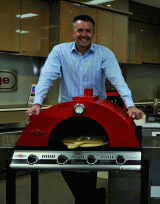
His work experience has given him the opportunity to work with people from start-ups to multinationals, he says. And this, in turn, has given him the necessary global experience that will enable him to revamp the Woodland Group and expand the company globally.
Specifically, he aims to leverage his corporate marketing experience, which was focused on business-tobusiness sales, and use it to drive consumer sales at Woodland, as well as improve business processes – and add some proper business analysis. All these changes are being underpinned by sometimes state-of-the-art technology.
“Peter and the guys know their products and the space they are in, but the business processes definitely need attention,” says McKell.
“Businesses also have tipping points – from zero to $2 million; then from $2 million to $20 million – and they need to deal with these if they are to take advantage of the enormous opportunities out there,” he adds.
McKell says there are four-to-five different transitions to be made as a company grows to the $50 million turnover that Woodland presently enjoys. The company has obviously done a lot right along the way, but now McKell, with owner Peter Woodland’s blessing, aims to take the company to the next level.
“Businesses and, typically, the people who run them need to change along the way. Initially, you get something off the ground from nothing if you take a highly regulated and processed approach to getting a business off the ground it won’t.”
But the day has obviously arrived when more sophisticated marketing and a more mature approach to the Woodland business in general is called for, despite its obvious success so far.
Marketing and sex
But that sophistication isn’t always quite what one might imagine.
“Marketing is a lot like sex – it’s always better when it’s done with rhythm,” says McKell rather unexpectedly.
He’s talking about how in engaging with customers, particularly when it comes to surveys. You need to build the conversation and, for example, not ask too many intrusive questions to begin with as you try and discover what the customer wants, he explains.
Online surveys are an important part of the marketing mix McKell plans to introduce to the company.
A survey can include a simple question about what a consumer is thinking or feeling that can help you fine-tune your marketing effort, he says.
But before the surveys get underway, the BeefEater and St George’s websites need an urgent update.
“Our websites rely on buyers finding us. It’s like waiting for them to trip over us in the street. I want to use the type of sophisticated CMS and CRM systems that are used in the b2b world.”
“We currently have bog-standard websites that are five-to-six years old and are just static brochure-ware. We are about to install a full-on CMS-driven website from PowerFront that can be automated and can run repeated marketing campaigns.
“It will have Flash and video, and all the bells and whistles that people now expect. The CMS system will also allow us to run email campaigns around product promotions. We’d be able to run 20 promotions out to a small market, with a 10,000 database in each set. And we’ll be able to do this twice too: for BeefEater and St George,” says McKell.
“You need a smart CMS system to do this. It’s one thing to have 10,000 people register for St George as part of a campaign; it’s another thing to replicate this globally.
“We also plan to leverage SMS, Twitter and other social networking technologies.”
Measuring which half works
McKell plans to measure the results of all this marketing activity as well.
“It’s one thing to deliver all this, but you have measure it too. You know the old joke: the CEO knows he’s wasting half his marketing budget, but he doesn’t know which half,” laughs McKell.
You have to decide what you want to get out of a campaign.
The aim is to have people want to buy your product from your retailers, so you have to communicate, educate and offer value beyond just what they buy from you, he says.
Which is where more sophisticated, interactive websites and social networking comes in. At the moment all this is in the early stages, but McKell has in mind discussions with customers via Facebook, Twitter and online surveys etc. “There is value in conversation,” he says.
Such consumer engagement could include recipes, and offers from business partners – he mentions barbecue herbs and spices from top-end providers, to give BeefEater customers extra value.
Measurement of this activity can help you manage it too. You might have 12 versions of a newsletter to send out to 10,000 people, either weekly, fortnightly or monthly,but one person may be on version 10, so you don’t want to send that person version one again. The technology to manage this is part of the new wave of CMS and knowledge coming out of the b2b world, says McKell.
He is installing PowerFront’s CMS system to do this at Woodland. It will also be used specifically to manage aftersales support for St George ovens.
“Ovens are complex beasties, with a lot of electrical components. And after-sales support is a challenge, as it’s outsourced to service agents – the ‘oven guy’ – who charges $80 a visit and treats the work like a sausage factory,” laments McKell.
A new customer relationship management software suite from CRM Now will help the company track service complaints and figure out what’s going on. “Say we get a complaint from a customer in Victoria. It could have been a bad day for the service agent, or the customer could be the problem. But, if we get three complaints about poor service in Geelong in the last 30 days, we know we have a problem.
This is data you can make hard decisions on.”
CRM Now is designed to meet the CRM needs of SMEs, and employs the kind of sophistication that has only been available in the b2b world for the past three or four years, through Siebel-on-Demand, says McKell. CRM Now’s founder is the former CEO in Australia of Siebel.
is allowing us to roll out the next wave of service technologies and processes, so we can have continuing conversations with our customers and measure every-thing as well.
“It’s allowing us to roll out the next wave of service technologies and processes, so we can have continuing conversations with our customers and measure everything as well.”
Monkeying around
Part of this conversation-and-measurement initiative is the use of online surveys from Survey Monkey.
Commonplace in the corporate world, they’re actually quite cheap, at $200 a pop, says McKell. You can upload and run your own online survey to any number of respondents, he says.
“At Ernst & Young we used to run one every three months, to discover information about different market trends etc.”
“It’s all about measurement of the customer’s experience.
We’ll be able to integrate relatively unobtrusive market surveys that will allow us to ask – rather than guess – what the experience of 2,000 people has been over the last year.”
Fine-tuning processes
Despite the introduction of all this snazzy marketing technology, McKell is not upgrading the company’s pres-ent MAGI Enterprise Resource Planning system, which, he says, he’s “quite happy with it at the moment”. His view is that, when it comes to back-office processing, it’s 80 percent about the people and only 20 percent about the system. “No training, no curiosity, it’s easier to sit and whine; the usual suspects,” he says of the people-and-technology issue.
“There’s a problem? The conclusion: the system is stuffed; get a new one. But you can’t, because it’s too expensive.”
“What you actually need to do is ask: what information do you really need, and is the system capable of providing that with a few tweaks? After two months of this type of analysis, we have now moved a long way down this path ourselves,” he says.
“The system is not SAP – we’re not at that level of sophistication – but it’s a good fit with our business where it is now.”
In addition, McKell has addressed a training shortfall.
Finance & accounting went through a three-day training course recently, he says. The first training they had had in a long time. That’s a big deal when August to Christmas is their busy period. And warehouse and manufacturing have now taken two days out to be fully refreshed on their technology as well.
Intelligent extras
There are also some technology extras planned for January-February, when business is quieter.
McKell plans to use this calm period to install IBM’s Cognos business intelligence suite across the top of the company’s general ledger and other systems, along with a new Siebel-on-Demand system.
Cognos will be able to pull information out of Siebel, PowerFront and MAGI, and provide us with new business insights, says McKell. The data is being captured, but it’s not being shared properly, and they can’t collate it and get reports.
“Nirvana is in June, when we’ll be starting to manage with insight. Instead of looking out the rear-view mirror, we’ll be able to look ahead and manage for the next 6-12 months, picking up on the long-term trends that are floating through different data-sets.”
“We’ll also be able to share this with our business partners, distributors and retailers. We can all get strapped to the rocket and compete with the Webers (barbecues) of the world. We already have the product, but we need to make our distributors and retailers love it and work on our behalf too.
CEO GADGET WATCH
Have Lapop, Will Play
 McKell is a laptop and BlackBerry man – but most especially a laptop man. He loves his top-end Toshiba laptop, he says – for work and play. “My life is my laptop.”
For work, he uses it to power through emails at 90wpm – his phenomenal typing speed is a legacy of his six years in the NSW Police, where he was forced to learn to touch type.
“We had to pass a 40wpm exam to be confirmed and we were only allowed three mistakes. Nor could you do it with two fingers as they’d watch you.”
Passing the exam proved harder than the unarmed combat test, but McKell managed it eventually, he says, and is now hugely grateful for the skill.
For fun, he uses his machine to store his thousands of songs, as well as a guitar chord dictionary. In an earlier life, he used to play guitar and busk. And then there’s the swell-and-wave predictor that he accesses from the Swellnet website. It provides a seven-days-ahead forecast for surfies.
However, the new job is out west and McKell lives on Sydney’s north shore, nearer the northern beaches – Narrabeen is a favourite – so he’s not getting so many surfs in nowadays.
There’s also his wife, Stephanie, and three boys, Nick, Baeden and Cameron, to pay attention to as well, and the joy and suffering of supporting Eastwood Rugby and the NSW Waratahs.
There’s one other gadget that he’s tethered to, albeit more reluctantly: his BlackBerry. He says he has a love-hate relationship with it.
“I avoided having one for a long time, arguing that there’s rarely an email that can’t wait until you get back to the office or get the laptop out on the train. Now I can’t go 15 minutes without looking to see if I have one. It’s addictive. It bites into holidays. It’s a poisonous circle, but it’s just the way it is.”…
Ever wondered how the big get bigger and why you aren’t one of them?
In the long term, it’s seldom about what you do or make. “It’s about cashflow, cashflow and more cashflow” says Mobico’s general manager Aldas Palubinskas.
As demand dries up and margins get squeezed, the temptation is to focus on what you do – rather than better managing those tasks that improve cashflow. Then, when demand increases again, everyone gets busy doing what they do and, again, the tendency is for attention to move away from managing the tasks that improve cashflow.
Nor is this just a corporate phenomenon, says Palubinskas. It applies across the board – from the smallest business to the largest organisation. However, improving cashflow is seldom just about chasing debtors. It’s about making sure your price, order, shipment and invoice are right first time. If anything isn’t right, the account doesn’t get signed off and you miss the opportunity to get paid on the spot and on time.
Who is going to pay a bill if it isn’t correct? Nobody – it’s human nature. And, sadly, if you miss the payment round, it usually it takes a month to sort everything out, and you get paid next time round.
This is the fundamental reason why most non-corporate businesses need overdrafts, factoring or larger amounts of working capital, says Palubinskas.
They collect too much in 60 and 90 days. Even worse, they often end up using their GST or provisional tax funds to bridge the gap, resulting in high, unbudgeted-for penalty costs. To thrive, you need to get the paperwork right first time, so you can collect in 30 days.
The same applies to order-handling. The less time an order takes to process and fulfill accurately, the greater the opportunity for others.
This means you shouldn’t just focus on processing orders. Think about how they are processed; how quickly they are processed; how accurately they are processed, and how many are processed.
Also think about how they’re billed; how accurately they’re billed, and when the money is collected. Manage your business – not just the tasks. You can’t thrive just by doing the job well, says Palubinskas.
Capture that data
“Fundamentally, business involves people either doing or selling things. So, business needs to capture how much time was involved – and maybe what you were doing at the time – or else capture what items were required, and at what price,” says Palubinskas.
“Now, the more accurate and timely you can make the capture and the process of that data, the better you can build, the better you can run your business, and the better you can collect cash.
“But, what do people do? Instinctively, they’re practitioners in what they decide to do. And they do this whether they’re a small, medium or large company. They focus on the practice; they focus on doing the job, rather than managing the doing of the job.
“You see it right across industry. If people just stepped back and said: ‘How can we do a better job of managing the doing of the job?’ they would be a lot more successful.”
Big and small guy problem
And to illustrate that this is both a big guy or gal and a small guy or gal issue, Palubinskas cites examples from different ends of the commerce food chain.
Demon Drinks is quite a newbie company. New Zealand-owned, it sells the “baddest and most kick-ass energy drink” – or so it says on its website. It’s got a sassy attitude to promotion – rather like Hell’s Pizza actually, but with more girls and toilet humour.
It also has a bold attitude to sales, and has gone ahead and equipped its sales staff with handhelds – aka mobile computers – to do away with the need for a middle-man and the admin. It’s a productivity and recession-beating move that many larger, more mature companies have yet to make.
Handhelds allow tradespeople, and service and sales staff in the field to handle their paperwork on the spot – without having to write anything down, says Palubinskas.
“With a mobile handheld you can manage stock, process payments, feed information back to MYOB or the home office, all at once,” says Palubinskas.
Demon Drinks is actually reasonably far up the SME food chain, but it’s still not a large corporation. The likes of Frucor (which also sells energy drinks, as well as fruit juice) and local food giant Goodman Fielder have been automating route sales in this way for years. However, it’s still not that common, says Palubinskas.
Mobile equals sales-to-go
Mobile systems work by loading up the person’s handheld with all the necessary customer details, products, pricing, order history, stock and sometimes even routes or sales targets, so they can self-manage.
In this way, handhelds do away with the paperwork that reps, contractors and tradespeople typically hate, as information on a job, sale or order is entered straight into the handheld and can either be sent straight back to the office or downloaded later, all without a piece of paper in sight.
Even those at the more modest end of the commerce food chain can benefit, says Palubinskas, as the solution is becoming increasingly affordable. He gives the example of the plumber who, stereotypically, puts his paperwork off to the last minute.
“It leads to so much waste and it affects cashflow,” says Palubinskas.
“Say, he’s out on a job and he uses four or five metres of piping – he can’t remember which or what type. He wrote it down on a piece of paper, but struggles to find it when he does his paperwork a week later. He’s not short of work, but he can’t collect his money if the bill is wrong, so he rounds it down, to help ensure that the customer will be happy to pay. If he repeats this scenario for too many jobs per month that’s a lot of money written off or not recovered. If he doesn’t, he probably collects slower.
“This is why many small businesses find themselves having to use overdrafts, or worse use GST or provisional tax to fund cashflow. The owner often wouldn’t need to if he or she
captured and processed the data around the business better.”
Palubinskas is in the business of selling handheld-based business solutions, but he makes a valid point that getting such data down on a handheld computer straight away can take as little as 10-20 seconds.
“And a mobile handheld solution can cost you as little as $5 a day. It pays for itself many times a day,” he says.
“Anyone who is involved in distribution, a route trade or field service, as well tradespeople, can benefit from better organised data collection. The more accurate and timely the capture of data, the better you can collect and the more you can sell or do” he says.
Even service technicians working for a number of companies, as is often the case in regional New Zealand where jobs are more scarce, can benefit from such solutions, as they also allow for better job allocation.
Palubinskas sees such capture of data on-the-go as still being quite innovative. There have been the early adopters, of whom Frucor and Goodman Fielder are two examples.
“Frucor’s and Goodman Fielder’s margins are a lot less than, say, a hose company or a bearing company that calls on a range of manufacturers out in Penrose one day, goes out to West Auckland another day, maybe has a long lunch on another afternoon, and then does the paperwork on a
Friday.
“Those guys don’t have these field sales automation systems, but they should have. They’d get much better productivity and control over their workforce.”
Palubinskas believes some New Zealanders are innovative, but many are slow to change, choosing to focus on just doing a better job, rather than managing the job better.
“New Zealand has a few innovators and they grow much faster than everyone else, so they get a much bigger market share,” he says.
“Our innovators have done really, really well. They thrive. But, do we have more of them than other countries? I hope so.”
FOR MORE INFORMATION
Mobico
W: www.mobico.biz
E: info@mobico.biz
T: +64 9 303 0686
Mitchell Taylor puts the success of the three-generation wine company down to family.
The company started life in 1969, when Mitchell’s grandfather, Bill Taylor, bought the Clare Valley vineyard – “440 acres of beautiful terra rossa soil”, as Taylor describes it.
“They decided to plant the largest planting of Cabernet Sauvignon in the Southern Hemisphere at the time.” Until then, the family had been involved in the hotel and wine merchant business in Sydney.
Mitchell’s father – another Bill Taylor – is still involved in the business, but his son took over as managing director in 2000. His other two sons are now also involved with the company.
At a time when a number of private vineyards have been bought up by large corporates, Taylors remains a family business – and a successful one too. Some competitors are struggling in these recessionary times, but Taylors is still thriving.
The recession has shaved about six per cent off revenues, this year, says Taylor. “But we are at the medium-level and have been growing steadily over the last 10 years.” He doesn’t wish to reveal specific numbers.
 “There’s an advantage in being a family business. You get the morale and the support from staff, with everyone working together, which you need because wine is a longterm, strategic business, where you are looking five-to-ten years out.
“We feel the family business model is a superior one when it comes to the wine industry, as you have a lot of inventory tied up in stock with the vintage.”
Unlike many family businesses, Taylor has consciously thought about managing the family dynamics. “We have a best-practice model. I am quite a proponent for family business; we’ve developed a family constitution that talks about the rules and the values of the family, and interaction between family members and the business… We also have plans for succession. We have three family council meetings a year and an elected council gets together once a year.”
Of course this raises the question of how other staff are viewed. Taylors says they are valued and this is shown by, for example, the big dinner for 120 the company staged recently to celebrate its 40th anniversary.
But just how did a Sydney company get into winegrowing in the first place? Well, being in the hotel and wine merchant business meant that Bill Taylor Snr was in a position to spot an opportunity.
“We used to import some of the great wines of Europe, the Bordeaux wines. the French have trouble with their Cabernet Sauvignon,” says his grandson. “We saw the potential of the climate here – it’s better than France’s.
Bordeaux is equivalent to Tasmania in terms of distance from the equator. We have a brilliant micro-climate in the Clare Valley. Cabernet Sauvignon grapes are very finicky and, through the years, Bordeaux wines are not as consistent as Australian red wines.”
“We saw the potential of the climate here – it’s better than France’s… Bordeaux wines are not as consistent as Australian red wines.”
There was also a technical development that made it possible to produce French-style wines in the much hotter climate of South Australia.
“Our business back then was, basically, fortified wines – ports. It wasn’t until new industry refining technology was introduced, and the first refrigeration plants installed, that we could make table wines,” says Taylor.
“High levels of alcohol in port in particular protect it from bacteria, chemistry allows us to protect table wines and preserve the flavours,” he says.
“Table wines spoil easily, but cooling them quickly and making sure you have put the right chemistry in place stops them spoiling. For example, you can add tartaric acid to the wines to get the right pH. It has its complexities, but red wine really is a mix of both art and science.”
And the rest, as they say, is history… except it was only the beginning of the Taylors Wines’ story.
Lucky Seahorses
The winery started off on a high note with its inaugural vintage. It tentatively entered its first Taylors Cabernet Sauvignon in the Royal Adelaide Wine Show and walked off with prestigious Montgomery Trophy for best red wine in the show.
This seemed to confirm the family’s assessment of the Clare Valley’s terra rossa soils as being fertile. The soil is red-brown loam over limestone and the cool climate of the valley is known to be very kind to Cabernet Sauvignon grapes. Then, while excavating the vineyard dam, they found the fossilised remains of tiny seahorses, showing the area had once been an inland sea. Bill Snr took this as further confirmation of the soil’s fertility and adopted the “lucky” three seahorses as the company’s insignia, which still feature on the company’s wine labels.
But there’s also the climate. The Clare Valley is 350 metres above sea level, which makes for warm days and cool nights. Temperatures are around 25-30C degrees during the day, while nights are under 10C, says Taylor. “This enhances the photosynthesis rate of the grapes, allowing them to catch up at night and start accumulating the sugar pattern within the grape.”
Which is all getting very technical, but underpins the way the company is run – attention to often quite technical detail.
“In wine, it’s all about the detail,” says Taylor.
In fact, it was technical knowledge that first bought Taylor into the family company, which he joined in 1988, for what was to be a short-term contract.
“We have a family rule that you have to go out and do your own thing first – there was no thought of going direct from school into the family business,” says Taylor, who was very keen to develop his own career.
“I did a commerce degree and worked in banking and stockbroking, and enjoyed it as a young fellow in Sydney and London. But, in the late ’80s, after the ’87 stock-market crash, it wasn’t as exciting as it was previously. There were all these changes and people couldn’t seem to explain what was happening, and I didn’t like what was happening…”
The upshot was that he came home – to help staff work the new PC.
They’d got a computer, at the company’s sales and marketing office, in Petersham, in Sydney, but no-one was prepared to turn it on, says Taylor, laughing.
“The accounting staff were scared of it, so I came in to teach them how to use it. Ledgers and bookkeeping was all manual then. The staff were lovely but older and my job was to train people up to use the new technology. Initially, it was only meant to be a 6-12 month contract, but when I got in there I got quite involved and could see the excitement of the other aspects of the business.
“It’s a very romantic business. You really get involved with the product, from planting the vineyard and then developing it the whole way through. It’s a multi-faceted business. You delve into everything: you’re a farmer and a manufacturer; then a scienctist and a marketer.”
Vintage management
Since then, Taylor had been heavily involved in the technical aspects of the business – both the accounting and ERP side, and the wine production, which is supported by an in-house developed system. More recently, he has introduced a mobile solution to make the company’s sales team more efficient.
Taylor has been keen to use technology to leverage the business. By the late ’90s, the company was growing fast and found itself outgrowing its IT system. For example, it had been relying on its telephone operators to be familiar with pricing, but, by 2003, it had more than 15,000 clients generating over 16,000 transactions a year.
It needed a new IT system.
The solution the company chose was SAP Business One, which, Taylor says, is still working nicely four years on – it was installed in early 2005.
“It’s helped us get all our stock organised. There is a long time-lag from harvesting to when you release a vintage to the market, so it’s important you have a computer system that can handle the costings, as the wine goes through all the chains, and work this into the prices.
“For example, you tie up a lot of dollars in oak, so you need to monitor how much time the different wines are in the oak before being released to the market. It can be three-to-four years – and the barrels cost $1,000 per barrel.
“Different styles of wine also have very different treatments. No two wines are the same in your portfolio, so there are different costs for different wines. For instance, Riesling and Sauvignon Blanc aren’t oaked as it’s not good for their style – they’re aromatic varieties. We release them earlier, so they have a different cost structure and a different ROI. Their selling time-frame is 6-12 months.”
Taylor describes the SAP Business One system as a “concise system”. Which is good, as we’ve been able to indulge in some bolt-ons, such as a plant register, says Taylor.
“There’s also an extensive inventory-management system, which is key in such a capital-intensive industry.”
More recently, Taylors has been working with SAP to install an EDI system, starting with some of the company’s key customers.
“There are two supermarket chains that are making very progressive use of our EDI system. Coles is developing a system with us, over the next six months. This will be a paperless system that will help with inventory management.
“We work closely with customers in managing stock. It’s difficult at the warehouse; you never want to lose sales from having an out-of-stock position. This means both ourselves and our customers have to manage stock in a timely and efficient manner. The system allows us to create sophisticated forecasting models, making our ordering system more efficient.”
Grape news
Grape processing has also had technology applied to it, with the purchase of a large airbag press that runs various schedules in accordance with an in-house developed process control application.
“The press allows us to do whole-bunch pressing,” says Taylor. “You tip the grapes straight into the press; you don’t have to put them in a crusher. The result is wine that’s full of flavour and which doesn’t have any harsh tannins, or the oxidative enzymes that cause astringency. It separates the wine from the skins, taking the juices out very gently.”
 The computer program allows for different levels of pressure as the cycle progresses and depending on the flow of grapes.
“You can taste it and vary the patterns until you get the right taste,” says Taylor. “Grape varieties are different, so we can process Riesling on one cycle and Sauvignon Blanc and the reds in a different manner.”
The new press is especially welcome as the company’s five-year plan includes expanding its vintage. It presently processes 7,500 tonnes annually, half of this produced by its own vineyard, the rest is bought in.
Smooth selling
In the last six months, the company has also installed a Salesforce system using Samsung Omnia smartphones that allow its 35-strong local sales force to audit, on the spot, what is happening in the stores they visit.
“The devices carry our distribution lists, which means the sales people can do gap analysis,” says Taylor. “We know where our wines are and what’s right, but these devices can highlight exactly what is happening and monitor what stock is moving through.”
The new mobile solution cuts out paperwork too – something sales staff find a challenge, as it involves writing up sales notes and then digesting all the resulting information. Now the sales manager back at headquarters can analyse instantly what’s happening and can send questions back again too, says Taylor. They also have tasting notes online.
The application is the Salesforce automation system and was implemented by local Salesforce partner FieldAtWork.
Export story
Taylors’ operation is not just a domestic one. It exports as far afield as Scandinavia, the UK and Ireland, and to the US and Canada. In Northern Europe, it sells its wines as far north as Iceland. It also sells to Malaysia, Hong Kong, India and, of course, New Zealand. The list goes on.
The recession cut revenues by six per cent last year, for the first time, says Taylor. It’s been good on the domestic front – where sales have been maintained – but down about 20 per cent on exports, to the UK, Ireland and Northern Europe in particular. We’re also feeling the impact a bit in the US, but Canada is going quite well.
More recently the company has stepped up its operation in the United States. Mitchell Taylor’s younger brother, Justin, moved to Atlanta last year with the aim of boosting Taylors Wines’ presence in the country.
“We sell mainly to family businesses there – restaurants – so being a family business ourselves is a major advantage. Your customers understand your philosophy,” says Mitchell Taylor.
The future
In the mid-eighties in the UK, bottle-shop owners would laugh at our wine, says Taylor. “They’d call it ‘Four-X’ wine or Chateau Kanga Rouge – from the Monty Python comedy sketch.”
But that changed when Australian – and New Zealand – wines started winning major European wine prizes. “We make some of the best wines in their categories and we started to prove it in the big international wine competitions,” says Taylor. “We recently won international awards in Germany, in the Mosel Valley.”
Australian wine is now the No. 1 selling wine in UK supermarkets. English snobbery has been largely overcome – because our wines are not only good quality but good value too, says Taylor.
“The Commonwealth scenario helps. We have the same sense of humour. We banter over our sports teams, and we don’t throw tradition at our customers and say: ‘This is how it’s done.’
“Australians and New Zealanders are very open. We say: ‘What do you want? How would you like us to make our wine?’ People like that.”…
Published on the | Written by
It’s all about ‘V’. Frucor’s bright green energy drink has captured consumer interest big-time. So much so that it now accounts for 50 percent of the Australian energy drink market, despite being only two years old.
Part of its secret is guarana, the stimulant extracted from the Brazilian plant. This is then combined with caffeine to create the popular new drink that is giving consumers the buzz they want when they fancy a change from hot coffee.
Frucor’s long-time managing director, Mark Cowsill, helped come up with the innovative 4pm energy-booster coffee alternative and says the drink is typical of the company’s overall approach to business. Innovation is the name of the game.
A lot of companies talk about innovating, but not many of them do it with quite the same vigour as Frucor. It’s apparent in its approach to technology too, which helps it deliver those hot new products.
For example, the company custom-built its own PDA-based sales system way back in 1994 when it couldn’t find what it wanted on the market.
This was when serious PDAs were still quite rare beasts.
Perhaps it’s got something to do with ‘V’ and all the other energy and new-age drinks the one-time fruit juice company now sells. Then again, it’s probably got more to do with a free-thinking company culture.
Managing director Mark Cowsill says, “No-one here has ever been tried for trying something and it not working.”
A good example of this is the ‘Wobbly’. Cowsill explains that some time back the company came up with this jelly fruit-juice kids’ drink as another way of expanding out of fruit juice and getting into kids lunch boxes. Unfortunately, “consumers walked away from it in their thousands.”
However, this example seems to be a rare case of the very successful company getting it wrong, but it does serve to illustrate its fostering of a consciously innovative company culture – which (after the fruit is juiced and bottled) has technology at its heart.
And central to this is Cowsill himself, who has been managing director for his whole 16-year tenure at the South Auckland-based company. “I arrived as the boss and I’m still the boss,” he says with a grin.
During this time, Frucor has evolved from being a $50 million fruit juice company to become a $450 million beverages company that now exports nearly half its product, mainly to Australia but also to the UK. It has seen five owners in 12 years, with the 110-year old Japanese beverage company Suntory recently acquiring Frucor from European multinational Danone, for $1.3 billion.
But back to those drinks. The fruit juice market has become rather static, although grocery staples like juice are holding up well in this tough recession we are undergoing. Back in 1996, the company was seeking to develop new products, and consumer surveys revealed people were looking for drinks that provided an energy boost, for the late afternoon in particular, says Cowsill.
“People were working long hours and saying, ‘I really feel the need of something to get me through the day’.”
They’ve had enough coffee by 4pm, some of them are on the move and, if it’s hot, they want a cold drink too, he adds.
Enter ‘V’, its guarana energy drink; the Mizone sports drink and now the new vitamin supplemented waters. This is leading edge stuff, says Cowsill.
Frucor was the first to introduce such drinks into Australasia. And now it has moved into coffee-on-the-go, striking a deal with Moccona to produce a range of chilled bottled coffee drinks.
“We did efficacy trials, in 1996-97, to ensure ‘V’ wasn’t all about a placebo effect,” says Cowsill. It wasn’t. He has personal evidence of this too, he says.
“My brother-in-law is a pharmacist and he thought it was all a lot of bull. He tried it one night and couldn’t get to sleep until 4.30am. That’ll teach him not to believe me,” he grins.
Cowsill thinks such product innovation encourages innovation in other areas, including IT. And this is also pretty important in big picture terms.
“It’s our major competitive advantage against the big multinationals,” he says. “We can do things they can’t; and we can do it quicker.”
This, in turn, derives from living at the far end of the world. “In small countries, people have to be much more resourceful. You don’t have the economies of scale, so you create new ways to do things that other people haven’t thought about.”
Cowsill describes a number of new technologies the company is using to drive its business and make it more efficient, in addition to the aforementioned custom PDA-based sales system.
Computer tells you where to go
Literally, in this case… Six months ago, Frucor installed a new Vocollect “voice-picking” warehouse technology.
It’s basically a talking computer which tells warehouse staff where to go, via a wireless headphone set, says Cowsill.
It will say, go and pick up seven cartons from bay 47, the warehouse man will then confirm he’s done this verbally and the computer will immediately update this, or, if he picks up five cartons, the computer will update that change too.
The result has been much better order-picking accuracy and fewer customer complaints, which was the reason for installing it in the first place.
Frucor has had a smooth run with the technology too. Basically, it’s an interface that sits on top of the company’s SAP warehouse management system and works without keyboards, and is paperless too, so has great green credentials.
The new system replaced a previous manual printed-list system. The headphone set is actually a Windows mobile client equipped with a microphone. Instructions from the computer system are converted into voice and then, in turn, the warehouse staff ’s instructions are converted back. Frucor says the error rate is low because the voice recognition software learns to recognise individual accents.
First deployed in Australia, the US Vocollect technology was implemented by Damatic, one of SAP’s partners.
PDA equals sales-to-go
This close tailoring of technology to business needs that Frucor’s use of “voice-picking” technology illustrates is a driving force behind innovation in the IT area.
It started when Cowsill took over and inherited the old NZ Apple & Pear Board’s systems, which he describes as “old, patched – 150 software patches, in fact – and slow. It took 28 hours to process invoices. We needed weekends to catch up,” he exclaims. TIMs software was quickly installed and then it was on to developing the custom sales system, which Cowsill calls “a rep pre-selling system”.
Because Frucor has a significant number of small accounts and customers change a lot too, it decided its reps needed to take a minicomputer on the road with them. Actually handhelds, they come loaded with all the necessary customer details and history, product range, pricing, order history and the rep’s current KPIs, i.e., their sales targets and, say, cycle KPIs.
“The rep can actually monitor how he’s going through the day,” says Cowsill. “I was out with a rep in Sydney recently and he could tell me how he was going with his budget, and how much he still had to sell each day for the remaining three to four days to make his budget, which he said was ‘a piece of cake’.
“They can self-manage, instead of relying on someone upstairs looking down. And they are incentivised; they can see how they are tracking.”
The company developed the first version of the software back in 1994 when it couldn’t find anything on the market. “We had a capable young team who put a basic version together – we’re now on version 5 – and from this baby was born a system that we now use right throughout the business,” says Cowsill.
The first handhelds were tough, grey steel bricks with a big aerial sticking out of the top.
The latest version is still rugged, but it now comes with GPS capability – to help devise the best routes for reps on the road – and has a longer battery life, and a good-sized screen.
The company now uses ‘Icons’, the latest iteration of Psion Teklogix’s product that Frucor brings in from Canada. It finds them better than using laptops or tablet computers as they are less of a barrier when a rep is face-to-face with a customer, and there is also no after-sales information to update in the car, which saves on time.
Tracking profits with BI
“To me, this is one of our core IT competencies. A guy can self-manage. It’s very user-friendly and at day-end they just download all the information to our SAP system, and that then starts the whole logistics operation, building up orders and pick lists etc,” says Cowsill.
This is just the beginning of Frucor’s information manipulation, however. The company relies heavily on its BusinessObjects business intelligence system to track what is happening with the business.
It provides the team with good information in the formats and with the frequency they need to make good decisions, says Cowsill, of the company’s business intelligence system.
“It gives us good reporting on our brands, products, channels and customers from a sales and profitability point of view. If we have queries, we can drill down and ask, ‘Why is this offline?’ and get a quick answer. For example, a margin on a product might be lower than expected; we can drill down and find, yes, we had to write off some product because of an issue.
“The system can also provide ‘exception reports or ranking’. You can say, ‘Don’t give me the whole 300, just give me those that are under this or over that, so you get a three-line print out rather than a 250-line one.”
With SAP’s recent take over of BusinessObjects, changes have been implemented that now make it easier to extract data from the SAP system. This means Frucor no longer has to work out all the traditional complex joins that are such a feature of SAP, according to its IS manager Paul Miller.
But the technology-drives-productivity theme doesn’t end with data entry and reporting. Frucor has a huge sales territory to cover as it includes both New Zealand and Australia. The latter has become an integral part of the company’s operation as it now exports nearly half its product across the Big Ditch.
Frucor has recently upgraded its route planning system to help those who have to traverse what Danone said was the biggest business unit in the world.
The company distributes its drinks as far afield as Perth in West Australia, Gisborne on New Zealand’s East Cape, Cairns in Northern Queensland, and Invercargill in New Zealand’s Deep South. It takes seven hours to fly from the east to the west of the company’s sprawling sales territory.
To help it manage the logistics of this massive distribution effort, Frucor has recently adopted a new software package from, unusually, UPS, the big US delivery company, which has a software subsidiary.
“We used to use Caci, but we needed a more dynamic tool and UPS has turned out to be an easy tool to use,” says Cowsill. Frucor finds it particularly useful because it allows for different call frequencies when planning the best routes for sales reps. The software optimises the route a rep should take, breaking it down by weekly, fortnightly and monthly calls, and sequences this.
“A significant part of a rep’s day is spent travelling, so taking time out of travelling means the rep can spend more time with the customer and that drives the business.”
Love sport
Cowsill is obviously very committed to his work, but he’s a regular sport-mad Kiwi bloke too. Asked what he does for fun, he says he “loves sport – playing and watching it”. He’s played rugby, cricket and tennis, and touch rugby – up until five years ago – and golf too.
He’s also used his love of flying balls to connect with his kids. “When the kids were growing up, Saturdays were taking them to sports – three kids playing different sports all over Auckland. One day I was in Pukekohe and my wife was in Huapai because the boys were both playing soccer… what is it, about 100kms apart?
“ life is dedicated to kids’ sports, particularly when you’re busy and you’re not home early every night, one thing you can do is give them time during the weekend.”
The boy’s sport theme continues, with Cowsill now watching his grown-up sons play ice hockey and rugby, respectively. He agrees the Canadian national sport is tough but, he says, “there’s plenty of padding. They’re Michelin men”.
Other than that, there are barbecues at the beach house up north, more tennis, walks, and getting the kids to load up stuff on his iPod for the beach “because they can do it about a thousand times faster than me”.
Recessionary tactics
Last but not least, Frucor may be a big company, but recessions are no respecters of size, so how is it coping?
Cowsill says markets have definitely slowed in both Australia and New Zealand, and the company is seeing this in people’s discretionary spending. The basic grocery items are holding up well, but the impulse buy of a nice, single-serve drink from the petrol station, for example, is not.
“This is a big channel for us; when petrol prices went to over $2.20 that had a bearing on sales.”
But, ever chipper, he adds, “In this environment, things like innovation, a strong company culture, and strong brands are the best assets to ensure you come out the other end in good shape.”
And, in the meantime, there’s that grocery staple – the two litre bottle of orange juice – to help keep sales up. Frucor still has it pretty sweet.…
Mobile devices aren’t what they once were. Rugged handheld computers in particular have evolved greatly. Indeed, they’ve become a whole family, and some of its members are quite delicate, although still strong.
There is the tiny ‘ring-scanner’ that straps to your finger and acts as a miniature scanner. Then there are the small, stripped-down cellphone style devices used in hospitals. But whatever form they take, they’re all high-spec devices capable of a myriad of functions.
Take the latest innovation – the über-cool RFID reader for use on the ski-field. It reads the skier’s season pass while it’s still inside his or her jacket. It checks its validity by pulling up a photo, so the lift-operator can quickly confirm that the pass-holder really is who they say they are. It speeds up the chilly process of waiting for the chair lift considerably.
But the ‘family’ is bigger than this, and examples of its members provide for an interesting display in Mobico’s boardroom, the venue for our interview with Aldas Palubinskas.
Some models are still of the rugged I-cantake-being-run-over-a-truck variety (and they are – repeatedly – says Palubinskas), while others are more akin to your everyday cellphone.
The varied designs are no accident. They perfectly illustrate the diverse forms mobile technology is taking as it emerges from the back-room and the courier depot, and starts to appear in a lot of places you wouldn’t expect – such as on the ski-field or inside the cockpit of a jet liner – as well as in hospitals, universities and throughout retail networks.
Just why they’re developing this way is a story Palubinskas is keen to tell. The general manager of Auckland-based Mobico provides mobile solutions to solve what are basically process problems we all have and that mobile technology can deal with very effectively.
It can free us from paper mountains, and the drudgery of multiple data-entry, with all its tedium, inaccuracy and waste of time and money. And it can deliver the kind of efficiency and savings that have become pressing with the tough recession we’re facing, says Palubinskas.
“Companies in retail and transport have used such technology for years, both to automate jobs, making them easier to do; and to monitor quality and cut down on waste,” he says.
The problem is that, beyond these industries, people aren’t aware of how and where to use such technology despite how powerful it is, he says. However, Palubinskas thinks a recession is a good time to look at new ways of managing business.
“When times are tight, people need the opportunity to do things differently. That’s a real cliché, but if you’re in business and you’re used to following certain processes it can be quite daunting to try and find another way of doing things, even if the return seems obvious.
“Mobile technology can substantially improve the quality of your business processes and free up cash by giving you better visibility of your stock or assets, or other resources. It means you can make better business decisions.”
Making the case for adopting a mobile model, he says; “Most business processes consist of somebody sighting something and recording it. The normal process, ever since people could write, has been to record this on a piece of paper and then manually enter that data later on or reproduce it throughout a whole paper chain.
Mobile technology allows you to do that data capture at the point of interaction, at the organisation’s edge, where you’re serving the customer or handling an item of inventory. “A lot of organisations have their business processes built around paperwork, but then you’re locked into how that invoice or service request gets handled. This technology lets you capture that data instantly, and accurately, so you’re able to complete many of those processes on the fly.”
Smart drive washes up
Palubinskas gives the example of a Fisher & Paykel maintenance technician who comes to your home because your Smart Drive washing machine isn’t working.
Instead of relying on paperwork, as used to happen, the technician now has a handheld with drop-down menus, which allow him, for example, to see if the part he needs is in his van. If it isn’t, he doesn’t even need to go out and check, he just sends a request straight back to F&P so his bin will have that part placed in it. So, later on, when he goes back to the depot, he can just pick it and come straight back to you.
“A whole bunch of processes have been blended together here and, once he has done the job, an invoice gets generated on-the-job and he’s pretty much clear of all the paperwork,” says Palubinskas.
Although it might not be obvious at first glance, you can translate this way of doing things to other processes which are actually quite similar, such as insurance or tenancy inspections, meter reading or aircraft manifests, and more advanced developments, in hospitals and even on the ski-field, says Palubinskas.
Mobico is presently installing a ski-field application. It illustrates one of the more sophisticated uses of mobile technology, as it uses RFID (radio frequency ID) tags. RFID has taken a bit of battering lately in terms of take-up, as people come to terms with how best to use it.
Despite this, Mobico is busily installing an RFID-based ski pass system at Mount Ruapehu – the ski season arrived early this year, putting the pressure on for a quick install. The system will see ski-lift operators check your pass while it’s still inside your jacket. The traditional lift pass has a bar- code, which means you have to fish it out of your jacket. This can be a cold, unpleasant business and also means delays as chair-lifts go past unoccupied, says Palubinskas.
With RFID-checking, chair utilisation goes up, queue throughput increases and customers get more runs. Which is why Ruapehu Alpine Lifts is installing the technology. This leads us on to the need to ensure backend processes can support mobile solutions. Palubinskas gives an example of how this is being done in a fairly non-traditional area for mobile technology – health.
Healthy option
Unusually for the normally paper-based health sector, Capital Coast District Health Board moved to a mobile-based inventory replenishment system in its hospital wards about five years ago.
The system involves every ward having a location identifier and its medical stocks – syringes, bandages, medicines etc – being bar-coded. A handheld scanner is used to identify and capture information about stocks. It keeps a count and then relays this information to the three hospitals’ Oracle database.
This has a set ‘refresh level’ for when stocks fall below a certain level. The system will then ask the administrator if he or she wants to generate an order and if so will automatically transmit one to the supplier concerned. It’s effectively a real-time, ongoing stocktake, says Palubinskas.
Mobico’s Ben Tompkins, the systems architect who helped install the system, says the solution has had a major effect. The hospitals used to overstock on saline solution and dialysis products, for example. These have a limited life, but it’s hard to predict how much is needed. The hospitals would over-stock and a lot of it would go bad, says Tompkins.
The scanner-based inventory solution has helped the DHB address this expiry date issue, along with many other issues. The health sector is starting to look at mobile solutions too. Palubinskas says that a Canterbury hospital pilot is currently evaluating a quite different mobile solution – an RFID system to tag beds, so they can be tracked around the hospital.
“You might say, ‘how can you lose a bed?’ But you’ve got assets flying around the place all the time and there’s no check on them, so there could easily be an extra gurney in the emergency department or parked up some back hallway.” Even though we’re talking about hospitals, says Palubinskas, “It’s pretty much the same technology solution that’s used to restock shelves in your local store, but using a different business model. And the payback is immediate for both, with savings being derived from reducing slowmoving items and ensuring fast-moving items are at hand.
” You should be so lucky to have people queuing up in these tight times… Well, The Warehouse and McDonald’s do, and when their queues get too long they have a mobile solution.
For instance, a McDonald’s staff member will sometimes appear at your side and take your order on a PDA, relieving pressure on till staff and speeding up your order.
Similarly, at The Warehouse, especially at Christmas when queues are long, extra staff will often come and scan your purchases, and give you a ticket, so when you get to the counter all you have to do is pay – no more waiting. Palubinskas says these “queue-busting applications” just record what people have in their basket, but from a business point of view are very powerful as they take on “20 percent of the task for 80 percent of the benefit”.
“Many field service applications take a same approach. It makes implementation much faster and cheaper. Applications can be expanded over time, but just that 20 percent is enough to gain 80 percent of the ROI.”
Savings stack up
And what kind of savings are we taking about? Palubinskas gives a robust retail example to illustrate.
With the move some time ago to ‘just-intime’ manufacturing and stocking, one result has been gaps on shops’ shelves as popular items sell out, while stocks of less popular items languish unsold. A similar solution to the health board’s – but on a much more modest level – has been shown to increase the profits of a medium-sized shop by $50,000 to $250,000 a year, simply by reducing out-of-stock gaps and managing stock better, says Palubinskas.
The solution consists of a handheld equipped with a scanner, which is hooked up to a wi-fi network.
“Customer satisfaction also improves greatly. Did you know sales and margins lost due to out-of-stocks and discounts on old expired stock account for many more dollars than stock theft or loss? When a full stock-take takes hours instead of days, retailers can stay on top of their inventory, replace what they need and clear what they don’t far more efficiently. Even with a small gain, such a system can pay for itself almost straight away.”
“It’s smart technology for tough times.” And to emphasise the low-volume point, Palubinskas says that vertical operations – he mentions Morgan Furniture – are starting to use mobile- based systems. You can automate routine jobs by using scanners, which makes for consistency and also allows you to monitor quality, he says.
And, although initial staff buy-in can be difficult, once people realise it makes their jobs easier and gives them more control they’re usually enthusiastic, he adds.
Air NZ pilots paperless take-off
Moving up the company-size scale, Air New Zealand is using a mobile solution for a manifest makeover – that’s the folder of passenger information the pilot must have before take-off.
Just because a company is big doesn’t mean it’s immune from cost pressures, and Air NZ has faced the same pressures as other airlines, as the industry has become intensely competitive in recent years. This has forced it to scrutinise costs closely. For example, airlines have to pay steep fees for every second their planes are on the tarmac. “So, why do they walk the paperwork (the manifest) to the cabin door and hand it to the pilot?” asks Palubinskas.
Well, Air NZ won’t need to any more. It has been piloting a paperless solution for its national feeder plane airlines – the little planes of the Eagle and Mt Cook lines. This sees the pilot receive his or her manifest information wirelessly, over the public GPRS mobile network, to a handheld, a Motorola MC35 handheld computer in this case.
No more delays because of slow paperwork – that’s the bonus from the passenger point of view. From Air NZ’s, it’s the large savings from not having planes tick up fees as they hang around on the tarmac waiting.
On route
Mobile solutions have developed even beyond this, however. One of the latest enhancements is the geo-stamp. This has come about because many handhelds that are used on the road are now GPS-equipped. A recent iStart case study, of Mighty River Power, discussed how the company’s meter installers now do their ‘paperwork’ using handheld computers.
These feature drop-down menus and picklists which detail jobs and record completion. The handhelds also ‘geo-stamp’ jobs, using a GPS stamp. This involves a reading of the longitude and latitude of the place of installation, and acts as additional confirmation of a job done – very useful when third-party contractors are being used.
Palubinskas says the system has saved on paperwork and delays, and hugely reduced costs. Job-sheet accuracy has gone up from as low as 25 percent, at busy times, to virtually 100 percent.
“New Zealand’s power companies like it so much that we have ended up working with all of them to install similar systems. They would also work well for government, local councils and other utility companies, and service organisations like insurance,” he adds.
Which brings our ring-scanner to mind again. Both the ‘ring’ and the geo-stamp are examples of novel uses of mobile technology. While the geo-stamp records that a job has been physically attended, the ring-scanner aids accuracy and makes its user more productive. The wearable scanner reads bar-codes, so freeing-up the user’s hands to move packages etc. Both technologies show how varied the uses of mobile technology can be.
The key is to understand the underlying business process issue you are trying to solve. There is often a mobile solution to it, says Palubinskas.
From clunky to cool
“Mobile computing is used all over New Zealand and has been for twenty years. It can solve tough business problems, which results in big efficiency gains and cuts costs. It has been used extensively in retail, transport and logistics, and could bring the same benefits to other industries and organisations, especially when it comes to reducing paper,” says Palubinskas.
“There are perceptions about big clunky devices that are grubby, but the state of them is just a reflection of the environment they’ve been used in. The technology can be used in even the most hygienic environments, as the hospitals have shown.”
iStart’s discussion with Palubinskas finished up with a chat about Apple’s hugely popular iPod and how, basically, it’s really an innovative use of the humble hard-drive. Palubinskas thinks it’s “technology as jewellery”. Which makes it doubly innovative and underscores the theme here: that the same technology can solve the business process problems of quite different industries.
The iPod is a good example of innovative thinking. It solved a consumer ‘problem’ more neatly than its fore-runners – it made music on-the-move easier, more varied and more fun. Palubinskas has similarly innovative aims in the business space. And some of Mobico’s solutions promise more fun too – more runs on the skifield, for example.
Saving the Planet the Mobile waySome people now have ‘saving the planet’ on their organisation’s list of KPIs.
|

Queue-Busting made simpleYou should be so lucky to have people queuing up in these tight times… Well, The Warehouse and McDonald’s do, and when their queues get too long they have a mobile solution. For instance, a McDonald’s staff member will sometimes appear at your side and take your order on a PDA, relieving pressure on till staff and speeding up your order. Similarly, at The Warehouse, especially at Christmas when queues are long, extra staff will often come and scan your purchases, and give you a ticket, so when you get to the counter all you have to do is pay – no more waiting. Palubinskas says these “queue-busting applications” just record what people have in their basket, but from a business point of view are very powerful as they take on “20 percent of the task for 80 percent of the benefit”. “Many field service applications take a same approach. It makes implementation much faster and cheaper. Applications can be expanded over time, but just that 20 percent is enough to gain 80 percent of the ROI.” |
Savings & FinancingBecause it’s hard to imagine the kind of financial benefits that a handheld computing solution can result in, Palubinskas quotes an example of a medium-sized shop increasing profits by $50,000 to $250,000 a year, by reducing gaps and managing stock better. For bigger customers, the huge jump in reporting accuracy of field technicians’ reports for Mighty River Power – from as low as 25 percent to 99.9 percent – tells a powerful story. Palubinskas says the savings come from less capital being tied-up in slow-moving stock, less waste and simpler data-entry that is more accurate, resulting in fewer incorrect invoices. There are also soft benefits, such as better customer service and retention. And, because times are difficult, financing is now more flexible, he says. “Payment can be made on virtually a daily basis, out of profits. And a business case and proof-of-concept roughed out pretty quickly so people can see just what’s possible.” “If you want to test out a solution, equipment can be borrowed or rented, but the chances are your key business processes have already been mobilised by another industry, whose experience you can leverage.” |
FOR MORE INFORMATION
Mobico
W: www.mobico.biz
E: info@mobico.biz
T: +64 9 303 0686
Published on the | Written by
He’s a tourism industry dream. For Mike Reynolds, CEO of newly revamped third mobile provider NZ Communications, this is his second time in New Zealand. The long-time BellSouth company man first came here 12 years ago and says one of the reasons he’s come back is because he likes it so much.
Originally from Tampa, in Florida, Reynolds has spent 20 years as an international telecommunications company executive roaming the globe. His last port of call – before moving to NZ eight months ago to head up NZ Communications – was Singapore, where he was president of StarHub. He was approached for the New Zealand job, he says, and is confident about his ability to ensure the company makes a mark, despite its entering a market with two strong incumbents.
He views NZ Communications as a start-up – just as StarHub was when he took it on, in 2000, he says. With a raft of new investors and a new management team, the old Econet Wireless, as the company used to be called, doesn’t really exist any more, says Reynolds. The Maori Hautaki Trust, a Crown entity, still retains a major 20 percent stake. Company chairman, ex-All Black Bill Osborne, has also carried over from Econet. But over $100 million in private equity has also been pumped into the company by new international investors.
Reynolds says during his seven-year tenure at StarHub, he took the start-up from being third mobile provider to second provider, and the company grew to become a NZ$2.5 billion company with 2,700 staff. Given this, he’s unfazed by our 105 percent mobile penetration rate, a statistic which amuses him. This unusual penetration statistic is the result of some people having two phones, largely to take advantage of Telecom’s and Vodafone’s different deals.
Reynolds joined NZ Communications last July and although the company is still in set-up mode it is expanding fast. It’s currently busy installing mobile towers in Auckland, Christchurch and Wellington, rolling out what will be our third 3G network. It will be nationwide, says Reynolds, as the company has a roaming agreement with Vodafone, which was brokered by the government under some pressure.
The company has installed 230 of the 400-500 cellsites it intends to set up in the three main centres and is targeting a launch date “in the next few months” if a few key resource management consents come through quickly, Reynolds says.
Staff numbers are already ballooning, from around 18 two years ago to 200-plus now, and the company now has six buildings to house all this growth. Having outgrown its original Auckland building, it now has four in the city, as well as local offices in Wellington and Christchurch. So, it’s serious business. Reynolds had been busy in Wellington, as well as overseeing the installation of a complex back-end system, to ensure the new company can offer the right products to customers. There will be special deals, he says, in answer to a question about how NZ Communications can compete with incumbents offering an array of these. But he wouldn’t be drawn on specifics, for fear of giving away information to his rivals.
His job at the moment is two-fold: ensuring the “playing field is a level one” and installing the back-end technology that allows for detailed customer analysis, so the right products can be developed to target opportunities.
Intense efforts to level the playing field have focused on lobbying the Commerce Commission to reduce the Mobile Termination Rate fees. These are fees telcos pay to each other when calls are switched through from one network to another. They favour incumbents, because they have more subscribers, and so tend to stifle competition.
Reynolds says he’s impressed with the action the Commerce Commission is taking on this front. He’s also impressed with the action the government is taking to make the Resource Management Act (RMA) quicker and cheaper to negotiate. He says getting this right, so the company can roll its network out without too much trouble, is the second most important matter that needs attending to “to level the playing field”.
“It is well-intentioned but the execution is very difficult and slow.”
Reynolds’ wrangling efforts around loosening up RMA demands relate directly to when the company can launch, as this can only happen when the correct number of mobile towers are in place, and the company is reliant on getting RMA permission to build them. But, he confirms, “we’ll be in business this year.”
Crossing the fence
Reynolds says he’s seen the telecoms industry change hugely since he first joined US telco giant BellSouth, in 1977, as a freshly minted MBA graduate. And a big part of that change has been the move to mobile communications. Reynolds well remembers the birth of mobile back in 1984, he says. It was originally a response to AT&T, another giant US telco, which refused to allow any change or innovation in telecommunications.
“We used to joke that you could get any colour phone, so long as it was black or beige.”
Reynolds spent 24 years with BellSouth, but his move to take on then start-up StarHub saw a shift to the other side of the fence.
“I’ve now been on both sides,” he laughs, referring to the contrast between his Singapore StarHub job and his time as a BellSouth man. Of his move to NZ Communications, he says, “It’s an interesting career choice. When I first looked at the market I thought it was an excellent opportunity.”
It’s comparable to Singapore, which has three successful operators in a country of four-and-a-half million, he says. The difference is that when he took on StarHub, mobile market penetration was 60-70 percent as against the much more mature market here now. He describes our 105 percent mobile penetration as “unique”, but says it’s one of the aspects of its appeal. “You always have a challenge. That’s the nature of the beast and it wouldn’t be any fun if there wasn’t one.”
However, he is concerned that we don’t have “a level playing field”. But he’s working on that and the sluggish regulatory tide does seem to be turning in the company’s favour.
When he first came here, with BellSouth in the mid-1990s, in the wake of the deregulation of our telecoms industry, he was also pushing boundaries, but internal ones. He was only here for 18 months then, but during that time he persuaded the BellSouth board to expand the company’s fledgling network beyond the three main centres. That was in 1995. BellSouth eventually sold out to Vodafone in 1998, which, as we know, went on to compete very successfully with Telecom. By then Reynolds had moved on to Asia. But it seems his instincts were correct. He agrees, smiling, that maybe he does have some unfinished business here. He certainly hopes to make more of a mark this time.
“Returning to New Zealand was a choice, not a necessity. I left a great situation for a bit of an adventure and that’s the way I like it” he says. “I love the country and the people – and the business proposition.”
The focus of his international career has been the Asia-Pacific region – he has lived and worked in Hong Kong and China, as well as Singapore – and cites our quality of life as a big part of the appeal in choosing to come back here again.
And then there’s the business challenge. Curiously, for someone in such a technology-based industry, Reynolds is not big on technical details – he leaves that to his technical people. “I am concerned about the execution of the technology. I have been embedded in the technology in the past, but we have a terrific team who are experienced in what they do.”
His role now is more the big picture so he’s interested in the services that technology can deliver, and tweaking these based on analysing information delivered by grunty back-end systems. This is probably a reflection of the fact that he comes from a business administration rather than a technical background; he’s an MBA man, after all.
Discovering customer wants
Analysis is his strong suit and he likes to “keep it simple” to make this easier. We’re swamped with data, he says, but it’s not always the right data. He cites the fact that he finds it easier to get “quarterly information than what I need on a daily basis”. It’s timely access that’s needed: five to six pieces of information every day, to track a few KPIs (key performance indicators) on a daily basis,” he says.
Which is why Reynolds is focused on ensuring NZ Communication’s back-end systems can extract and deliver the right information to him and his management team.
“I try as best as I can to take technology out of the equation. It’s very easy to get hung up on it. The technology is a given. You are not going to have a competitive advantage from it for very long. You win in terms of what you understand about the value you can give to your customers.”
This understanding comes from what he calls “granular” information – information that’s wide and deep. He gives the example of customer analysis undertaken while at StarHub.
“We were looking at customer data by segment. It’s not always obvious what’s actually happening with customers,” he says. “For instance, there was a group of older Singaporeans who turned out to be heavy data users. Not at all what we were expecting, so then you go on to develop a product.”
This is the kind of customer analysis and focus he is bringing to his New Zealand role. “When we launch, we’ll feed in the usual information around ARPU (average revenue per user) and churn rates etc,” he says.
“This is part of building up a fine-grained picture of customers.”
He sees the Hautaki Maori Trust investors being able to offer an extra contribution here. “There are special things that they bring from a values perspective, and from their perspective as customers. It comes back to really understanding your customer, how you layer that. It’s not just age or ethnicity, as you learn more and more your segmentation starts to be built around how people use technology, what their habits are and then that particular segment will cut across all different segments. It’s almost a 3D model.
“For instance, take texting. Everyone assumes it’s the youth, but then you find there are others doing it. The more you understand this, the more granular you can get, so you can offer something that is of tremendous value to some people that other segments would yawn at.”
This is exactly what happened in the Singapore example: older people aren’t usually big data users, but granular analysis revealed this one group was. “I don’t like averages,” says Reynolds. He quotes the example of the man with one foot on a block of ice, the other in a fire. “On average, he should be comfortable, but clearly he’s not.”
In relation to telecoms, he says that ARPU can be misleading. “While ARPU is an important measurement, it’s important to go beyond that: ‘Is the number of users on a day-to-day basis changing?’ The ARPU may not have changed but there may be distinct changes as you peel the onion back.”
Accordingly, the technology supporting both the company’s network and the customer intelligence in the back-end is very much focused around integration, to ensure information is easily accessible. Oracle provides the ERP suite and was chosen not only because it has specific telecommunications components, which address billing and roaming, for example, but also because of its ease of integration with other systems.
To complement it, SAP Business Objects has been used to build the business intelligence capability and was chosen partly because the data warehouse part of the system was easy to build. The ERP system can also have modules bolted onto it, which allow for monitoring and analysis of telecoms-specific KPIs. SAP Business Objects also provides a uniform environment and having commonality around systems makes for ease-ofuse for end-users.
For its customer management requirements, NZ Communications turned to Indian telecoms system specialist Lifetree, again because it integrates well – in this case, with customer accounts. This allows for, for example, good tracking of customer queries, where a particular query can be steadily escalated up the chain until it is either responded to, by a customer service rep, or actioned in some other way. Previous customer history can also be accessed easily, which makes providing a good service that much easier.
So, as Reynolds says, it does seem to be all about the customer – once a more level playing field has been created, of course. He explains that, in order to provide good service, the back-end has to lead the front-end. Without a good, integrated back-end, delivering proper front-end service is difficult. “If you’ve got the front-end right without the back-end you’re still in deep trouble.
He says that while the company’s CRM system is traditional in terms of its capability, the company has a unique opportunity, as a start-up, to optimise the system to deliver the timely information when it is needed, to whom and where it’s needed, so managers have those five to six pieces of information they need. “To this end, how the system interfaces with data, and how you’re able to pull the reports and information out, is important,” says Reynolds.
Reynolds’ “granular” approach takes this a step further into the customer area too, in allowing for very detailed analysis of what different customers want. That this may not always be what’s expected – as his Singapore example illustrates. His comments around gadgets (see sidebar story) further support this view. He adds that, “Five years ago, if someone had described YouTube to you, you’d probably have thought it was a silly idea, now it’s the norm.
“I guess what I’ve learnt, after 32 years, is not to look too closely at the crystal ball because the technology, and the value to people, is just growing at an increasing rate and the best thing you can do is deliver the platform that allows that growth and creativity to prosper.”
| CEO Gadget Watch Blackberry Early Adopter |
|
Just as Reynolds stresses he’s no longer geeky when it comes to the technology NZ Communications uses – he’s more concerned with what it can deliver the customer – he says he’s “getting old and boring”, about his personal use of new technology. “I’m not nearly as gadget-conscious as I used to be.” However, he is a big BlackBerry user. “I was one of the early users. In fact, I started using it back in 1997, when it was just basically a paging device and wasn’t a phone at all. But it was a tremendous business tool and I have used it ever since.” It doesn’t necessarily have to be a BlackBerry now, but to able to access your mail, your calendar and all of your communications while on-the-go is great, he says. Beyond this mobile business tool, Reynolds says his main interest now is in what young people are doing with technology – especially as he thinks innovation is increasingly being centred around devices like the iPhone, with the network just providing the backbone. He cites the example of his 24-year-old son and his friends, and what they are doing with their iPhones. The young man is Boston-based dental student, and Reynolds says he was impressed when, recently, he was trying to recall a local restaurant and his son did a quick geographic search on his iPhone and found it almost instantly. Reynolds had expected to have to go online. Father and son then went on to discuss a movie and, while they were talking on the phone, his son’s friend called up a trailer on his iPhone. “And we’re just scraping the surface of what we can do with just a basic 3G service here,” says Reynolds. Devices, not networks, are starting to matter, he says. “Once you have the device the applications will follow.” Reynolds says he tries out new devices on his son and his friends, to see what they think of them – and what they do with them. “Fit the capability and the creativity follows. This is true of the iPhone and the net, in general.” Here, as with his emphasis on customer analysis, Reynolds strives to remain open-minded about the technology he so clearly enjoys – and, again, to take nothing at face value. “The key is to put the capability out there, and the creativity will follow. Don’t try to do it yourself. It’ll never happen. The applications follow naturally.” |
AU: 1800 462 388 · +61 401 189 448