
As someone who sits at the junction between IT news, technology vendor hype and the interpretation of it all into advice for businesses buying software, AI has been an unavoidable cacophony in recent times.
Artificial intelligence (AI) has become the dominant theme in business technology, with every tech vendor on the planet hyping new features as AI-driven this or AI-empowered that. And until recently, the noise has been just that: Best ignored when it comes time to get out the cheque book.
Often, AI capabilities have simply been embellishments of typical IT capabilities such as process automation, data analytics, or integration tools.
“AI is the new IT” I’ve said before, while also thinking, like most, that I’d better keep across what’s going on here.
While buyers remain sceptical, AI is rapidly maturing as the large language models that support it grow in sophistication and reduce in cost.
As AI gets embedded into business software platforms, this sophistication is arriving in the hands of software users and piquing the interest of both execs and IT procurement teams.
The AI translated a list of ERP product parameters into full sales-ready descriptions ready to upload to the web store, saving days and days of work.
The explosion of generative AI tools has excited users with the potential for this new breed of technology and driven rapid uptake. It has also heightened expectations that, at least in the immediate time frame, are likely to be dashed.
But there’s no doubt the cycle is trending up the enlightenment slope as AI use cases become clearer, LLMs improve, and vendors move from experimentation to embedding AI tooling into their products.
There are strong use cases emerging for ‘agentic’ AI that add genuine value to call centre staff helping customers resolve complex issues (which is why we called them in the first place, right?). And to be clear, I’m not talking the dreaded chatbots here, although they too are being improved (to avoid the call in the first place).
In CRM and online retailing, AI is delivering real value in surfacing customer insights and augmenting data collection.
I recently heard a great example where AI transformed a painful process of loading thousands of new products to an e-commerce site. The AI translated a list of ERP product parameters into full sales-ready descriptions ready to upload to the web store, saving days and days of work. Copilot can deliver some real value it seems.
We’re also seeing product recommendations and x-sell/up-sell suggestions that are actually useful, using AI’s ability to understand the semantics of the customer journey.
While the benefits of AI in enterprise resource planning (ERP) systems is less obvious, AI’s ability to generate insights from data, particularly in forecasting likely or possible outcomes, is looking promising for predictive analytics.
The use of natural language in search queries or in problem statements is making it easier for users to engage naturally with systems, without technical skills or detailed knowledge of the data they are searching.
GenAI is valuable for accelerating tasks, especially in contextualising search results, and is delivering improved personal productivity, but not necessarily something that sits comfortably inside an ERP.
It has also become an asset for developers by enabling quick retrieval of relevant code blocks or open-source solutions to resolve integration mapping or complex logic, significantly enhancing dev team productivity.
It is starting to not only identify data gaps or outliers, it’s then prompting users with suggestions to resolve the issue, in some cases even asking if it should go ahead and fix it.
Despite the advancements in AI, many buyers remain pragmatic and even sceptical about its capabilities.
Believing AI magic will happen can be a distraction away from the hard work of automating or integrating processes, or from improving transactional data quality. Those things are the true enablers of digital success.
But again, AI is having an impact as vendors introduce anomaly detection, alerting users when transactions are outside of norms so they can be fixed at source thereby improving data quality.
It is starting to not only identify data gaps or outliers, it’s then prompting users with suggestions to resolve the issue, in some cases even asking if it should go ahead and fix it. The net result is better quality, where AI-driven analytics can then start to play their part.
But are these trends translating into requirements that buyers are taking to market?
From my experience, not yet. Buyers are very engaged with the possibilities of AI, but they may not know yet the specific AI features that they require. What they want to do is align with vendors that have a strong story around how AI will be incorporated into the product they are evaluating. Which explains the hype. But the story must be believable and in pragmatic terms that people can get their heads around.
In our recent work interviewing local ERP leaders as part of iStart’s 2025-26 ERP Buyer’s Guide, the use cases listed in the table below were the common threads, as an attempt to meet that measure.
I’d expect features such as these to appear more regularly in software buyer requirements lists as the market matures.
One thing is for certain, AI technology will continue to evolve and improve. As it does, its role in business technology will create tangible applications that drive genuine efficiency and innovation.
The AI news is all good for innovation and productivity, but I worry about only one thing: Who will end up paying for the massive investment that the sector is attracting? Watch this space.
EMERGING USE CASES FOR AI IN BUSINESS TECHNOLOGY
Function |
Use Cases |
Process automation |
|
Analytics |
|
Content |
|
Software engineering |
|
Support |
|
Search |
|
Source: iStart ERP Buyers Guide 2025-26, vendor interviews and related literature reviews
 Hayden McCall is managing director of digital publisher iStart technology in business and owns Software Shortlist, a consulting business helping companies to buy better software. He has been involved with IT and the software industry for over 25 years.
PEBKAC is a well-known anagram in IT support circles.
It describes the human factors that often contribute to IT support calls that have little or nothing to do with the device or the software that it is running.
“Problem Exists Between Keyboard and Chair” almost sums up the human condition – we are all born with frailties and idiosyncrasies that even the best technology in the world cannot eliminate.
While your average IT genius might assume the root cause is what’s lacking between the ears of users, there’s often other factors that come into play. Bad software design definitely plays its part, but poor eyesight also contributes.
After a few too many ‘should have gone to Specsavers’ moments on the wrong end of support calls in recent times, it was time to take the advice.
Specsavers in the local mall were consulted to take up the lesser of my lost causes.
It quickly became apparent that the solution involved a whole range of technologies now at the disposal of the optometrists, of which I knew almost nothing.
Long story short, I got talking with my friendly optometrist about their practise management systems and all this fang-dangled equipment and landed on an arrangement to share it with iStart’s highly intelligent, and possibly similarly ageing, readership in the hope that you might be similarly elucidated.
The ophthalmological equipment catalogue below provides a rundown of the main machinery your eyes will be assessed with (acknowledgements to Specsavers).
Optical Coherence Tomography
An Optical Coherence Tomography (OCT) is an advanced 3D eye scan which Specsavers includes as part of every standard comprehensive eye test. It takes a series of advanced 3D scans of the back of the eye, including the optic nerve, retina, and macula. The scans are highly detailed and allows the Specsavers optometrist to view the granular structures of the patient’s eye, for a more advanced and accurate examination of the individuals eye health. This helps the optometrist to detect any eye conditions in their earliest stages so the individual can see better for longer. The OCT scan used to be the exclusive domain of ophthalmologists and was only recently approved for use by optometrists. Since 2017, it has been responsible for detecting over 150,000 referrals for glaucoma in Australia, along with 0.5 million registrations for diabetes checkups.
Tonometer
A tonometer is an instrument used to measure intraocular pressure (IOP) which is the fluid pressure of the eye. Non-contact tonometer’s use a puff of air to flatten a small section of the patient’s cornea which measures IOP. This doesn’t hurt but there may be a loud click as the puff of air is delivered. Maintaining a healthy IOP will help to preserve the patient’s vision and prevent vision loss from eye conditions such as glaucoma, a sight-threatening ocular disease.
Autorefractor
An autorefractor is a machine which measures the ability of the patient’s eyes to focus and gives an approximation of the individuals prescription. The patient will be asked to stare into a machine through two lenses at a picture, for example of a hot air balloon at the end of a long straight road. The machine focuses on the picture and makes the balloon appear to be brought closer and further away. As it does this, the machine calculates an estimation of the patient’s prescription needs with the results of how well the individual’s eyes focus on the image.
Slit lamp
The slit lamp is used to observe the health of the cornea, the iris, and the lens. The optometrist will ask the patient to place their head against a frame and chin rest while the optometrist looks through a powerful microscope at each eye. It is also used in combination with a high-powered handheld lens to provide the optometrist with a 3D view of the back of the eye.
PMS
Specsavers uses the Socrates patient management system to manage patient data linked to examination results and in New Zealand also uses Genesys for managing the patient experience. This meant that when I walked into the store, they already knew who I was, when I last had an eye exam (7 years earlier) and importantly could assure me that the gradual degradation of my eyesight and health was entirely normal. The data gathered is also put to good work. The Specsavers ANZ team has been managing a program of work to integrate Socrates into various industry referral programs such as KeepSight (Diabetes), Oculo (GP and ophthalmologist referrals) and more recently for Macular disease (AMD) referrals.
Now, with a combination of progressive lenses for general use and upgraded reading glasses for working at my PC, I am navigating my way around screen and device with much more comfort, and a lot less PEBKAC.
Orcon, one of Vocus New Zealand’s several retail ISPs, has this week announced a change in its go to market services to deliver business grade services to residential customers.
The move is in response to the Covid-related mass migration from the office to home working environments and the need for higher service levels.
Chief executive Taryn Hamilton says the ISP has scrapped ‘business’ and ‘residential’ distinctions and will instead tailor technical solutions to match customer needs.
“In essence, we’re offering business grade service levels to anyone who wants it.”
“Connectivity in the home is no longer just about smooth 4K streaming. We know people run business critical applications from their home office, and there’s a need to offer more than just a straight pipe. We saw a real opportunity to create an ISP straddling the reality of a blended world and offering new and innovative solutions to modern internet problems.”
The ISP is pushing four offerings across ‘guaranteed’ home Wi-Fi coverage, fast(er) fibre, enhanced support and 4G backup for continuity in the event of a fibre failure at home.
Wi-Fi guarantee
In a collaboration with Google Nest, new customers will be taken through an onboarding workflow that uses address records to assess the size of their home or premise and recommend an optimal number of Google Nest Wifi units.
The guarantee relies on the Nest’s use of mesh technology to blanket the customer’s location in Wi-Fi signal.
The promise is backed up by Orcon’s technical team, which will provide assistance with location and set-up if needed, and will send out additional units at no cost if additional coverage is required.
Hamilton says Wi-Fi issues are the number one cause of complaints ISPs see.
“By using Google technology, house size data, and Orcon’s local technical support, these issues can easily be overcome.”
The base Nest unit is included with upgrade options for larger premises of 1 or 2 more units at $10/mth each.
The guarantee has an out clause, offering to refund customers their latest monthly bill and waiving early termination clauses in the event of sub-par Wi-Fi performance.
The ISP has worked with Google for several years offering packages using the now obsolete Google Wi-Fi range extender.
(And Dads, from personal experience, it is worth every cent to get Mum and the teenagers off your back).
Hyperfibre
Orcon will soon launch a new 2Gbps plan at $150/mth, has reduced pricing on its 4Gbps plan (to NZ$185) and is soon to introduce an 8Gbps plan.
Currently the 1Gbps (950 Mbps down, 450 up) plan is priced at around $100/mth, a no-brainer upgrade from the base 100Mbps plan at $90/mth.
Hamilton says that while the use-case for such ridiculous speeds is still outside most people’s needs, the ISP simply wants to offer the fastest plans possible.
“We’re also seeing tech-savvy businesses take up Hyperfibre and ditch expensive dedicated fibre circuits,” he adds.
Priority Support
In a new move for the Kiwi residential market, Orcon is offering a $15/mth Priority Support bolt-on which guarantees two things: if there’s a technical fault, a customer jumps the queue and is assured of having an onsite technician arrive within hours, not days. Further, customers calls and emails are routed to the next available agent.
“This provides peace-of-mind that any issues are fixed quickly for those running a business or working from home. In essence, we’re offering business grade service levels to anyone who wants it – in a smarter and cheaper way.”
4G Backup
Orcon launched its 4G Backup product in 2019 with small businesses in mind. If a customer’s main fibre connection goes down, the modem seamlessly switches over to 4G.
Hamilton says the service has proved popular with retailers and those reliant on Eftpos, but post-Covid the market is bigger than that.
“My own Covid experience confirmed that I need my internet to work, no ifs, buts or maybes,” Hamilton says. “Now people work up to five days a week from home and can’t afford downtime in the middle of a call, an online presentation, trading stocks or submitting a last-minute report. With 4G Backup, there’s an extra layer of reliability ready to kick in when you need it most.”
The announcement was accompanied with a new ‘Dream, Design, Innovate’ website and a dreamy TVC campaign that has users lost in a creative collaboration drifting into virtual orbit above earthly constraints. The campaign, says Hamilton, cost the company the ‘cost of an average Auckland house’ which, according to the latest valuations from QV, makes it upwards of a NZ$1.3 million investment, presumably with TV network placement costs still to come. The ad was directed by Joel Kefali, of Lorde’s Royals music video fame.
There was no news on Vocus New Zealand’s mooted IPO, after the parent company in Australia was lined up for sale to Macquarie and Real Assets (Mira), but indications are that this is still in the pipeline.
Vocus NZ had 226,000 broadband customers last year, making it the third-largest player in the fixed-line market after Spark and Vodafone New Zealand, and is the fourth largest telco overall, after 2degrees.
It reported revenues of almost NZ$400 million in the year to June and employs about 600 staff.
Buying the wrong software is an expensive and painful decision.
Splashing out on a new application to run your business is a major strategic decision, but it can easily start off down the wrong track creating problems that will be with you for many years after the project is completed.
Every business, and the culture within it, is different (and we’ve seen more than a few), but most are poorly equipped when it comes to buying business software.
The reality is that it just doesn’t happen very often.
To be clear, we’re not talking here about buying small business accounting (Xero, MYOB, Quickbooks/Reckon etc). This is about proper ERP (SAP, Oracle, Infor and their ilk). Whereas small businesses tend to rely on what your accountant recommends (and is set up to handle), ERP selection and evaluation is a much more specialised skillset mapping requirements to functionality and industry credentials.
That you are here reading this, dear buyer, is a good indication you are starting in the right place – putting the groundwork in to educate yourself on the products available in iStart’s ERP Buyer’s Guide, shortlist your options and put in place the steps needed to ensure you make a decision that is right for you.
Best for project
So what is best practise when it comes to the process of ERP selection and evaluation?
Of course Google throws up plenty of good advice, but a lot of it is high level, generic and repetitive – like getting executive buy-in (check), appointing a senior project champion (check), being open-minded with your ‘to-be’ requirements (check) and resolving to do a ‘vanilla’ implementation (check) – although I never really understood what was wrong with chocolate.
The first issue to avoid?
The decision on what to buy and who from is too frequently left to chance. There’s a natural instinct to ask the nearest person that seems to know anything about IT and see what they reckon.
That’s like getting your plumber to design your next house.
Now, depending on your needs and the experience of your plumber, that might lead to a great result. As long as ‘simple’ applies only to your business process, then there’s every chance their answer will be on the right track.
“ You’re going to be recommending a partnership that you hope your business will not hate, so time invested in getting to know the software and people is well spent.”
But if you’re in the ERP game then you’ve probably left simple behind.
ERP is about handling layers of complexity and yours is likely to be a unique blend of industry, culture and markets that needs a more robust solution that can accommodate your particular nuances.
So, here’s some tips that will reduce the risk of a cock-up and save plenty of cash along the way.
TIP #1
Treat selection and evaluation as a mini-project
Decisions made early in project establishment are vitally important and so need proper resourcing.
That means a plan, clear scope and specific deliverables. These should include an updated and approved business case, appointment of a preferred vendor and budget estimates nailed down for licensing and implementation.
To create momentum, appoint a trusted project manager and a busines analyst (type) with an understanding of how your business runs at a process/systems level.
At this stage, representation from finance, IT and operational SMEs (of the subject matter expert variety) may not be necessary within the project team, but guidance and engagement with these key stakeholders will be.
If you’re lucky, the team will have some experience in software selection, but chances are they will need some help. Give them budget and autonomy to appoint a specialist independent advisor in ERP selection and evaluation.
An external consultant is not there as a hygiene factor so you can say yes to the ‘independently reviewed?’ question. Hire them early so they can contribute their experience to project establishment and ensure early work delivers value later.
Resist the temptation to engage with vendors at this stage. Their implementation methodology will be very important, but not until later.
The establishment phase is important as it lays down the groundwork that will ensure the implementation project gets off the ground smoothly.
TIP #2
Define scenarios, not requirements
If yours is like most projects, reaching this stage is not where things have started.
The business has probably been working steadfastly gathering the requirements for a system that will address long-running pain points. But that vital exercise can become a selection overhead that muddies clarity on the key areas that offer the most promise.
We recommend that requirements are kept at a high level and only be developed for areas that will differentiate one system from another. If you are searching online for the comprehensive list of ERP requirements you are off-track.
90 percent of these requirements will be delivered perfectly adequately by 90 percent of the systems you might be considering.
It’s the 10 percent that really counts and that is where your focus should be concentrated.
Identify these and express them in daily shop-floor terms (OK maybe de-coloured) that explain clearly the scenarios where you expect your ERP solution to inform decision making.
There may only be 10-20 that actually matter in a vote for one system vs the other, and these are the ones that go into your RFI document. It is up to the shortlisted vendors to explain back to you in similar terms how their system will address the scenario.
Your RFI document shouldn’t consist of a checklist of hundreds of function points that you expect the vendor to self-assess fit/gap. What does 198 versus 212 ticks out of 223 requirements tell you? Probably more about the respondents’ interpretation of the context in which the question is asked than any measure of system capability.
TIP #3
Build a pros/cons Shortlist
Using a structured approach to identify possible candidates and document the decision process will pay dividends when the Chairman says you should go with the solution his fishing buddy sells.
That means pros, cons, local vendor contacts and reference site checks to back up every yes/no decision.
This is not an exercise in collecting all the contact details for vendors so you can blast a 50-page RFP out to all and await the genius in the responses.
It is the due diligence needed to concentrate your efforts on genuine contenders and avoids you getting inundated with vendor enquiries and complex responses that all need consideration.
And while this point may not be top among your concerns, it also means you don’t waste vendor resources responding to opportunities that are unlikely to convert because they are fundamentally a mis-match from the outset. There’s probably a study somewhere tallying up the total cost to businesses responding to hopeless RFPs, but let’s just agree – it’s a substantial waste.
Aim for a maximum shortlist of five for your RFI and narrow that down to just two to invite into the detailed discovery of an RFP process. Everyone will thank you.
TIP #4
Rank the responses (and then ignore)
There has been plenty of debate over whether software procurement should use the age-old RFI/RFP process. Surely there’s something way cooler these days?
Yeah, nah. Call them what you will, but the fundamentals remain.
So let’s not try and get fancy. The RFI invites vendors into the process, the RFP produces the basis from which an agreement can be drafted to confirm your chosen ERP partner.
So how to pick a winner?
Don’t let vendors respond in freeform, be prescriptive. Direct them to respond specifically and succinctly to the questions posed inside your template.
That means sending out a Word document (no, not a PDF numpty) that contains all relevant background but is primarily structured around your 10-20 real world scenarios (ref Tip #2) that the solution must address. Under each, provide a section for the vendor to insert their response.
From there, you have the basis to conduct a structured evaluation. Assign a 1-5 priority factor to each scenario and score the adequacy of their response on a 1-3 scale.
Priority X Score = Ranking.
And the highest ranking solution wins? Ah, no. The completion of the exercise is what delivers the real value, the number that drops to the bottom is (probably) by that stage fairly arbitrary.
With the metrics in hand, your head can then have a good long chat with your gut, consult carefully with your heart and together resolve why the plumber and the Chairman’s fishing buddy are wrong.
TIP #5
Discovering proof
So you’re down to a two horse race. It’s time to get down to the knitting. You’re going to be recommending a partnership that you hope your business will not hate, so time invested in getting to know the software and people is well spent.
At the same time, vendors will be eager to drill down into your detailed operations and uncover the process steps that make you unique, and also protect themselves from an expensive mis-match.
And you both really ought to make sure you get along with one another.
All that comes together in your demo/discovery workshop(s).
These workshops signal to the business that your project is about to get serious, so don’t approach this phase lightly.
You’re asking senior execs and SMEs to assemble in a room (virtual or not) and explain to strangers the intricacy of how they do their jobs. You’ll also be asking them to endure demonstration of software that is configured for an entirely different business.
It will be a stretch of grey matter, relationships and patience. Good humour is a recommended ingredient.
Fortunately (ref Tip #4) you already have the prioritised business scenarios written up and some idea of how the solution will address your requirements, so the agenda is clear.
If all goes well, you’ll come out of the room both the wiser.
If not, then the decision has probably been made for you.
iStart provides a range of services to assist your software evaluation project. From free advice over the phone to a quick shortlist assessment or deeper advisory services through Software Shortlist, we are always happy to listen. Please get in touch with the author at hayden.mccall@istart.co.nz or 0800 928 268 or 1800 462 388
There is a bright spot in the local tech sector employment market as top-end-of-town corporates begin repatriating up to 10 percent of their offshored roles.
Automation will play a key role too, but economic reality might stem the flow.
The turnaround is a response to the Covid-19 lockdowns around the world and impacts on offshored ‘business process outsourcing’ (BPO) operations.
“Several of our largest companies have had to urgently adjust their contact centre strategies.”
And the numbers are significant.
Telstra, as an example, is understood to have sent up to 12,000 ‘seats’ offshore in outsourcing deals, the majority based in Manila where its call centre capabilities were among those hit by the Philippines’ lockdown.
If the predictions for companies bringing 10 percent of outsourced roles back home materialise, that’s 1,200 new long term jobs being created from one employer. Some are saying the figure could be as high as 30,000 jobs being created in Australia.
Already we have seen short term impacts on contact centre services, particularly in the ‘voice’ segment. The sector enjoyed boom times over lockdown as telcos, hotels and airlines (in particular) were forced to bolster call centre operations as front line staff retreated home and customers panicked over bookings and services.
The impacts were much wider after Rodrigo Duterte, president of the Philippines, a major offshore provider, shut down the local industry overnight.
That move impacted services provided globally by millions of Filipinos in what is the country’s largest export sector, and rippled widely across the services sector worldwide.
India followed suit, but gave a week’s notice and (eventually) exempted essential workers, which included many in the IT sector which perform key back office roles to keep IT systems running.
Those back office roles, along with data entry functions, are a major segment serviced by the BPO industry.
While the contact centre impacts were short-lived and now more likely to be replaced by redundancies, the shock waves have corporates in a jitter about future geopolitical risks to their core operations.
Their response is to reduce reliance on external providers.
Grant Custance, writing in an opinion piece for InnovationAus, argues that this is an opportunity for up to 30,000 new local jobs to be created.
Custance, a supplier of workforce management solutions to the sector, explains: “With the impact of COVID-19, several of our largest companies have had to urgently adjust their contact centre strategies as the South East Asian contact centres they have relied have been forced to close, at least temporarily.”
It’s a trend that dovetails with the work from home movement that Covid has precipitated.
“We now have technologies which allow contact centre operators to […] ensure productivity remains high and agents are making their customers happy, but to ensure contact centre employees will not be restricted by where they live.”
He points to AI technologies, such as Robotic Process Automation, which were already changing the number and nature of call centre functions, playing an even more important role in future.
“AI and machine learning (ML) add enormous value by uncovering and acting on patterns which make customer and business predictions far more frequent and accurate.“
That translates to a higher-skilled local workforce being trained to provide capability in these emerging technologies. This will be both as users supporting business processes directly, as well more senior roles training and testing the systems to operate accurately. Those involved in developing and deploying process automation tools will attract even higher wages.
But the reality, say industry insiders, is that there won’t be 30,000 of them and that’s down to pure economics.
They explain that the big Indian outsourcers (the likes of HCL, Tech Mahindra, Wipro, TCS etc) charge their clients A$20-25k for a basic ops person.
While these charges are hidden inside mega-million dollar deals – Fonterra for example recently signed a NZ$100 million deal across five years – the arithmetic remains the same.
That same ops person employed directly in Australia or New Zealand would command $60-90k, or let’s say triple what the outsourcer would be billing.
And let’s not forget what the employees themselves get paid. Local wages can be anywhere from 15 to 30 percent of what the client is being charged. That translates to the operator being paid as little as $5-7k (yes that’s per annum).
How far the tide, and the efficiencies of automation, can run against the forces of economic reality remains to be seen.
 ABOUT HAYDEN MCCALL//
Hayden McCall is the publisher behind iStart. Despite his natural charm he is a poor wit and lacks the requisite skills to contribute much in column inches. The occasional attempt at anything with journalistic merit is typically lambasted by the editorial team and seldom makes the cut.
Australia and New Zealand, along with the rest of the world, are braced for the worst as lockdowns come into force to slow the spread of coronavirus.
The economic impacts will be wide sweeping, and no sector will be immune, but is the tech sector uniquely positioned to weather – or, dare we say, prosper – from the pandemic?
There are many ways digital providers of every description can ease the burden
Yes, it may be a little gauche to look for advantages in all this mess but technology is undoubtedly playing a central role in business’ survival and it is uniquely placed to keep wheels on while others are in crisis mode.
The tech sector is not the only one that will ride this out better than others. We’ve put together a list below of the ‘silver-lining’ industries which can expect to see benefits.
But firstly, what factors should give IT confidence?
Remote working
As offices and factories close, employees of all descriptions face the prospect of forced isolation. Employers formerly unwilling or ‘unable’ to offer employees flexible working arrangements are currently receiving crash courses in the possibilities of just that.
For tech workers however, that might look a lot like business as usual. Technology professionals have long known the benefits of working remotely and likely already do so regularly. For companies in the technology industry, the challenge of mandatory worker isolation is more molehill than mountain. The point being that the productivity of tech firms will be much less affected by the challenges of getting effective (read billable) work done remotely.
If selling or installing remote working solutions are your market, these are the boom times. Videoconferencing software provider Zoom has experienced a 15 percent share price spike in the last month alone, Lifesize says its usage numbers are up 100 percent, and US video tech company Bluejeans says it’s seen increases in video conferencing traffic on its network of up to 400 percent. Similarly, Microsoft Teams is reporting a massive 500 percent increase in meetings, calls, and conferences. Similarly Skype, Slack, Google Hangouts and the multiplicity of other messaging and collaboration tools can all expect usage to head stratospheric as the western world locks down.
In China, Alibaba’s remote work app, DingTalk, was downloaded 670,000 times in the first half of January. Since then, the app has been downloaded an additional 17 million times. In fact, downloads in general from China’s App Store are up almost 50 percent compared with last year as citizens forced into isolation use tech to fill their time on and off the clock.
Of course those vendors are all global cloud software providers, so the local benefit is limited to related services. Many businesses do not have an IT function at all and need help to decide on and set up solutions that will work in their environments.
On-premise risk
As the great migration home gets underway and businesses are, like it or not, forced to adapt, business solutions that don’t work remotely are being scrutinised. Where they’re found lacking, urgent, secure solutions are needed. Businesses of all descriptions are scrambling to keep their operations running, and it will fall to ICT service providers to ensure remote access methods are functional and secure.
A blowtorch will be on IT teams who need to explain why staff can’t work remotely due to access issues to the systems needed to do their jobs.
Cloud software and infrastructure, remote desktop software and network access tools are de rigueur for most tech support firms from local IT support shops to national managed service providers, and those services are in heavy and urgent demand.
Healthcare infrastructure is being tested
The legion of healthcare providers currently scrambling to prepare for – and respond to – the Covid-19 pandemic as it unfolds need technology to play its part.
First the good news: Globally, healthcare providers have already started investing in modern health tech solutions, most notably virtualised care and remote diagnosis systems. Whatever the outcome of the Coronavirus pandemic, the new healthcare solutions that emerge from it are likely to have telehealth and virtualised care at their core. Overloaded healthcare systems are simply faced with no choice but to reduce the human burden, and, right now, contagion risk, from physical facilities.
Now the bad: Local health authorities and medical practitioners have been glacially slow to endorse the use of virtual healthcare solutions. Despite the availability and uptake of technologies in other markets, clinicians here are not set up to deliver services digitally. With primary healthcare facilities already being stretched to breaking point, the current modus operandi is slowing health delivery, impacting outcomes and putting health workers and patients at risk.
The potential for sweeping, digital upgrades to healthcare is vast, as governments, the private sector and providers themselves come together to aid in rapid diagnosis, monitoring and management of Covid-19 cases as the virus spreads.
As we’ve seen with the rapid and comprehensive introduction of government economic support packages, the urgency of a crisis can make the wheels of bureaucracy spin.
Health tech providers can expect business to tick upward as a result.
Business interruption is an opportunity to take stock
Accompanying all of this, of course, is the almost certainty of significant, global economic downturn, with hospitality, travel and education among the most vulnerable industries in this region. The tech sector is better positioned than most to actively support those worst hit and do everything they can to help those businesses get through.
Still, as business slows there is a real – if, perhaps, slightly optimistic – opportunity to play technology catch-up. Blowtorches aside, projects that might otherwise have been placed on the figurative back burner may get more attention as day-to-day operations slow. The benefits of ‘cloud’ can now expect to be crystallised and gain yet higher priority again. But non-urgent technologies – think automation, ERP, e-commerce, DX etc – should get more (and often overdue) attention as senior executives get time to think more strategically about how complex implementations can be progressed to make good of the disruption. Countering that, no doubt, is the uncertainty of future revenue streams.
Tech hardware distributors hit by Chinese supply disruptions are already seeing manufacturing starting to return to life, and as supply chains start moving again, clearing the order backlog will provide both an early spike in recovery and an opportunity to levy ‘urgency premiums’ for those demanding immediate service.
The greater good
Across all of this there is a greater opportunity, the kind that sees the tech sector, as a collective, coming together to help the worse-affected sectors. There are many ways digital providers of every description can ease the burden caused by the Covid-19 pandemic – we’ve already seen the removal of usage/data caps, but delayed payment plans and philanthropic help to roll sleeves up and deliver services to clients in sectors hit hardest are all in play.
Longer term, that spells business opportunity. Managed well, those concessions can be turned into loyal new clients, and a more resilient economic environment for everyone, both tomorrow, as we struggle to slow the spread of Covid-19, and the day after that, when, hopefully, life starts to return to normal.
And what other sectors are likely to see benefits? Our predictions below:
Sectors to economically benefit from Covid-19
- Health sector generally (and providers of PPE mask + sanitisers specifically)
- Cleaning/sanitation (related products and service providers)
- E-commerce (esp supermarket and meal delivery)
- Couriers (with e-commerce spike)
- Supermarket/FMCG and particularly canned and dried goods manufacturers (not to mention toilet paper manufacturers)
- Remote meeting/video conferencing/collaboration software and related ICT services
- Home entertainment (Netflix, X-Box etc)
- Virtual healthcare technology
- Medical insurance (even though the pandemic probably isn’t covered)
The week that Oracle announced its acquisition of NetSuite back in 2017, two senior resignations hit the desk of VP Product Marketing at NetSuite.
Last week at the vendor’s annual client conference in Sydney, on a welcome summer retreat from a chilly Minnesota, Paul Farrell was pleased to say one of them was back asking for his old job.
“It takes two to tango in the integration game, especially when it comes to sensitive financial data.”
The pair had wanted no part of another Larry-wash at what, until then, had been a high growth entrepreneurial software startup-come-unicorn hitting its straps.
They were not alone in their fears. Clients and partners alike had seen previous acquisitions by big red go the way of hard-nosed corporates before it, and worried that some of the free spirit of the company would be subsumed.
What they didn’t factor in was that Ellison, already a majority shareholder, had been an insider on NetSuite’s vision from the outset. Far from another corporate raid, the acquisition would give his engineering team access to learnings from NetSuite’s cloud-based SaaS experience. With Oracle already firmly on a move-to-the-cloud-or-die path, aggregating cloud expertise made a lot of sense. It also made sense to add NetSuite’s rapid growth to Oracle’s mixed successes in the enterprise software space, where it continues to outstrip anything else in the stable.
The grand plan has now gone full circle, as Farrell announced several initiatives that will see NetSuite leverage the best bits of Oracle’s massive investment in cloud technology in recent years.
Specifically, he pointed to the Oracle Cloud Infrastructure (OCI), of which NetSuite is now a part, which provides benefits through a truly global multi-tenancy architecture and via Oracle’s autonomous database tools.
How that translates to NetSuite’s community of users gets technical fairly quickly, but Farrell explained that ‘autonomous database’ means that a client database will self-tune its indexes based on the way that a business uses the solution, rather than to how the community as a whole uses it. Result? Faster application performance and less speed complaints from users. Truly multi-tenancy? Administrators will now be able to choose an optimal time to accept upgrades into the system, rather than having that optimal time decided for them.
OCI? This is the whole cloud architecture, but includes Oracle’s integration engine, the much-maligned Oracle Fusion. For NetSuite users and sales execs alike, this opens up a very important differentiator that other competing cloud accounting solution providers such as Xero and MYOB have been able to offer for quite some time – bank reconciliations.
When questioned, Farrell clarified that in fact what has been built is an API layer that facilitates the exchange of banking data and that the API has been set up with, currently, only US institutions. He could not provide any detail on when that integration might be available for local (A/NZ) customers, but, as other ERP providers have found, it takes two to tango in the integration game, especially when it comes to sensitive financial data. What priority will be given to setting up commercial negotiations and delivering bank feeds between NetSuite and our friendly local banking oligarchs, as well as what influence Open Banking regulatory changes will have, remains to be seen.
Farrell heads up a team that grew at 26 percent YOY to over 2,000 employees today who collectively clocked 3.8 million hours of development effort in the past 12 months. It’s a formidable capability when focussed as it is on a single version of a single product. As a result there is a raft of updates announced in the latest (v20.1) release. No doubt release notes will detail these better than space allows here.
What was refreshing was the openness provided, particularly to media and analysts, on where NetSuite is headed with its product roadmap. Albeit wrapped in the usual cautions around forward looking statements, what was unveiled was (in yachting parlance – we are talking Oracle here) a full skirt lift.
Customers must have left with some confidence that they are nowhere close to any sunset in their backing of the NetSuite boat, even in its new Oracle livery.
Farrell’s ex-staffers, however, may feel a bit differently.
Hayden was hosted at SuiteConnect Sydney by Oracle NetSuite.
The founder and managing director of the Technology Investment Network, Greg Shanahan, has used its 20th anniversary to implore the industry to do more to diversify the nation’s economy through technology, innovation and increased R&D.
In announcing the 2019 ‘TIN200’ – the top 200 tech companies – have broken through a record $12 billion mark in total revenue, $8 billion of which was in export earnings, Shanahan (pictured) said the organisation is committing towards making tech companies an increasing force for good in New Zealand, utilising their talents and robust networks to help address economic disparity and bring about genuine societal change.
“In 20 years’ time, when we are looking back on another two decades of evolution of the New Zealand tech sector, I’m confident that we’ll be able to trace the threads back to the TIN Report of 2019 and see how the successes of today translated into the strong foundations of a tomorrow that brought benefit and prosperity to all,” said Shanahan.
“ has the potential to become our country’s leading source of offshore income.”
The 2019 results, launched at a gala awards event in Auckland last night, equates to double-digit growth and total growth of over a billion dollars for the second consecutive year, continuing a surging double-digit performance for the sector.
In other firsts, the report also shows that investment in R&D has surpassed $1 billion for the first time, and employment numbers in the tech export sector have exceeded 50,000 staff globally, with half employed locally.
“We’re delighted to present these record-breaking findings on the performance of the New Zealand tech companies that are exporting Kiwi innovation to the world,” said Shanahan. “Through an overwhelming number of key metrics, our tech export sector is sending a strong message that it has the potential to become our country’s leading source of offshore income. We’re very excited to see the potential that this long-term sustainable growth presents.”
With 52,000 employees globally, averaging an income of $82,000 each, the sector makes a compelling case for an increased focus and understanding from the broader economy when it comes to diversifying New Zealand away from its traditional reliance on the agricultural sector. At $8.7 billion, the TIN200 in aggregate is the third largest contributor to New Zealand’s exports, behind dairy and tourism.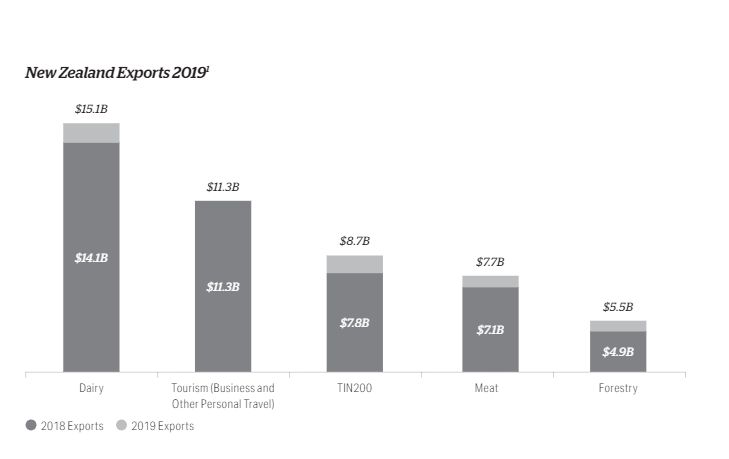
Source: TIN Report 2019
Shanahan also noted that future growth looks assured with the TIN ‘Next100’ list outpacing the TIN100 in terms of growth rate, a sign that the tech sector is developing a strong pipeline of emerging new companies in behind the established firms.
The TIN Report, now in its 15th year, monitors the performance of New Zealand’s top 200 (TIN100 and Next100) largest technology exporters in the areas of Information and Communication Technology (ICT), High-tech Manufacturing and Biotechnology, approaching almost 1,000 companies for its survey this year.
Perennial top performer Datacom Group retained its position as #1 on the TIN200 list, also achieving #1 on the growth rankings producing an estimated $188m in additional revenue.
90 Seconds was the recipient of the TIN Rocket Award for 2019 after achieving the biggest jump in TIN200 rank (climbing 29 places), after the company attracted additional growth capital and relocated its HQ to Singapore. An increase in offshore investment was highlighted with deals announced by seven companies that added to $326 million, alongside eight that were sold to offshore interests, releasing equity and attracting further investment.
David Downs, general manager, New Zealand Trade and Enterprise, led a discussion on the technology sector’s societal impact, with input from headline speakers Rebecca Tohill, CEO and Founder of Fusion5; Greg O’Grady, Co-founder and Chief Scientific Officer, Surgical Design Studio; and Maru Nihoniho, Founder and Producer, Metia Interactive.
Copies of the 2019 TIN Report, which is sponsored by New Zealand Trade and Enterprise (NZTE), Absolute IT, BNZ, EY, James & Wells, and NZX, can be ordered here. Launch events are also planned for Christchurch and Wellington next week.
The key highlights from this year’s report are:
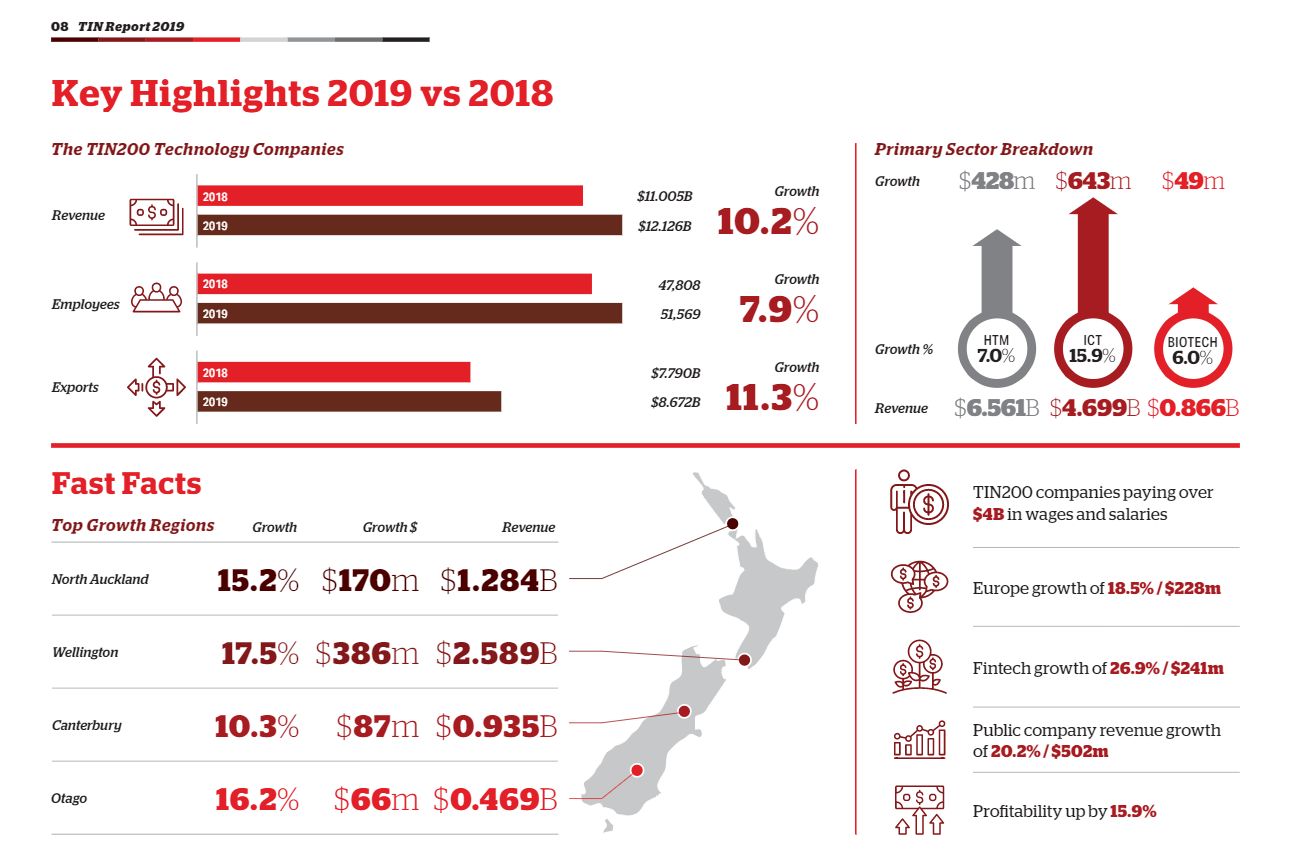
- TIN200 companies continue their strong upward trajectory, achieving a consecutive year of $1.1 billion growth in revenue for the first time
Total TIN200 revenue rose to a record $12.1 billion in 2019, growing by 10.2 percent or $1.1 billion. This is the first time that the TIN200 has achieved two consecutive years of over $1 billion revenue growth. - The strength of ICT firms continues to drive the New Zealand tech sector forward
The 95 ICT firms in the TIN200 delivered another impressive year, increasing turnover by $643 million or 15.9 percent. This accounts for well over half of the TIN200 growth, and this compares favourably to the 7 percent and 6 percent growth rates of the High-tech Manufacturing and Biotech primary sectors respectively. Fintech remains a key growth sector, after another strong year of 26.9 percent growth. - Over 50,000 staff are now employed globally by the TIN200
The group now employs nearly 52,000 staff around the world, of which over half are employed in New Zealand. These employees are paid over $4 billion in wages – another historic milestone never before reached by the TIN200. The average wage for a TIN200 employee is more than $82,000. - Traditionally strong export markets continue to drive TIN200 export growth of 11.3 percent
Offshore revenue for the TIN200 reached a record $8.7 billion on the back of 11.3 percent export growth. Australia and North America maintain their position as the two largest export markets, both growing by 9.7 percent to contribute nearly 50 percent of total TIN revenue. Europe, however, topped in growth rate after an 18.5 percent revenue rise. - Significant change is seen in the ownership landscape following considerable foreign interest
A total of seven TIN200 companies received offshore investment with $326 million invested between them. With eight TIN200 companies also acquired by offshore interests, there is a clear shifting dynamic in the TIN200 ownership environment. - The Wellington region demonstrates the strongest growth in both dollar and percentage terms
While growth was seen in all regions across NZ, Wellington stands out as the fastest growing, increasing sales by $386 million or 17.5 percent. This puts Wellington alongside North Auckland and Otago as the only three regions with double digit 5-year CAGRs, proving they are consistent drivers of overall TIN200 growth. - Innovation remains critical for the NZ tech sector
R&D continues to be a key focus for TIN200 companies and has reached over $1b for the first time in TIN Report history. This has pushed it above the 10 percent of revenue mark, with TIN companies allocating 11.1 percent of revenue toward R&D activities.
EY Ten Companies to Watch 2019: TIN100 companies with the largest revenue growth in 2019
| Rank | Name | Growth ($000) | 2019 Revenue ($000) |
| 1 | Datacom Group | $188,153* | $1,294,933 |
| 2 | Xero | $146,200 | $552,800 |
| 3 | F&P Healthcare | $89,600 | $1,070,000 |
| 4 | Scott Technology | $49,000 | $182,000 |
| 5 | Pushpay | $46,200 | $144,400 |
| 6 | Gentrack Group | $29,296 | $104,477 |
| 7 | Transaction Services Group | $29,000 | $155,000 |
| 8 | Grinding Gear Games | $26,852 | $99,246 |
| 9 | Vista Group International Ltd | $24,100 | $130,700 |
| 10 | Gallagher Group | $21,000 | $271,000 |
Source: TIN Report 2019
*Calculated by TIN based on the new NZIRFS standard rolled back and applied to 2018 using the Datacom confirmed growth figure of 17.0 percent
Let’s not beat around the bush. Reading between the lines of our recently released 2019-20 ERP Buyers Guide, there isn’t a huge amount of innovation in the Enterprise Resource Planning space. And that’s quite OK, with the overriding lesson being a simple one. Don’t be distracted when it comes to ERP solutions. Instead, look for solid, proven value and a cornerstone upon which you as a business can innovate.
Let us also be fair. Innovation in ERP systems is constrained by the nature of the beast: Systems of record are, by definition, bound by solidly set principles – IFRS 9, great read that it is, could hardly be described as an ode to innovation and agility.
Striving for differentiation is the reason that ERP vendors (not uniquely among packaged software vendors it must be noted) tend to jump on any ‘innovation’ bandwagon riding the cycle. We’ve seen it with the cloud (it’s just someone else’s computers). We’ve seen it with big data (it’s just data). We’ve seen it with the Internet of Things (it’s just more devices creating more data).
This therefore begs the question: Is yet more innovation really necessary in the ERP space? The short answer is ‘no’. It is far more distraction, hype and buzzword, than it is reality. But nonetheless ERP is fundamentally important to innovation.
SAP partner Zag’s CEO Nick Mulcahy put it thus: “With everyone focused on the Digital Economy we are seeing a resurgence in ERP because you cannot deliver transformative change and exceptional customer experiences if your back office isn’t matched.”
He’s on the money here, in a ‘you should walk before you run’ way. Don’t look for innovation in the ERP solution, instead look there for the sort of stability and dependability associated with the foundation of a new building.
On a modern platform, your business will be able to do clever stuff which wins more fans with staff and customers alike, creates efficiencies or addresses the market in new ways (let’s bear in mind that a great deal of innovation is merely selling the same things in a different way: Amazon, Lyft, AirBnb, etc, we’re looking at you).
Shannon Moir, director of digital innovation at Oracle and Microsoft specialist Fusion5 confirms Mulcahy’s view. “We are keeping our clients’ ERP as a central focus but taking a cloud first approach for extension of the ERP’s capabilities,” she explained.
The innovation such as it may be, is therefore happening outside the ERP, Not within.
“We are finding that the core ERP cannot keep up with innovation, so you need to use modern integration and public cloud to get better insights – not just better data – that the ERP can transform into better decisions,” Moir added.
As for what is being integrated, it is the sort of acronym salad one comes to expect with any discussion about technology on the bleeding edge. Said Moir: “At a high level we are using modern integration to augment insights and decision making by integrating things like mobility, IoT, big data, AI and RPA .”
The innovation, such as it may be, is therefore happening outside the ERP. Not within.
ERP is invaluable
It may not be sexy, but a good ERP system becomes essential for just about every business which reaches – or aspires to reach – a certain scale. Where that inflection point is varies widely from one business to another, and from one vertical market to another.
That’s what underpins the value of the ERP market. In its Market Share Analysis released this May, Gartner put it at US$35 billion for the full 2018 year. The leading vendors come as no surprise, with SAP, Oracle, Sage and Infor making four of the top 5. Workday is in there too, distinguished as the only one founded post-2000, and, arguably, one innovator that is disrupting traditional views of what an ERP is or should be, focusing not on orders and invoices but on what you need to do your job.
There is, therefore, a ton of money in the ‘if it ain’t broke, don’t fix it’ model; in fact, Gartner confirms precisely this view, when it notes a ‘slow but incremental move to latest version ERPs’. The researcher even has a short but sweet blog, seductively titled ‘Do you really have to upgrade your ERP to innovate’. Answer: Not really, but let’s assume you’re already past that point.
ERP upgrades or total replacements are, as anyone in the industry is likely to attest, painful. Dollars and cents determine if the juice is worth the squeeze and that is why companies tend towards reluctance when it comes to tinkering with core systems of record.
But you can only avoid the pain for so long, and no doubt, dear reader, that is what brings you here.
Addressing ‘recent’ ERP innovations
It would be entirely inaccurate to say nothing changes in terms of ERP capabilities. Of course it does. But is it innovation? Or is it evolution? A review of online articles covering ERP innovation serve up the same themes (this one leads with ‘You may not think of innovation when you consider ERP’), over and over again. You’ll recognise them all, because we’ve mentioned them already.
‘Form follows function’, as the design principle goes, holds equally true in the world of ERP software.
Yes, there have been leaps and bounds made in the reliability, usability and accessibility of ERP systems, but looking forward from here ERP product strategists should caution themselves against heeding marketing’s call for innovation for innovation’s sake. And you as a buyer should be similarly cautious about the claims made versus value gained.
Let’s examine some of the more prominent developments and see if they are truly important in determining the right solution for you.
Cloud…and mobility
‘Cloud’ and mobility architectures have to be the first cab off the rank. Innovation? Perhaps when the idea of connecting directly to the back office using a WAP-enabled Nokia was first floated. Or perhaps when NetSuite commenced business – but both these events took place in the 1990s. A quarter of a century ago, these may have been innovations, but today, we’re merely seeing maturity of concepts which were probably ahead of their time and ahead of the necessary enabling infrastructure.
That’s why every ERP software maker, including dyed-in-the-wool on-premise vendors, offer cloud-hosted options, subscription licensing and web-accessible screens. It explains Workday and it explains NetSuite (part of Oracle since 2016) and it explains the ‘web-native’ investments made by a slew of vendors, including SAP’s Business by Design, Infor’s CloudSuite and Microsoft Dynamics 365. It’s a recent phenomenon that will continue to evolve, but users should now understand that building for web doesn’t necessarily mean building better.
‘Form follows function’, as the design principle goes, holds equally true in the world of ERP software.
Pronto product marketing manager Kashyap Patel notes that “Cloud deployments for ERP are now quite common. The one-solution-fits-all approach for ERPs will continue to gain momentum, especially when offered primarily on the multi-tenant cloud.”
Put bluntly, when something is no longer a differentiator, it can’t be called an innovation.
The question to ask: Do you need cloud ERP? The answer: It should definitely be on your radar. In fact, it probably is. But taking an approach of ‘browser-based or die’ will limit your selection options, perhaps to your detriment. And be very cautious about the benefits sold versus the ongoing cost of ownership when considering subscription licensing and full vendor-managed SaaS cloud. Likewise be very clear what type of ‘cloud’ you are considering – they come in lots of shapes and sizes. Ask your own questions, but the ‘Hosting, Architecture and Licensing’ section of iStart’s ERP Buyer’s Guide lays this out consistently by vendor and summarised in the Cloud ERP table.
Industry-specific: Necessary, but not sufficient
The next promise vendors will tout is that their solution is preconfigured to suit vertical industries – captured in the clunky pretext ‘verticalisation’. In much the same way that cloud has now been around for an awfully long time, ERP solutions have been able to be configured to address the needs of specific industries so long it is more norm than exception.
There’s another reality which won’t be tackled in the marketing brochures. No matter how preconfigured the solution, it isn’t going to fit your business perfectly. While the principles of business are fairly universal, the way it is done is not. Even within the same vertical, two companies can routinely do things very differently. In some cases, that’s the sole thing which differentiates one from another. And that’s also why, despite industry-specific solutions, you’re still going to pay for the expertise of a configuration consultant or team.
There’s slightly more to it, though. Patel notes that as systems mature the user experience is likely to become more customisable, which is a level beyond tweaking a system to meet your business’ needs: “ERPs are known for their customisations implemented according to the business processes and organisation structure. To marry the scalability of cloud ERP with its core benefit of customisability, innovation will arise in the user’s ability to customise or personalise their ERP accounts without writing a single line of code or any spending on development efforts.”
As an example, the founder of JD Edwards, Ed McVarney, has founded an ERP solution ‘Nextworld.net’ that takes this principle to its conclusion, joining an emerging category called “codeless” software. The idea is that the platform allows business processes to be created though drag & drop configuration, which then also creates the application screens needed to run them. The Salesforce ‘Lightning’ platform offers a similar app development environment, which after years of the vendor attaching itself to a ‘No Software’ moniker, it now describes as ‘low-code’. While the flexibility and customisation will appeal, for many the effort needed to start from a blank canvas will be a deterrent – you are looking for an ERP after all, an application development framework is a different beast.
Patel says user-driven actions might include screen customisation and layouts, custom fields for data entry, do-it-yourself software integrations, and personalised mobile app configuration. “Users will be able to personalise a very large aspect of their ERP experience without waiting for customisations to be delivered to them.”
We can extend that to include ‘…or wait on expert consultants to configure the solution the way users want.’ Self-service and user-defined dashboards and ease of configuration are indeed innovations in ERP architecture worthy of investigation.
The question to ask: Do you need an industry specific ERP? Absolutely. But question any vendor that says they are delivering you an ERP that is pre-configured especially for your industry. Chances are what you are actually being sold is simply a combination of modules in a bundle. Or a product that is, in fact, suited to your industry. For vendors like Infor, with multiple unique ERP products in its quiver, that is what ‘verticalisation’ actually means. Do however look for flexible, configurable user dashboards, DIY application builders and integration wizards as these will allow you to, at low cost, build tools and capability that differentiate your business from the next.
Open integration
ERP vendors like to punt integration as innovation, but it isn’t really, because systems integration has a long history. The concept of the Enterprise Service Bus (and the related concept of Service Oriented Architecture) dates back to the late 1990s, and ‘SI’ has a far longer tail than that.
No matter how preconfigured the solution, it isn’t going to fit your business perfectly.
Granted, integration has come a long way, particularly with the standardisation of web services and APIs, along with the toolsets to set up and manage them, which means for the most part, integration gateways are open and modern. That’s great and should definitely be a feature in any modern ERP. Again, however, the constraint isn’t likely to be the software you choose, but instead the skill levels of the people available to actually build the integrations which make sense for your business. And with the real value to be gained in extended value chain integration – that is, with your partners and suppliers – the issue is more likely to be gaining their cooperation and buy in.
Patel puts it this way: “While ERPs aim to target every business function, deep specialisation in a particular area will continue to be elusive . Integrations into specialised software will be the way forward. API-driven and API-first development will be the approach to add further functionality into the product suites.”
The question to ask: Does integration matter? Undoubtedly. But the capacity for integration isn’t the same thing as the integration itself. With the right technical skills, any integration is possible, with any software, so it will typically not be a differentiating factor in your decision.
Aah, the blockchain
We’ll come right out and say it: despite the mountain of hype associated with the blockchain, it is impractical when it comes to in-house business software and doesn’t do anything existing technologies don’t already do better. Time will tell on this one, and some say it already is (and the Estonian example of blockchain in action is largely a retcon/marketing effort).
The question to ask: Do you need a blockchain? The answer: Unequivocally no. And that answer isn’t restricted to your choice of ERP solution. Here’s a decision tree which helps draw your own conclusions. Next please.
The Internet of Things…and big data
IoT has enjoyed about as much hype as the blockchain. In its favour, it is real, it delivers value and – on top of it all – everything connected to the internet has always been a thing, anyway. In a post-IPv6 world, IoT just means lots more things, probably cheap ones, and new streams of data. It also means new specialised networks, like LoRaWan and SigFox, which don’t need SIMs or other expensive means by which to exchange data with those things.
Innovation? See the sentence in italics. More things? Certainly, but that’s been the story of computing since the days of Colossus. More data? See Colossus and everything after.
It is no secret that the capability of the tech industry to both produce, handle and store massive volumes of data increases exponentially, with Moore’s Law the usual yardstick. ‘Big Data’ in the 90s was measured in terabytes. These days, it’s petabytes or more.
But Moore is just more. Is it innovation in the ERP context? You probably know the answer already.
The question to ask: Does IoT and big data capability matter to you? For most, probably not in the context of an ERP procurement decision. Can your choice of ERP system handle it should it become important to you? Almost certainly. It is just data, after all, and producing/handling data is what ERP has done since day dot. More likely your issue will be the integration aspect, and once integrated, how well you can configure the analytics tools in the software to ensure IoT data is embedded into processes, not just collected for its own sake. So the innovation to look for is strong analytics tools beyond report writing, that allow you to look at any data within or collected by the ERP, in any way you want. It’s your data – make sure you can get to it.
Robotic Process Automation, ‘AI’ and other clever computers
Artificial Intelligence is half way there. It is artificial. Intelligent? Not so much.
The very first computer programmes do more or less the same thing that modern AI does. Input, output. AI handles a ton more inputs and is capable of adding context and much more to the processing. Does that make it intelligent? No. Does that make for more useful software? Absolutely.
Pronto’s Patel comments on analytics and its hot sister, AI: “More will be sought from data. ERP is expected to the play the role advisor, providing actionable recommendations. AI, especially deep learning, would be an enabler to help ERP evolve into being an advisor. Again, data science will always continue to be a decision aid rather than decision maker…over time, this would become a standard offering rather than a premium one.”
So the innovation to look for is strong analytics tools beyond report writing.
Given that your ERP holds data in context, it will be central to such augmented decision assistance. MRP, advanced production scheduling and route optimisation tools are examples that are already well embedded inside ERP solutions and were so well before modern AI and machine learning laid claim to such capability.
What about RPA? The benefits of removing rote processes from the daily tedium has to be a good thing. But as Mulcahy points out, your ERP project is the opportunity to digitise your processes before they need to be patched up with an RPA solution.
The question to ask: Are AI, machine learning and RPA etc important to your ERP decision? The answer right now is probably not. But it is, arguably, the answer to the question this article poses, once the intelligence part is sorted out.
A final word
The information technology space is very large, very confusing, full of hype and marketing distractions. It also delivers massive value and the various components have become essential to our way of life will only grow in importance.
ERP is a cornerstone and a foundation for business at scale. It should be seen as such. It doesn’t have to be sexy and innovative; it has to be robust, reliable and accessible. And, in this day and age, easy to use. Beyond that, look for product innovations that are not bleeding edge, but well tested, customer-proven and which deliver real value to the business or the end user.
Download the ERP Buyer’s Guide
Download the 2019-20 edition of iStart’s guide to get analysis of how the top solutions compare, along with detailed product and partner fact sheets for the leading ERP systems in the A/NZ region.
…
It’s high stakes when the PMs of both countries sign off on a joint statement confirming, amongst other initiatives, agreement to use a common standard for e-invoicing that promises to deliver savings to Australian and New Zealand businesses of more than $30 billion over the next 10 years.
If you haven’t heard of e-invoicing yet then you undoubtedly will as it is designed as a business-friendly policy ploy to demonstrate government’s willingness to deliver value to, in particular, the small business sector (you know, the one with all those voters in it).
The story goes that businesses who sign-up will create an invoice in their accounting system, and it will automatically appear in their customer’s accounting system, reducing the hard work and errors of them re-keying data and enabling invoices to be paid faster.
The local rhetoric on e-invoicing to date is long on benefits and short on how they will be achieved.
Last week the PMs were joined by global trade standards body GS1, home of the humble GTIN barcode, and designer of the NZBN, in endorsing OpenPEPPOL (Pan-European Public Procurement Online) in a Memorandum of Understanding “to better support electronic transactions”.
Miguel Lopera, President and CEO of GS1 says: “The will enable us to explore and discuss in good faith the use of GS1 identification keys and GS1 EDI standards in PEPPOL as well as the use of PEPPOL services by GS1 member companies.”
The reference to EDI standards is interesting. GS1 also endorses the use of a version of the UN/EDIFACT messaging standard that has been in place since at least the early 1970s, variants of which are used the world over by manufacturers, their supply chain partners and customers.
PEPPOL itself has been established, over the past 20 years or so, as the standard for suppliers to government in 23 European nations, led by Norway and Denmark, and is being implemented as the mandatory de facto standard in the UK health sector. Norway has also mandated its use for all government procurement.
While the local rhetoric on e-invoicing to date is long on benefits and short on how they will be achieved, early testing work in Australia is around what is being called the Digital Capability Locator (DCL). The DCL allows a business to look up a trading partner’s preferred document exchange partner, known as an Access Point, and deduce from that the relevant business data necessary to populate and successfully send an invoice direct into their system. The ABN and NZBN business numbering systems are envisioned as the unique key that the DCL will use.
Indications are that MBIE is currently building an equivalent to the DCL to serve the New Zealand market, but details are scant.
Access Points are central to e-invoicing as these are the companies that handle the transmission of each invoice, ensuring it can be accepted by the receiving system.
Gone is the apparent complexity of opening a dialogue with your new customer requesting their address, GST number and accounts payable e-mail address, you’ll just add the relevant xBN to your invoice and voila, Houston, we have contact. Or, more correctly, your PEPPOL-compliant accounting software will.
Users of the Xero accounting solution may know there is something similar called Xero-to-Xero where customers already using Xero can be invoiced directly, exactly as intended with e-invoicing. A quick review of their documentation demonstrates that what sounds a simple concept can quickly become complicated.
Day-to-day complexities such as discounts, product variants, returns, credits, part-payments and so on, create exceptions.
It is these exceptions that explain why e-invoicing between software providers isn’t already a standard feature. SAP, for example, offers a standard EDI gateway and leaves its customers to work out what is required to set up EDI with suppliers which may be running Oracle or Sage or whatever. This means that in most mature, high volume markets, such as in FMCG and hardware, a hub and spoke model is in place. Many suppliers connect to the major buyers through various EDI messaging gateways to ensure compliance with the buyers’ requirements.
Typically, the buyer will establish a trading relationship by setting up the new supplier in their ERP system, including specifying the exact product codes, descriptions and agreed pricing, before then issuing a purchase order (PO), which, once fulfilled, can be invoiced.
As an example, Foodstuffs North Island CEO Chris Quin told the GS1 conference in Auckland last week that 90 percent of its invoices from suppliers are paid automatically without any human intervention. In Foodstuffs’ case, the messaging gateway is private, having been built and operated by Foodstuffs themselves. Quin confirmed that its replacement, delivered by a major programme of work called ‘Tardis’ (“because it’s bigger on the inside”) is being phased in from the middle of this year.
Public messaging gateways, traditionally known as VANs, or value added networks, are nothing new of course. They’ve been in place for decades in the EDI world. Many big businesses have been using e-invoicing as a component of their own supply chains for decades. For most, the invoice is a final and relatively simple step in a much more complex procurement supply chain. These commonly rely upon on GS1’s GTIN barcodes to define exact product parameters (such as pack dimension and weight) and delivery status notifications from logistics providers to ensure the systems of all parties accurately reflect the status of orders.
Michelle Newsome from EDI provider B2BE welcomes the initiative: “Any government-endorsed framework that educates the market on what is possible with B2B messaging is helpful.”
“But let’s be clear, there is nothing new here. The PEPPOL standard has been around for 20 years and EDI for closer to 40.”
E-invoicing relies on a four corners model, whereby sending and receiving companies have a relationship with EDI providers, such as B2BE.
“The four corners concept is how the existing B2B messaging environment works, and we are working with the relevant agencies on both sides of the Tasman to explore what efficiencies might be possible,” Newsome says.
Newsome noted that B2BE is a member of the Digital Business Council which has been established to oversee e-invoicing in the Australian market, along with 27 other accredited messaging providers.
While current e-invoicing plans are less ambitious than a full set of supply chain transactions, the $30 billion question is whether nationalising PEPPOL integration as a government service for invoicing will broaden EDI usage to smaller businesses or businesses outside of high transaction volume industries.
The key may be the as yet unanswered question – who will pay?
According to the MBIE discussion paper, trans-Tasman e-invoicing costs will get covered by charging transactional and licencing fees to offset costs.
Under a user pays model, and with no government mandate, business will have to determine if it is worth the bother versus the status quo.
MBIE has provided a helpful guide as a starter for businesses looking in to e-invoicing: https://youtu.be/dy7eGUuAX7Y
…
AU: 1800 462 388 · +61 401 189 448