






Published on the 25/02/2026 | Written by Heather Wright
Next-gen robotics to meet workforce pressures…
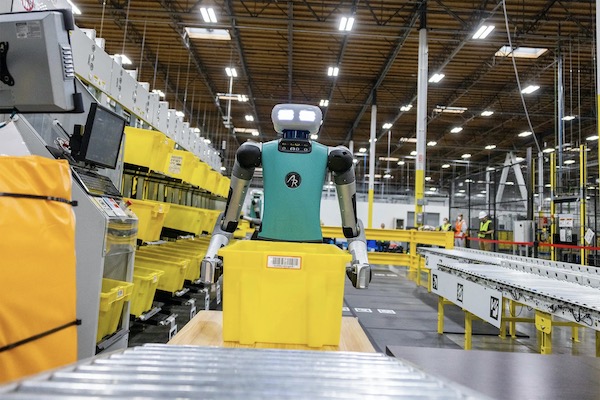
Humanoid robots are moving rapidly from experimental projects to real enterprise adoption, as rapid progress across AI ‘brains’, mechanical ‘brawn’ and battery systems drive ‘physical AI’ towards wider commercial deployment.
In a new analysis of ‘physical AI’ – which spans humanoid robots, autonomous vehicles, industrial automation and drones – Barclays is forecasting the market to reach US$500 billion to $1.4 trillion by 2035 depending on adoption scenarios.
“Humanoid robots are no longer a futuristic fantasy, but a pragmatic tool for operational transformation.”
Autonomous vehicles are leading the way, with Barclays noting that development of them has been underway for nearly a decade, production closely aligns with existing automotive supply chains and there is already large volumes of real-world driving datasets that models can be trained on.
The AI Gets Physical forecasts autonomous vehicles to be an up to US$550 market by 2035. Drones and industrial systems will follow as major contributors.
The market for humanoid robots, meanwhile, is forecast to reach between US$30 billion and $200 billion by 2035, an order of magnitude bigger than the 2025 range of $2-$3 billion, with warehousing and logistics expected to account for around a third of humanoid applications by 2027 according to Counterpoint Research referenced by Barclays.
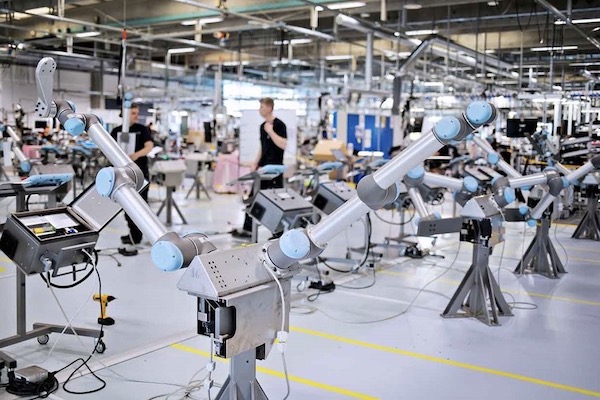
For the record, Barclays defines humanoid robots as those designed to behave and look like humans, built for human centred environments and tasks. Advanced industrial automation includes AI-enabled robots performing physical tasks in factories and logistics, including collaborative robots (cobots), AI-guided robotic arms, autonomous mobile robots and warehouse robots for picking, sorting and transport.
The report notes while humanoid robots are constrained by more limited physical AI training data, the complexity of integrating models and hardware control systems and battery limitations, global deployment momentum is already visible, with around 15,000 new ‘installations’ in 2025. China accounted for 85 percent of those, with companies like AgiBot, Unitree and UBTech leading the way. The three accounted for nearly 56 percent of global sales last year, with those sales exceeding $500 million, according to Counterpoint. AgiBot, whose robots are used across entertainment and performance, services and guidance, data production and intelligent manufacturing, pulled in revenue of more than $140 million, just two years after launching its first humanoid offering. (It also offers a RaaS – renting as a service – business model, lowering the barrier for adoption of the robots.)
Not to be outdone, Tesla announced during its Q4 earnings call that humanoid robots are one of its core growth priorities now. Its Optimus robot is projected to cost between US$20-30,000. Electric vehicle competitor Hyundai, also has a play in the market, through its subsidiary Boston Dynamics, which plans to launch a US$130,000 Atlas robot, which is being pitched as a production-ready, enterprise grade robot for factory work. Early use cases will focus on automotive line work which involves repetitive work and awkward postures.
The report notes that potential use cases for humanoid systems are beginning to crystalise as labour dynamics become more pronounced due to an aging population.
Industrial robots used by the likes of Amazon and Walmart in their supply chains are also helping highlight where systems designed to perform specific tasks may eventually reach their limits, Barclays’ says, opening the doors for humanoid offerings.
While warehousing and logistics is expected to be the top application for the robots come 2027, at 33 percent, automotive (24 percent), manufacturing (15 percent), and retail and service (12 percent) are also expected to reap the benefits.
Forrester is also bullish about the future of humanoid robots. Charlie Dai, Forrester VP and principal analyst, says the robots are no longer a futuristic fantasy, but a ‘pragmatic tool for operational transformation’.
Forrester’s Automation Survey 2025 reveals that 69 percent of automation decision-makers are adopting or planning to adopt humanoid robots, with early deployments in manufacturing, logistics, healthcare and customer service. In fact, companies are already reporting benefits with 40 percent reductions in processing errors and 20 percent decreases in labour costs when the humanoid robots standardise repetitive, high-friction workflows.
Forrester points to BMW’s use of the robots for ergonomically challenging assembly tasks and Keenon Robotics reducing restaurant labour costs by 20 percent through automated food preparation and cleaning. Other cases cited by Forrester include Singapore’s Sengkang Community Hospital which is using Dexie – a social robot – for multi-lingual dementia care. The systems are augmenting, rather than displacing, employees, Forrester stresses.
But the rapid progress also comes with a warning, with high R&D costs, deployment complexity and regulatory uncertainty expected to continue to slow broad adoption. While breakthroughs in generative AI, physical AI and AI-native cloud platforms are rapidly expanding robot capability and lowering development time – Nvidia’s Isaac GR00T-Dreams cut model development from three months to 36 hours – Forrester warns that humanoid robots still require significant investment in hardware, software and workflow redesign, while cybersecurity, liability and safety frameworks remain underdeveloped.
Dai is urging leaders to approach the technology with ‘disciplined experimentation’. Targeted pilots, rather than widescale deployments, will be the name of the game for the next two years.
“The next two years are critical: Those who take a measured, strategic approach will position themselves to unlock significant value as the technology matures, while avoiding the pitfalls of premature or overhyped deployment.”
Barclays warns that adding humanoids to the workforce could fundamentally change cost structures as OpEx costs give way to higher CapEx expenditure on robotics – a move the company says could strengthen margins and boost valuations with companies moving from variable labour costs to more stable, depreciable assets. Like Forrester, Barclays says this isn’t a story of robots replacing humans, but instead one of workforce augmentation and emerging investment opportunities.
Large scale deployments signal inflection point
Some of the world’s largest retailers offer insight into how physical AI is already influencing supply chain operations. Amazon operates more than one million robots across its fulfilment network, with systems including Sequoia, which brings inventory to employee workstations; Proteus, which moves order carts alongside workers; and Vulcan, which navigates cluttered spaces using sight and touch.
As part of Amazon’s fulfilment centre design, the robotics systems are expected to reduce cost-to serve by around 25 percent during peak periods, while also providing streamlined stowing, picking, packing and shipping workflows and lowering processing times.
Walmart is following a similar path. Barclays reports Walmart’s latest generation of more automated fulfilment centres are approximately twice as productive as legacy facilities. Current deployments focus on strenuous physical tasks such as lifting products on and off pallets, and AI-assisted tracking helps reduce damage to fragile and fresh goods. Robotics are also improving pickup and delivery speeds across stores as part of the company’s wider supply chain modernisation program.
Barclays notes that while many warehouse tasks have been automated, others remain resistant because they require human-like dexterity or the ability to handle objects, navigate tight spaces or adapt to unstructured conditions. Humanoid robots are designed for environments built around people, offering the potential to perform a wider variety of tasks without requiring facilities to be completely redesigned.
Digital twins and edge necessities
A significant enabler of physical AI is the use of simulation and digital twin platforms, which allow robots to be trained safely and efficiently before real-world deployment.
Physical AI models lean heavily on simulators to recreate the real world. While both physical and cognitive AI require huge amounts of data to train the model, physical AI requires much more complex inputs from the 3D world including images, video, text, speech and real-world sensor data.
“These platforms run ‘digital twins’ of factories, warehouses or even entire cities, essentially video games for robots.”
It notes the simulator to real world transition remains a key bottleneck in physical AI training, since no simulation can fully capture real-world unpredictability.
Edge computing is another foundational requirement. Large models are trained in data centres using cloud compute, but robots must run models locally – on device – to respond instantaneously to real-world stimuli.
“Physical AI is the toughest frontier in AI because these systems must master physics, causality and time to truly work in the real world. In practice, this evolution transforms AI from a tool for efficiency and knowledge synthesis into an active agent of physical work within the real economy.”