







Published on the 25/03/2026 | Written by Heather Wright
Funding fuels geographic and product expansion…
Kiwi agritech Halter is on the hunt for 200 new staff after a record-breaking US$200 million (NZ$377 million) Series E funding round which has seen the company valued at US$2 billion (NZ$3.4 billion), nearly doubling its June 2025 valuation.
The round was led by Peter Thiel’s Founders Fund, which has been a long-time investor in the company, backing it in its Series A round in 2017. Existing investors Blackbird, Icehouse Ventures, DCVC, Bond, Bessemer, Ubiquity, NewView and Promus also participated.
“Halter is beginning its largest ever hiring effort, seeking more than 200 people across product, engineering and customer operations.”
The US$220 million raise is one of the largest-ever in agtech globally and smashes Halter’s own record for the largest VC raise by a Kiwi-founded company. It follows earlier reporting that the round was heavily oversubscribed with some of the biggest names in VC keen to get involved.
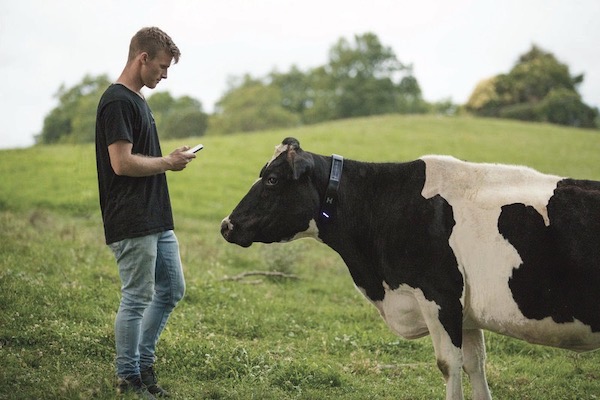
Halter’s GPS-enabled collars use audio cues and vibrations to contain and herd both dairy and beef cattle within virtual boundaries, enabling farmers and ranchers to move herds from a smartphone, redrawing fence lines from their smartphone. Animal health can also be monitored through the smartphone, along with pasture management, with live data on animal locations, health and feed availability providing a digital twin of farms and ranches, and providing users with access to complex data points in simple and easy to interpret ways. Versions are available for both dairy and beef cattle, with Halter saying beef farming needs its own technology, not a dairy product repurposed for beef cattle as everything about beef systems varies massively. The company has positioned the systems as full herd management, from a smartphone, at US$5 to US$8 per animal per month.
Since launching in the US in 2024, Halter says American ranchers using Halter have built 60,000 miles of virtual fencing. Globally it claims 645,000 kilometres of fencelines have been drawn since 2024.
Founder and CEO, Craig Piggot, who was recently named Innovator of the Year at the 2026 Kiwibank New Zealander of the Year Awards, says Halter was started because of the belief technology could fundamentally change what it means to run a farm, and enable farmers to use innovation to build long-term futures on their land.
“Our farmers need tools that work and the fact they’re using Halter tells us our technology has earned their trust. This raise lets us bring it to far more of them, and faster.”
Scaling up
As part of the Series E expansion stage, Halter says it is beginning a recruitment drive, seeking more than 200 people – its largest-ever hiring effort. Positions will cover product, engineering and customer operations with many based at its Auckland headquarters. Additional staff will also be hired in Australia and the United States in the coming weeks as well. The company employs more than 300 staff, including a team of more than 100 engineers and designers.
Founded in New Zealand and maintaining an Auckland headquarters, Halter also has Australian operations, based in Melbourne, and a US office, which it opened in Colorado in 2024 following its US$100m Series D funding round.
The company, which topped the 2024 Deloitte Fast 50 Index with 1,539 percent revenue growth and secured $165 million in 2025 to accelerate its global expansion, has rapidly scaled across New Zealand, Australia and the United States, with more than 2,000 farmers and ranchers as customers, and a million of the solar-powered smart collars sold.
The Series E funding round will support several initiatives for the company, which says it will enable it to accelerate its commercial expansion across the United States and fund the roll-out of a range of new products in the coming months.
“Investment will continue across product development, including animal health monitoring and pasture management, shaped by how customers are using the system in the field,” Halter says. “The focus remains on supporting farmers building their operations with Halter.”
The company says it will also enter the United Kingdom and Ireland later this year, along with key South American markets.
Piggot says farmers in the UK and Ireland have long expressed interest in Halter.
“The UK and Ireland are very similar to New Zealand in terms of landscape and climate – we know we can have impact there,” he says.
Halter’s growth sits within a wider movement toward virtual fencing and precision livestock management. Research and Markets has put the precision agriculture market at US$9.5 billion in 2025, with projections to reach US$17.3 billion by 2031.
Across New Zealand and Australia, Halter’s uptake aligns with increasing adoption of agricultural automation.
Founders partner Amin Mirzadegan says while agriculture is a “multi-trillion dollar industry that feeds the world”, it remains one of the least digitised sectors on earth.
“Halter is changing that by bringing software, sensors and AI directly into livetock operations in a way that farmers actually adopt.”